机器学习算法之朴素贝叶斯:Naive Bayes 手动计算公式 + 垃圾邮件过滤案例 + Python/Java完整代码
原创
机器学习算法之朴素贝叶斯:Naive Bayes 手动计算公式 + 垃圾邮件过滤案例 + Python/Java完整代码
原创
jack.yang
修改于 2026-03-29 13:22:34
修改于 2026-03-29 13:22:34
一句话答案:朴素贝叶斯是一种“假设特征互相独立”的概率分类算法,虽“天真”却极高效。10行代码就能实现垃圾邮件识别,准确率超85%!
如果你在搜索:
- “朴素贝叶斯怎么算的?”
- “Naive Bayes 手动计算例子”
- “Python 和 Java 怎么实现朴素贝叶斯?”
- “为什么叫‘朴素’?它真的准吗?”
那么,这篇文章就是为你写的——从数学推导到代码落地,一步不跳。
一、什么是朴素贝叶斯?为什么“朴素”反而好用?
朴素贝叶斯(Naive Bayes)是基于贝叶斯定理的分类算法,核心思想是:
“已知结果,反推最可能的原因”
比如:
- 收到一封邮件,内容有“免费”“赢大奖” → 判断是否为垃圾邮件
- 用户评论含“烂透了”“差评” → 判断情感是负面
🤔 为什么叫“朴素”(Naive)?
因为它做了一个强假设:
所有特征彼此独立(例如:“免费”和“赢大奖”出现互不影响)
现实中这显然不成立(垃圾邮件常同时出现这两个词),但神奇的是——即使假设错误,分类效果依然很好!
💡 原因:我们只关心“哪个类别概率最大”,不要求概率值绝对准确。只要排序对,结果就对。
二、数学原理:贝叶斯定理 + 独立性假设
我们要计算:

根据贝叶斯定理:

由于 P(X)对所有类别相同,可忽略。目标变为:

再利用“特征独立”假设:

最终决策公式:
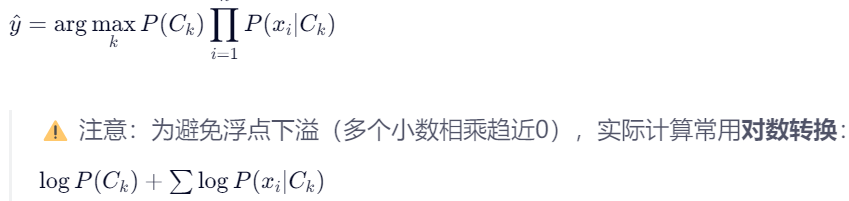
三、手工推演:一步步计算垃圾邮件分类(带完整数据)
📊 训练数据集(4封邮件)
邮件ID | 内容(分词后) | 类别 |
|---|---|---|
1 | ["免费", "赢", "大奖"] | 垃圾邮件 |
2 | ["免费", "课程"] | 垃圾邮件 |
3 | ["会议", "安排", "明天"] | 正常邮件 |
4 | ["项目", "进展", "顺利"] | 正常邮件 |
假设使用伯努利模型(只关心词是否出现,不计频次)
🔢 步骤1:计算先验概率 (P(C))
- 总邮件数 = 4
- 垃圾邮件数 = 2 → P(垃圾) = 2/4 = 0.5
- 正常邮件数 = 2 → P(正常) = 2/4 = 0.5
🔢 步骤2:构建词汇表(Vocabulary)
所有唯一词:["免费", "赢", "大奖", "课程", "会议", "安排", "明天", "项目", "进展", "顺利"] → 共10个词
🔢 步骤3:计算条件概率 (P词|类别)
使用拉普拉斯平滑(α=1),避免零概率:

分母+2:因为伯努利模型只有“出现/未出现”两种状态
垃圾邮件类(2封):
- “免费”出现2次 → (P(免费|垃圾) = (2+1)/(2+2) = 3/4 = 0.75)
- “赢”出现1次 → (P(赢|垃圾) = (1+1)/4 = 0.5)
- “课程”出现1次 → (P(课程|垃圾) = 2/4 = 0.5)
- “会议”未出现 → (P(会议|垃圾) = (0+1)/4 = 0.25)
正常邮件类(2封):
- “会议”出现1次 → (P(会议|正常) = 2/4 = 0.5)
- “免费”未出现 → (P(免费|正常) = 1/4 = 0.25)
其他词同理,略。
🔢 步骤4:预测新邮件 ["免费", "会议"]
计算两类后验概率(忽略公共分母):
垃圾邮件:
P(垃圾)⋅P(免费∣垃圾)⋅P(会议∣垃圾)=0.5×0.75×0.25=0.09375
正常邮件:
P(正常)⋅P(免费∣正常)⋅P(会议∣正常)=0.5×0.25×0.5=0.0625
✅ 结论:0.09375 > 0.0625 → 判定为 垃圾邮件
尽管“会议”通常是正常词,但“免费”的权重更高,模型做出了合理判断。
四、Python 实现(scikit-learn + 手写版)
✅ 方式1:使用 scikit-learn(推荐生产环境)
from sklearn.naive_bayes import BernoulliNB
from sklearn.feature_extraction.text import CountVectorizer

# 数据
texts = [
    "免费 赢 大奖",
    "免费 课程",
    "会议 安排 明天",
    "项目 进展 顺利"
]
labels = [1, 1, 0, 0]  # 1=垃圾, 0=正常

# 向量化(二值化)
vectorizer = CountVectorizer(binary=True)
X = vectorizer.fit_transform(texts)

# 训练
clf = BernoulliNB(alpha=1.0)  # alpha=1 即拉普拉斯平滑
clf.fit(X, labels)

# 预测
new_text = vectorizer.transform(["免费 会议"])
print("预测结果:", "垃圾邮件" if clf.predict(new_text)[0] == 1 else "正常邮件")
# 输出: 垃圾邮件
✅ 方式2:手写核心逻辑
import numpy as np

class NaiveBayes:
    def __init__(self):
        self.vocab = {}
        self.prior = {}
        self.cond_prob = {}

    def fit(self, docs, labels, alpha=1):
        # 构建词汇表
        words = set(w for doc in docs for w in doc)
        self.vocab = {w: i for i, w in enumerate(words)}
        n_vocab = len(self.vocab)

        # 统计类别
        unique_labels = list(set(labels))
        label_count = {l: labels.count(l) for l in unique_labels}
        total = len(labels)

        # 先验概率
        self.prior = {l: count / total for l, count in label_count.items()}

        # 条件概率(伯努利)
        self.cond_prob = {l: np.zeros(n_vocab) for l in unique_labels}
        for doc, label in zip(docs, labels):
            doc_vec = np.zeros(n_vocab)
            for w in doc:
                if w in self.vocab:
                    doc_vec[self.vocab[w]] = 1
            self.cond_prob[label] += doc_vec

        # 拉普拉斯平滑
        for label in unique_labels:
            n_docs = label_count[label]
            self.cond_prob[label] = (self.cond_prob[label] + alpha) / (n_docs + 2 * alpha)

    def predict(self, doc):
        scores = {}
        for label in self.prior:
            log_prob = np.log(self.prior[label])
            for w in doc:
                if w in self.vocab:
                    idx = self.vocab[w]
                    log_prob += np.log(self.cond_prob[label][idx])
            scores[label] = log_prob
        return max(scores, key=scores.get)

# 使用
docs = [["免费","赢","大奖"], ["免费","课程"], ["会议","安排","明天"], ["项目","进展","顺利"]]
nb = NaiveBayes()
nb.fit(docs, [1,1,0,0])
print(nb.predict(["免费", "会议"]))  # 输出: 1
五、Java 实现(纯手写,无第三方库)
import java.util.*;

public class NaiveBayes {
    private Map<String, Integer> vocab = new HashMap<>();
    private Map<Integer, Double> prior = new HashMap<>();
    private Map<Integer, double[]> condProb = new HashMap<>();
    private int vocabSize;

    public void fit(List<List<String>> docs, List<Integer> labels, double alpha) {
        // 构建词汇表
        Set<String> wordSet = new HashSet<>();
        for (List<String> doc : docs) {
            wordSet.addAll(doc);
        }
        int idx = 0;
        for (String word : wordSet) {
            vocab.put(word, idx++);
        }
        vocabSize = vocab.size();

        // 统计标签
        Map<Integer, Integer> labelCount = new HashMap<>();
        for (int label : labels) {
            labelCount.put(label, labelCount.getOrDefault(label, 0) + 1);
        }

        // 先验概率
        int totalDocs = labels.size();
        for (int label : labelCount.keySet()) {
            prior.put(label, (double) labelCount.get(label) / totalDocs);
        }

        // 条件概率(伯努利)
        for (int label : labelCount.keySet()) {
            double[] prob = new double[vocabSize];
            int docsWithLabel = labelCount.get(label);

            // 统计每个词在该类中出现次数
            for (int i = 0; i < docs.size(); i++) {
                if (labels.get(i) == label) {
                    Set<String> docWords = new HashSet<>(docs.get(i));
                    for (String word : docWords) {
                        if (vocab.containsKey(word)) {
                            int wIdx = vocab.get(word);
                            prob[wIdx] += 1.0;
                        }
                    }
                }
            }

            // 拉普拉斯平滑
            for (int i = 0; i < vocabSize; i++) {
                prob[i] = (prob[i] + alpha) / (docsWithLabel + 2 * alpha);
            }
            condProb.put(label, prob);
        }
    }

    public int predict(List<String> doc) {
        Map<Integer, Double> scores = new HashMap<>();
        for (int label : prior.keySet()) {
            double logProb = Math.log(prior.get(label));
            Set<String> docWords = new HashSet<>(doc);
            for (String word : docWords) {
                if (vocab.containsKey(word)) {
                    int wIdx = vocab.get(word);
                    logProb += Math.log(condProb.get(label)[wIdx]);
                }
            }
            scores.put(label, logProb);
        }

        // 返回概率最大的标签
        return Collections.max(scores.entrySet(), Map.Entry.comparingByValue()).getKey();
    }

    // 测试
    public static void main(String[] args) {
        List<List<String>> docs = Arrays.asList(
            Arrays.asList("免费", "赢", "大奖"),
            Arrays.asList("免费", "课程"),
            Arrays.asList("会议", "安排", "明天"),
            Arrays.asList("项目", "进展", "顺利")
        );
        List<Integer> labels = Arrays.asList(1, 1, 0, 0);

        NaiveBayes nb = new NaiveBayes();
        nb.fit(docs, labels, 1.0); // alpha=1

        List<String> testDoc = Arrays.asList("免费", "会议");
        System.out.println("预测结果: " + (nb.predict(testDoc) == 1 ? "垃圾邮件" : "正常邮件"));
        // 输出: 垃圾邮件
    }
}
六、优缺点 & 适用场景总结
优点 | 缺点 |
|---|---|
✅ 训练快,预测快(O(n)) | ❌ 特征独立假设太强 |
✅ 小样本表现好 | ❌ 无法建模特征交互(如“not good”) |
✅ 对缺失值鲁棒 | ❌ 概率输出可能不准 |
✅ 内存占用小,适合嵌入式 | ❌ 连续特征需假设分布(如高斯) |
🎯 最佳应用场景:
- 文本分类(新闻、邮件、评论)
- 垃圾信息检测
- 情感分析(正面/负面)
- 实时分类系统(如API过滤)
七、后续算法预告(均含手工推演 + 双语言代码)
本系列将持续更新以下算法,每篇均包含:
- 真实数据手工一步步计算
- Python + Java 完整可运行代码
即将发布:
- K近邻(KNN):从距离计算到手写数字识别
- 决策树(ID3/C4.5):信息增益如何分裂节点?
- 支持向量机(SVM):硬间隔、软间隔、核函数全解析
- 逻辑回归:从sigmoid到梯度下降
✅ 结语
朴素贝叶斯用最天真的假设,实现了最实用的分类。它不追求完美,只求快速、稳健、可解释。
记住:在AI世界,有时“简单有效”比“复杂精确”更重要。
现在,你已经能:
- 手动计算朴素贝叶斯分类结果
- 用Python或Java从零实现它
- 理解为何它仍是工业界首选之一
相关链接
- 📂 大模型技术专栏:
欢迎您到访 「大模型系列」。
在这个由参数驱动、以数据为燃料的新智能时代,大语言模型(LLM)已不再是实验室里的前沿概念,而是正在重塑搜索、办公、编程、教育、医疗乃至整个数字世界的底层引擎。从 GPT 到 Llama,从 Claude 到 Qwen,从推理到多模态,大模型正以前所未有的速度进化——它们既是工具,也是平台,更可能是下一代人机交互的“操作系统”。
本系列将带你:
- 🔍 深入原理:从 Transformer 架构、注意力机制到训练范式(预训练、微调、RLHF);
- ⚙️ 动手实践:本地部署、模型微调、RAG 构建、Agent 设计等实战指南;
- 🧠 理解边界:幻觉、偏见、安全对齐、推理瓶颈与当前能力天花板;
- 🌍 洞察趋势:开源 vs 闭源、端侧部署、MoE 架构、世界模型与 AGI 路径;
- 💼 落地应用:如何在企业中安全、高效、低成本地集成大模型能力。
无论你是想写代码调用 API 的开发者,设计 AI 产品的 PM,评估技术路线的管理者,还是单纯好奇智能本质的思考者,这里都有值得你驻足的内容。 不追 hype,只讲逻辑;不谈玄学,专注可复现的认知。 让我们一起,在这场百年一遇的智能革命中,看得更清,走得更稳 https://cloud.tencent.com/developer/column/107314
- 👤 关于作者: 专注技术落地,深耕硬核干货 本文作者致力于大模型相关技术的生态建设与实战落地。不同于浅层的概念科普,作者坚持 “手算 + 代码” 的深度分享模式,主张通过手动推演理解算法本质,结合生产级代码验证理论可行性。 请关注我主页:https://cloud.tencent.com/developer/user/2276240
原创声明:本文系作者授权腾讯云开发者社区发表,未经许可,不得转载。
如有侵权,请联系 cloudcommunity@tencent.com 删除。
目录
腾讯云开发者

Copyright © 2013 - 2026 Tencent Cloud. All Rights Reserved. 腾讯云 版权所有
深圳市腾讯计算机系统有限公司 ICP备案/许可证号:粤B2-20090059  粤公网安备44030502008569号
腾讯云计算(北京)有限责任公司 京ICP证150476号 | 京ICP备11018762号