周一 30 issue + 3 bug + 1 新模块:先做哪个?Matt Pocock 用 3 条 on-ramp 帮你分流
原创
周一 30 issue + 3 bug + 1 新模块:先做哪个?Matt Pocock 用 3 条 on-ramp 帮你分流
原创
术哥
发布于 2026-07-31 22:06:45
发布于 2026-07-31 22:06:45
🚩 2026 年「术哥无界」系列实战文档 X 篇原创计划 第 182 篇,AI 编程最佳实战「2026」系列第 64 篇
大家好,欢迎来到 术哥无界 | ShugeX | 运维有术。
我是术哥,一名专注于 AI 编程、AI 智能体、Agent Skills、MCP、云原生、AIOps、Milvus 向量数据库的技术实践者与开源布道者!
Talk is cheap, let's explore。无界探索,有术而行。
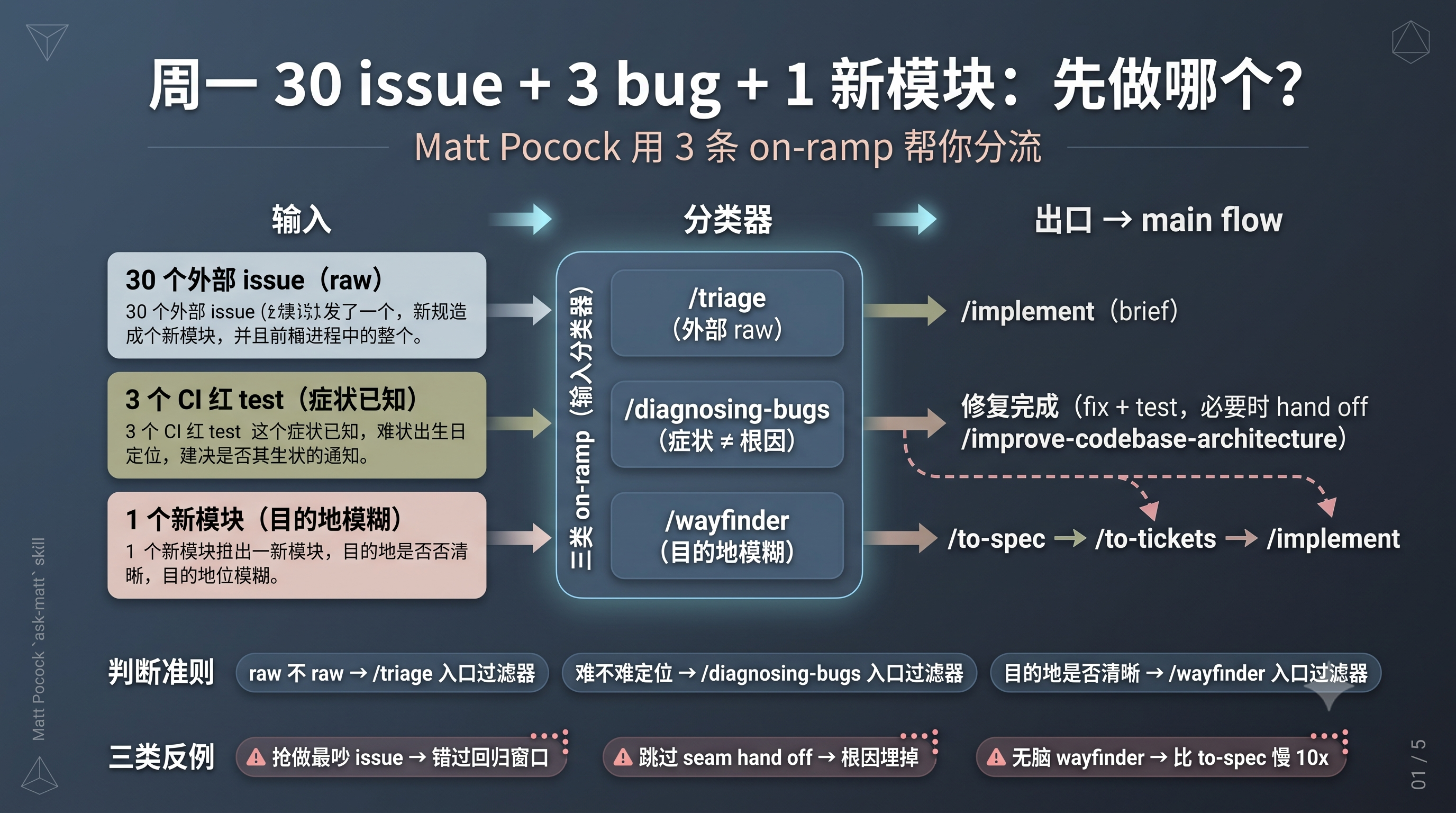
Matt Pocock 三类 on-ramp 入口决策信息图封面
周一早上九点。你打开仓库,看到通知栏里有三个完全不同的东西在等你:
- GitHub 仓库里积累了 30 个未处理的 issue,从 typo 文档、模糊的 feature request、到一条上周三在生产环境炸过的 bug report,全堆在
needs-triage标签下。 - CI 上挂着三个回归 test 在变红 - 这几个 test 昨天还是绿的,没人改过相关代码,但今天就是红了。
- 你脑子里还有一个想做半个月的新模块,设计稿草草画过,没人 review,目的地模糊,但不做又放不下。
三类输入,三个完全不同的来源,三种完全不同的处理节奏。如果你把它们一股脑丢给同一个 Agent 会话,结果大概率是先做最吵的那条 issue(因为通知最多),三个回归 bug 被推到明天,新模块被硬塞进当前会话做到一半就 context 跑满。
Matt Pocock 的 skills 仓库把这个问题前置到 ask-matt skill 的一开头处理 - 三类输入各有自己的入口 on-ramp,汇入主链路之前先做分流。这篇文章不讲 on-ramp 概览,专门讲判断准则:什么工作该走哪条路,以及按错顺序走会出什么问题。
说明:本文内容基于 Matt Pocock
skills仓库(mattpocock/skills)源码和ask-matt/SKILL.md等文档分析整理而成,文章中的判断准则和"周一早晨 30 issue + 3 bug + 1 新模块"等场景数字是写作构造的示例,不构成对真实项目使用效果的承诺。文中的判断准则和分类思路仅供参考,实际使用时请以你的 issue tracker 配置、团队工作流和具体场景测试结果为准。 如果你有实战经验,欢迎在评论区分享。
1. 三类 on-ramp 不是工具,是输入分类器
ask-matt/SKILL.md 里的 on-ramp 段落不长,但定位非常清晰:
A starting situation that generates work, then merges onto the main flow.
Bugs and requests piling up →
/triage... Something's broken →/diagnosing-bugs... A huge, foggy effort - a greenfield project or a huge feature build, too big for one session →/wayfinder...
注意判断的依据是输入的来源和形态,不是优先级,也不是紧迫度,更不是我想先做哪个。三个 on-ramp 各自接收的输入,差异不是工作量大小,而是来源:
输入来源 | 形态 | 起点不是我 | 节奏 |
|---|---|---|---|
别人提的 bug report、外部 feature request、堆积的 issue | raw、未分类 | 是 | 大量并行、互相独立 |
突然变红的行为、间歇性 flake、藏在上一个 known-good 状态里的回归 | 真实症状,定位未知 | 不一定 | 单点深挖 |
我想做的全新模块、巨型特性、超出单会话范围 | 想法模糊,目的地未确定 | 不是 | 串行、每会话一票 |
第三列起点不是我听起来不起眼,但它解释了为什么 /to-tickets 产出的工单不能再走 triage - 后面会展开。
"Triage is only for issues you didn't create - bug reports, incoming feature requests, anything that arrives raw. Tickets that
/to-ticketsproduced are already agent-ready, so don't triage them." -skills/engineering/ask-matt/SKILL.md
2. 周一早晨的连续场景
让我们把开头那段真实场景按 on-ramp 拆开看。
2.1 那 30 个 issue:走 /triage
这一类是外部输入。Reporter 大多是陌生人或者同事,描述里夹着术语、上下文、情绪、甚至截图。它们的共同特征是 raw。
triage 不是给你修 bug 的,是给 issue 打标签 + 写 brief 的。它的产物是一份 agent-ready brief,下一个 agent 接过去不用再回头问问题。triage 的输出会进入 /implement,由 /implement 真正去写代码。
按 triage/SKILL.md 第 26-45 行的定义,每个 issue 必须恰好带一个 category role(bug 或 enhancement)和一个 state role(五个之一)。
2.2 那 3 个回归 bug:走 /diagnosing-bugs
这一类是症状已知、原因未知。CI 上红的就是这三个 test,你昨天没动它们,前天没动,但它们就是红了。
diagnosing-bugs 跟普通 debug 不一样。它一开始不让你读代码、不让你提假设、不让你二分。它强制你先造一个能在本地复现这个 bug 的命令 - 一个运行起来就红的命令,且只对这个 bug 红。红线写在 SKILL.md 第 60 行:
If you catch yourself reading code to build a theory before this command exists, stop - jumping straight to a hypothesis is the exact failure this skill prevents. No red-capable command, no Phase 2.
它的产物是 fix + regression test。如果修完之后发现根因是架构问题(没有好 seam),它会把发现 hand off 给 /improve-codebase-architecture - 这是它独有的分支出口。
2.3 那个新模块:走 /wayfinder
这一类是目的地不清晰。你脑子里有一个方向,但连 spec 都没定型,更别说 ticket。
wayfinder/SKILL.md 第 7 行把这个 skill 的本质讲得很直白:
Wayfinding is about finding that way, not charging at the destination. This skill charts the way as a shared map on the repo's issue tracker, then works its decision tickets - questions whose resolution is a decision, not slices of a build to execute - one at a time until the route is clear.
wayfinder 不做实现,只做决策。它的产物是一张 issue tracker 上的 map,每张 ticket 是个需要回答的问题。当 map 上的 fog 散尽、路线清楚时,它把 map 交给 /to-spec,由 to-spec 把那些决策坍缩成可执行的 spec,再走 /to-tickets → /implement 主链路。
2.4 三个出口在 main flow 的位置
on-ramp | 出口 | 汇入点 | 产物形式 |
|---|---|---|---|
| agent-ready issue |
| brief + state label |
| fix + regression test | 修复完即结束;如发现缺 seam → | diff + test |
| 决策地图(map of decision tickets) |
| issue tracker 上的 map |
注意:只有 triage 是直接汇入 /implement 的,wayfinder 必须先经过 to-spec 才能进 main flow,diagnosing-bugs 严格来说不走 main flow(它本身已经把 bug 修完了)。
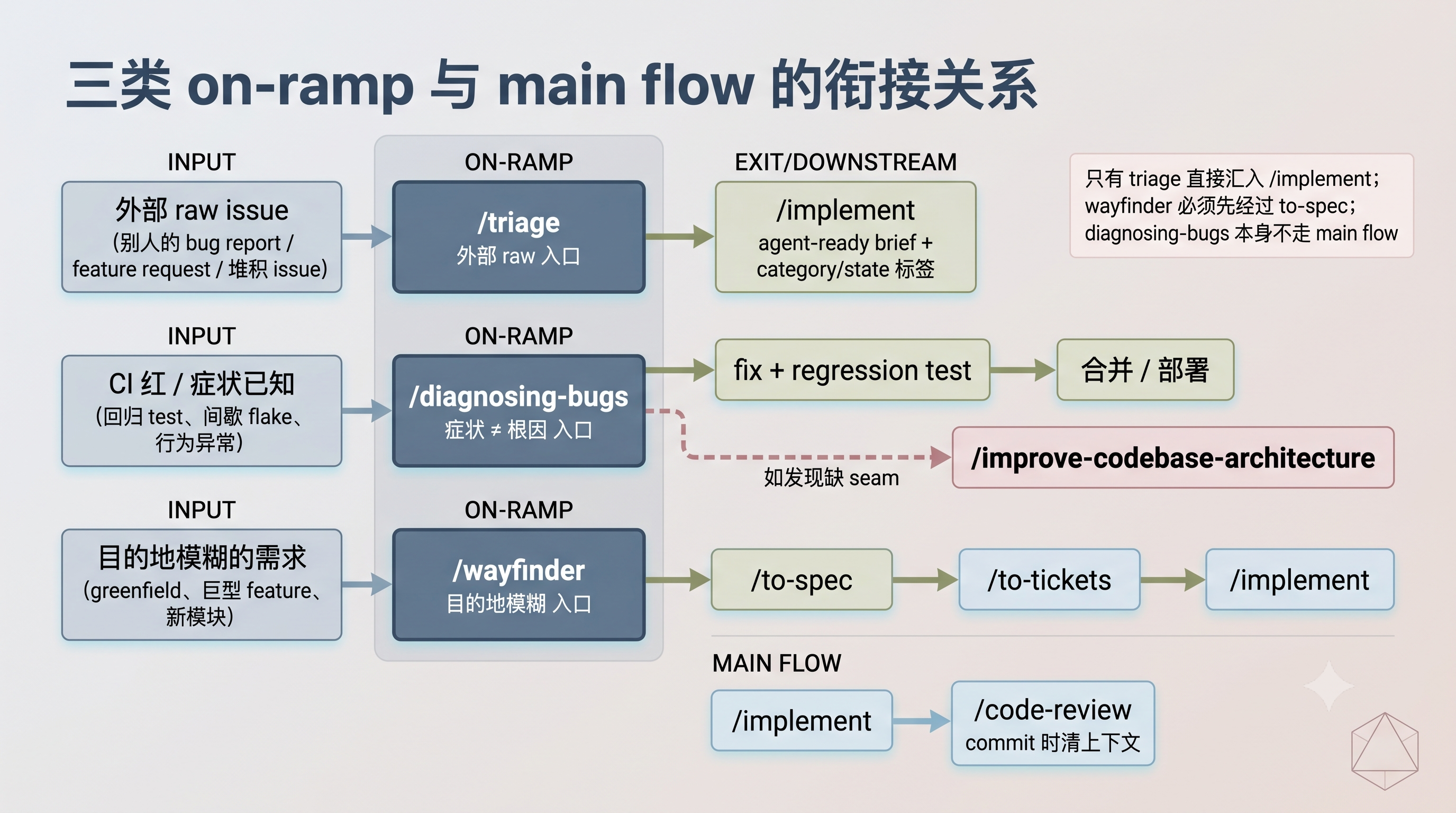
三类 on-ramp 与 main flow 衔接架构图
3. on-ramp 选择判断决策表
这是文章最核心的一张表。按这张表判断,比凭感觉决定今天先干啥靠谱得多。
输入形态 | 起点 | 工作体量 | 症状清晰度 | 走哪个 on-ramp | 直接出口 |
|---|---|---|---|---|---|
别人的 issue/PR、raw bug report、外部 feature request | 我没创建 | 1 条 1 条独立 | 描述可能模糊也可能清楚,但作者不是我 |
|
|
我自己 to-tickets 拆出来的工单 | 我创建的,brief 已写好 | 已切片 | 已清晰 | 不要再走 triage |
|
CI 红 / 测试不通过 / 行为突然异常 | 我自己代码 | 单点 | 症状清楚,根因未知 |
| 修复(必要时 hand off seam 问题) |
简单 typo、显而易见的不一致、第一次排查就明白原因的 bug | 我自己代码 | 微小 | 症状=根因 | 不走 diagnosing-bugs,直接 |
|
我想做的全新模块 / 巨型 feature / 超出单会话 | 我创建 | 半月以上 | 目的地未确定 |
|
|
已经有清晰 spec 的小特性 | 我创建 | 几天内 | 已清晰 | 不走 wayfinder |
|
这张表里两个最容易被忽略的判断:
- raw 不 raw 是 triage 的入口过滤器。
/to-tickets出来的工单不是 raw,不能再走 triage。 - 难不难定位 是 diagnosing-bugs 的入口过滤器。第一次读代码就明白的 bug 不需要 6 phase 全跑。
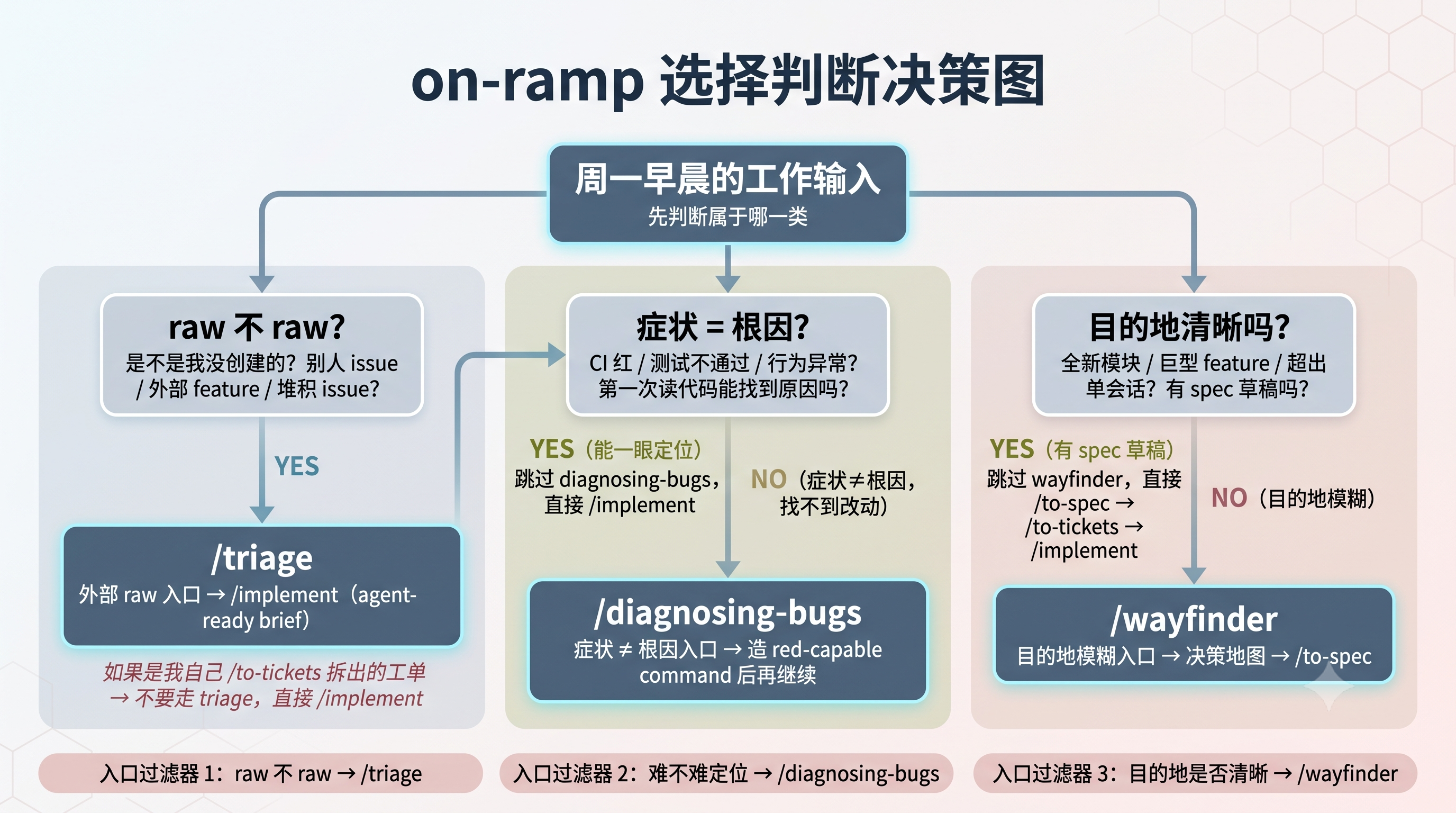
on-ramp 选择判断决策结构图
4. 三类判断准则的细节
4.1 按 issue 数量和来源判断要不要 triage
数字本身不重要,但量级有意义。如果你的 issue 列表里出现以下任一信号,就该停下来分批 triage,而不是直接挑着做:
- 跨来源:有陌生 reporter 提的 issue + 有同事口头说的 feature + 有 bot 报的 crash,全混在一起。
- 跨状态:有的写得很完整(复现步骤、期望行为、实际行为齐全),有的只有一句话它不工作了。
- 未分类:labels 是空的或只有
needs-triage,没有人做过 category/state 判断。
triage/SKILL.md 第 26-45 行定义的 2 个 category + 5 个 state 就是用来处理这种混乱的。2 个 category(bug / enhancement)回答是什么;5 个 state(needs-triage / needs-info / ready-for-agent / ready-for-human / wontfix)回答现在该谁处理。
五类状态机解决的实际管理问题:triage 之前你面对的是一堆 raw 文本,五类 state 之后,每个 issue 都落在一条已知的处理路径上。要么等更多信息(needs-info)、要么已可以交给 agent(ready-for-agent)、要么必须人介入(ready-for-human)、要么不需要做了(wontfix)。这条流水线把30 个 issue 不知道从哪开始换成30 个 issue 各自在哪一步。
标签流转示例(一条典型 issue 的轨迹)
第 12 号 issue 是陌生 reporter 报的:
- 进入仓库:labels 为空,state 为隐式
needs-triage。 - triage agent 读完 body 和 comments:信息不全,需要复现步骤。
→ 加
needs-info标签,回复模板化的 Triage Notes(注:源码triage/SKILL.md第 94-106 行的官方模板是 "What we've established so far / What we still need from you (@reporter)" 两段式,下面是基于此改写的中文示意,不是官方模板):
> *This was generated by AI during triage.*
> Triage Notes
> - Category: bug(疑似,但待复现确认)
> - Reported version: 未提供
> - Reproduction: 需要 reporter 提供以下信息 -
> 1. 触发该 bug 的具体步骤
> 2. 期望行为与实际行为
> 3. 错误日志或截图
> - reporter 回复后,重新 triage:能复现,category 确认为
bug,state 改为ready-for-agent。 → 写一份 agent-ready brief,结构对应triage/AGENT-BRIEF.md模板:
## Agent Brief
**Category:** bug
**Summary:** 用户报告 X 操作在 Y 条件下崩溃

**Current behavior:** ...(系统的实际行为)
**Desired behavior:** ...(应该的行为)
**Key interfaces:** ...(涉及的接口/类型/函数)
**Acceptance criteria:** ...(每条都可独立验证)
**Out of scope:** ...(显式说明不做什么)- 这条 issue 现在被
/implement拾起。triage 不再介入。
为什么 /to-tickets 产出的工单不能再被 triage
这是这一节最容易踩的坑。/to-tickets 自身的输出(SKILL.md 第 27-40 行)已经是 vertical slice + agent-ready 的工单。每条工单穿 schema/API/UI/tests 全栈、可独立 demo、大小适配一个新 context window。它出来的工单结构上等价于 triage 出来的 brief。
让 triage 二次处理它们会发生什么?会产生重复标签、状态错位、brief 被覆盖三类事故。更糟的是 - 它会让 triage 失去 raw 入口 的语义。把 我没创建的东西 和 我已经结构化好的东西 混在一起处理,整个 on-ramp 的入口过滤就失效了。
triage/SKILL.md 第 88-90 行还留了一个 quick state override 的口子:maintainer 说 move #42 to ready-for-agent 可以直接执行,跳过 grilling。这条口子是为了避免 triage 变成橡皮图章 - 如果一个 issue 信息已经够了,再走一遍完整 grilling 是浪费。
4.2 按 bug 严重度判断要不要 diagnosing-bugs
不是所有 bug 都需要 diagnosing-bugs。这条边界值很值得花一段讲清楚。
diagnosing-bugs/SKILL.md 第 12-14 行把 Phase 1 写成了 skill 的灵魂:
This is the skill. Everything else is mechanical. If you have a tight pass/fail signal for the bug - one that goes red on this bug - you will find the cause ... If you don't have one, no amount of staring at code will save you.
判断准则:症状是不是一眼看不懂。
- 第一次看代码就发现是空指针 → 不走 diagnosing-bugs。
- 报错信息直接指向某行代码 → 不走 diagnosing-bugs。
- 间歇性 flake,跑了 10 次只红 1 次 → 走 diagnosing-bugs。
- 上一个 known-good commit 之后某 test 突然变红,找不到改动 → 走 diagnosing-bugs。
- 报告里写我点了 X 然后 Y 挂了但你本地复现不出来 → 走 diagnosing-bugs。
判断的核心是有没有 tight feedback loop。一个 tight feedback loop 必须满足 4 条(SKILL.md 第 53-58 行):
- Red-capable - 跑的是 bug 的实际代码路径,断言用户的精确症状
- Deterministic - 同输入同结果(flaky 就用 pinned reproduction rate 钉死)
- Fast - 秒级,不是分钟级
- Agent-runnable - 可以无人值守跑(最后手段是 HITL bash 模板)
red-capable command 模板示例(演示用,非官方)
假设一条 bug 报告是在 macOS 14 上执行 git mv 重命名带空格的文件后,提交时索引报错。下面是 Phase 1 产物的最小模板(注:源码 diagnosing-bugs/scripts/ 目录下只有 hitl-loop.template.sh(HITL 专用,41 行)一个脚本,下面是基于 [DEBUG-a4f2] 标签模式和 red-capable 4 条验收标准自构的演示,不要当作官方模板):
#!/usr/bin/env bash
# [DEBUG-a4f2] tight feedback loop for issue #142
# Red-capable: 在受控环境下复现 "rename + space + commit" 失败路径
# Deterministic: 使用固定输入文件名 + 固定 git 版本
# Fast: 端到端 < 5s
# Agent-runnable: 无需人工交互;失败即 exit 1

set -euo pipefail

# 1. 准备受控 repo
TMP=$(mktemp -d)
trap 'rm -rf "$TMP"' EXIT
cd "$TMP"
git init -q
git config user.email "loop@local" && git config user.name "loop"

# 2. 创建带空格的源文件
echo "seed" > "my file.txt"
git add "my file.txt" && git commit -q -m "seed"

# 3. 重命名 + 试图提交
git mv "my file.txt" "renamed file.txt"
# 关键断言:这一步在 bug 存在时应该让 `git commit` 失败
git commit -q -m "rename" 2>/dev/null || {
 echo "[DEBUG-a4f2] BUG REPRODUCED: git commit after mv of spaced file failed"
 exit 1
}

# 4. 收尾断言:通过则说明 bug 已修
git log --oneline | grep -q "rename" || {
 echo "[DEBUG-a4f2] UNEXPECTED: commit did not contain rename"
 exit 1
}

echo "[DEBUG-a4f2] OK: bug not reproduced"
exit 0
四个 tag 全部满足之前不许进入 Phase 2。Phase 3 才提假设,且必须 3-5 个 ranked hypotheses,每个写成 falsifiable 格式:
If
<X>is the cause, then changing<Y>will make the bug disappear / changing<Z>will make it worse.
为什么只提一个假设是反模式?因为单假设锚定在第一个 plausible idea 上,会让你跳过早该考虑的方向。SKILL.md 第 84 行原文:
Generate 3–5 ranked hypotheses before testing any one of them. Single-hypothesis generation anchors on the first plausible idea.
它如何把修一个 bug 升级为留下一个 regression test + 一个 seam
diagnosing-bugs 跑完之后留下来的不只是 fix,还有两样东西:
- Regression test - 就是上面那个 red-capable command。它现在变绿了,但以后这个 bug 再回来它会重新变红。
- Seam - 一个正确的接缝点,让测试能锁定 bug 的真实模式。
SKILL.md第 110-115 行原文:
A correct seam is one where the test exercises the real bug pattern as it occurs at the call site. If the only available seam is too shallow...
更关键的一条规则写在同段:
If no correct seam exists, that itself is the finding. Note it. The codebase architecture is preventing the bug from being locked down. Flag this for the next phase.
也就是说 - 修一个 bug 留下一句"缺 seam"的话,diagnosing-bugs 把它 hand off 给 /improve-codebase-architecture,让架构层面的改造来解决接缝缺失。这个 hand off 在 Phase 6 的 post-mortem 里完成,而不是修 bug 之前 - 因为修完之后你对根因的理解比开始时深。
4.3 按工作体量判断要不要 wayfinder
wayfinder 是三个 on-ramp 里认知负担最重的。SKILL.md 在 ask-matt 章节里直接写"save it for exactly that, never a well-scoped feature"。
判断准则只有一条:目的地是否清晰。
- 目的地清晰(一个 spec 草稿、一组已写好的接口、新模块的第一个 PR 范围已经收敛) → 不走 wayfinder。
- 目的地模糊(只知道大致方向,不知道边界在哪,feature 大到要拆若干个 spec) → 走 wayfinder。
- 一眼看不到头(greenfield、巨型 build、超出单会话多次的体量) → 走 wayfinder。
SKILL.md 第 112 行留了一个明确信号:
If this surfaces no fog - the way to the destination is already clear, the whole journey small enough for one session - you don't need a map. Stop and ask the user how they'd like to proceed.
也就是说 wayfinder 不是先无脑开图、跑完再判断 - 它开图之后第一步就是检查有没有 fog,没有 fog 就关掉。这是个内置的反例闸门。
为什么是决策地图而不是交付物
wayfinder 的 map 是 issue tracker 上的索引,不是仓库。第 23 行原文:
The map is an index, not a store. It lists the decisions made and points at the tickets that hold their detail; a decision lives in exactly one place - its ticket - so the map never restates it, only gists it and links.
四类 ticket 各司其职:
- Research(AFK) - 读文档、外部资源;
/researchsubagent 跑 - Prototype(HITL) - 提升讨论保真度;答案是一个 artifact(UI sketch、状态模型)
- Grilling(HITL) -
/grilling+/domain-modeling一问一答;agent 不能替人答 - "a grilling agent that answers its own questions has broken this" - Task(HITL or AFK) - 必须先有动作才能做决策;唯一会真做事的 type,存在的理由是 unblock 一个 decision
注意:一次会话只解一个 ticket,research 类型例外。这是 wayfinder 的节奏,跟 main flow 多 ticket 并行完全不同。
5. 三类反例:按错顺序走会出什么问题
5.1 反例一:先做最吵的 issue,回归 bug 没人修
操作:周一打开仓库,看到一条高赞 issue 标题里带 emoji,写得很激动。直接 /implement 开始修。三个 CI 红的 test 继续红。
问题:
- 那条 issue 本身大概率会走 triage 跑成
needs-info,因为描述再激动也没复现步骤。 - 三个回归 bug 错过了症状最明显的时间窗 - 它们的 red 信号还新鲜,diagnosing-bugs 跑起来最快。等一周后没人记得它们怎么红的,feedback loop 会变难。
- triage 队列里 29 条 issue 没动。
正确顺序:回归 bug 优先(症状热 + 风险高)→ issue 批 triage → 新模块评估要不要 wayfinder。
5.2 反例二:先抢修 bug,错过结构性机会
操作:诊断一个 bug 修到一半,发现根因是缺 seam(接缝缺失)。但因为想赶紧让 CI 绿,跳过了 /improve-codebase-architecture 的 hand off,临时打补丁绕过。
问题:
- bug 是修了,但缺 seam 的根因还在。下次同模式 bug 还会出现,diagnosing-bugs 还得重新跑一遍。
- 多个相关 bug 可能都共享这个 seam 问题 - 这次修了三个 bug,下次还是同样的 patch 套路。
正确顺序:bug 修复完成后保留 seam 缺失的发现,hand off 给 /improve-codebase-architecture。SKILL.md 第 134-136 行原文:
Make the recommendation after the fix is in, not before - you have more information now than when you started.
5.3 反例三:先上 wayfinder 反而比 to-spec 更慢
操作:想做的新模块有大概方向,开个 wayfinder 会话,画一个 map,挂 20 个 decision ticket。
问题:
- 你的 spec 草稿其实已经能写完,只是没人 review。这种情况 wayfinder 是在做 to-spec 该做的事 - 前者把信息分散到 20 张 ticket 里,后者坍缩在一份文档 里。前者慢十倍以上,且 map 还得回头交给 to-spec 坍缩一次(兜一圈浪费)。
SKILL.md自己在第 112 行埋了反例闸门:"If this surfaces no fog ... you don't need a map."
正确顺序:先评估目的地是不是已经清晰。如果只是需要访谈 grill → /grill-me 或 /grill-with-docs;如果需要 spec 化 → 直接 /to-spec;只有目的地真的不清晰才上 /wayfinder。
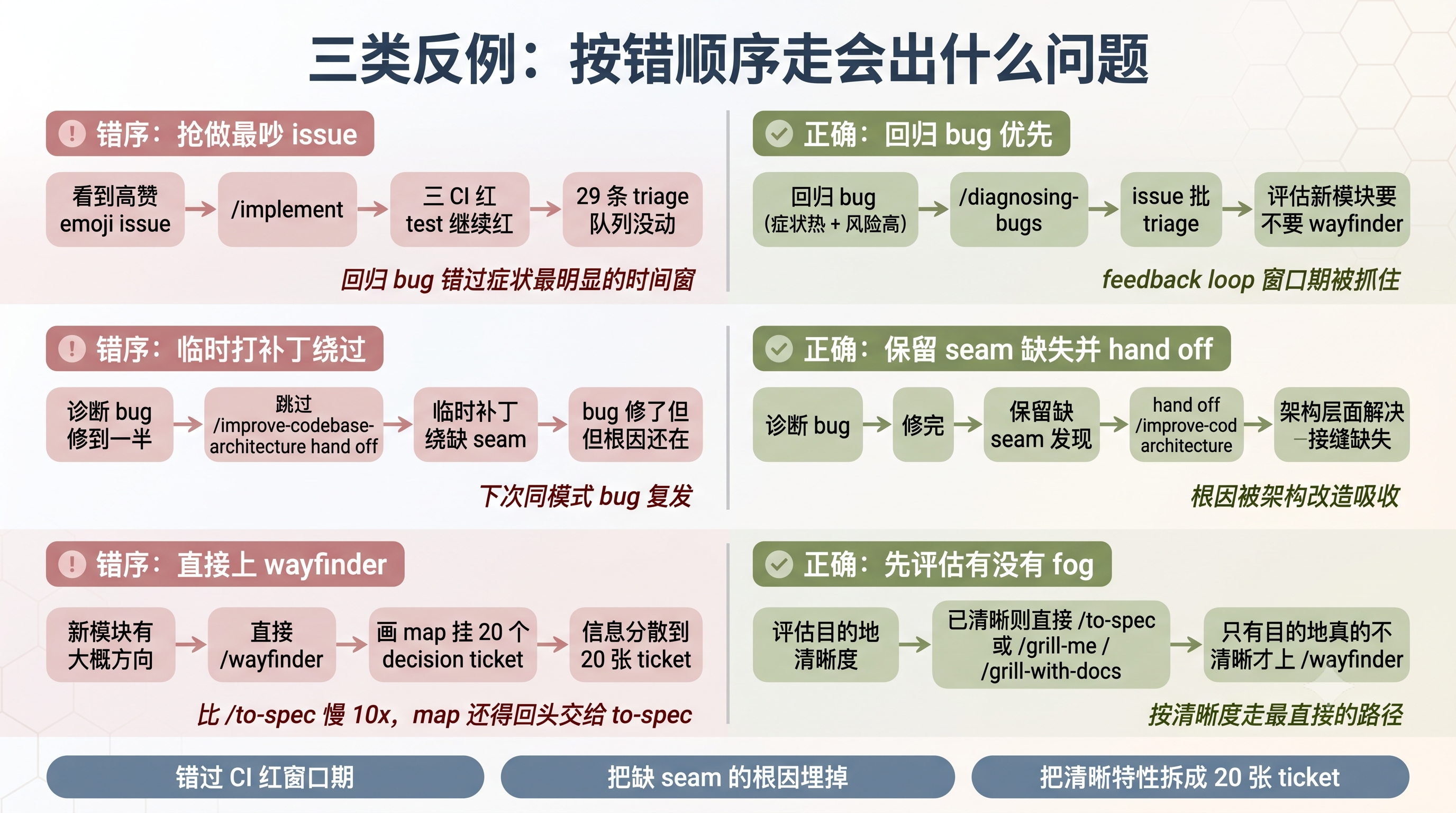
三类反例对照图:错序处理 vs on-ramp 顺序处理
6. 上游产物如何接入下游节点
最后把这三个 on-ramp 的产物和下游节点的关系列清楚。这张表跟第 2 节的出口表呼应,但视角换成上游产物。
上游产物 | 来自哪个 on-ramp | 产物形态 | 下游节点 | 备注 |
|---|---|---|---|---|
|
| issue body + category/state 标签 |
| brief 已经行为化、可验收、不指路径 |
|
| 同结构 brief + 为什么不能委派一段 | 人 | 适合 maintainer 处理 |
|
| Triage Notes 模板 | 等 reporter 回复 | 不进 main flow |
|
| 简短原因 +(若是 enhancement) | 关 issue | 已实现的 wontfix 不进 out-of-scope |
fix + regression test +(可选)缺 seam 备注 |
| diff + test + post-mortem | 合并 / 部署;如发现缺 seam → | hand off 时机是 fix 之后 |
决策 map + linked decision tickets |
| issue tracker 上的 map |
| 不能跳过 to-spec 直接 implement - 会扔掉决策细节 |
spec |
| markdown |
| to-spec 不访谈,只综合已被 grill 过的共识 |
vertical-slice 工单 |
| issue / ticket |
| 已 agent-ready,不再 triage |
实现的 diff |
| PR |
| commit 时清上下文 |
注意最后一行 - /implement 输出走 /code-review,这条主链路在另一篇(06 篇 main flow)展开。
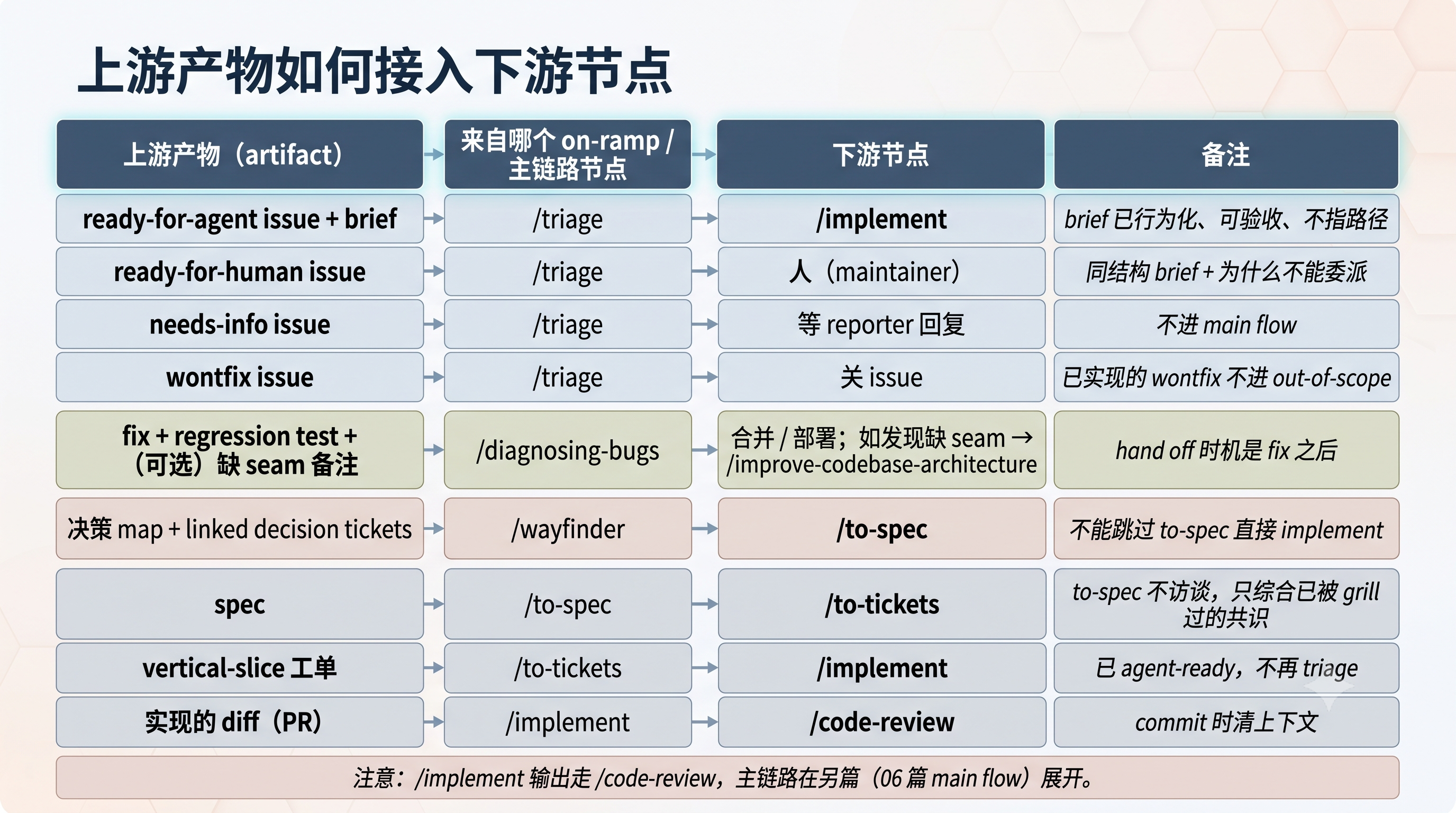
上游产物与下游节点映射结构图
总结
把三类输入混在一起处理,Agent 默认会挑最吵的 - 那条高赞 issue、那个 emoji 标题、那个看起来能做的小需求。这不是 Agent 偷懒,是它没有分类器。
ask-matt 的三类 on-ramp 提供的就是这个分类器:
- raw 进来的、不是你创建的 →
/triage,产 agent-ready brief - 症状清晰根因未知的 →
/diagnosing-bugs,造 red-capable command 后再继续 - 目的地模糊超出单会话的 →
/wayfinder,先决策后执行
判断准则只有三条,按这个顺序走 - 不是按哪个最吵。按错顺序的代价不是浪费几小时,是错过 CI 红的窗口期、把缺 seam 的根因埋掉、或者把一个清晰特性拆成 20 张 ticket 兜一圈再合回来。
文章没承诺 triage 就会减少积压、diagnosing-bugs 就会减少 bug 复发、wayfinder 就会减少返工 - 这些都是结果,不是承诺。它们能保证的是输入被分到合适的入口,至于入口之后怎么样,取决于具体 issue、具体 bug、具体 feature。
好啦,谢谢你观看我的文章,如果喜欢可以点赞转发给需要的朋友,我们下一期再见!敬请期待!
原创声明:本文系作者授权腾讯云开发者社区发表,未经许可,不得转载。
如有侵权,请联系 cloudcommunity@tencent.com 删除。
目录
腾讯云开发者

Copyright © 2013 - 2026 Tencent Cloud. All Rights Reserved. 腾讯云 版权所有
深圳市腾讯计算机系统有限公司 ICP备案/许可证号:粤B2-20090059  粤公网安备44030502008569号
腾讯云计算(北京)有限责任公司 京ICP证150476号 | 京ICP备11018762号