Memory Edition (Standard Architecture)

Last updated: 2024-11-01 17:02:08

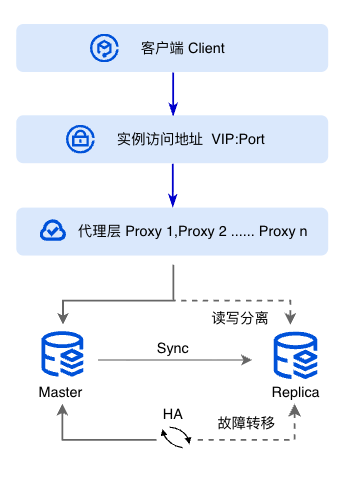
TencentDB for Redis® Memory Edition (Standard Architecture) refers to the version that supports one or more replicas (replicas being the non-master nodes) and is the most commonly used Redis edition, compatible with the protocols and commands of Redis 2.8, 4.0, 5.0, and 6.2, offering data persistence and backup, ideal for scenarios that demand both data reliability and availability. The master node serves daily access, while the replica nodes ensure high availability (HA). In case of a master node failure, the system automatically switches to a replica node, ensuring smooth business operations.
Taking 1 replica as an example, Memory Edition (Standard Architecture) is as follows:


Replica Description

Memory Edition (Standard Architecture) supports 1–5 replicas to meet the different requirements for availability and performance of your business in different scenarios. All replicas of Memory Edition (Standard Architecture) play a role in supporting system's high availability, so the more replicas, the higher the availability. If the number of replicas is greater than or equal to 1, read/write separation can be enabled to extend the read performance through replica nodes.
Glossary:
Master node: A Redis node that provides read and write capabilities.
Replica node: A Redis node that provides high availability or read-only capability. A master node cannot be a replica node.
Replica support:
Instance Version
Supported Replica Quantity
Read/Write Separation
2.8 Memory Edition (Standard Architecture)
1
Unavailable
4.0 Memory Edition (Standard Architecture)
1 - 5
This feature is supported.
5.0 Memory Edition (Standard Architecture)
1 - 5
This feature is supported.
6.2 Memory Edition (Standard Architecture)
1 - 5
This feature is supported.
Read-Only Replica (Read/Write Separation):
Supported editions: TencentDB for Redis® 4.0 Memory Edition (Standard Architecture) and later instance. When the number of replicas is greater than or equal to 1, automatic read/write separation can be enabled to extend the read performance vertically. Up to 5 replica nodes can be supported.
Implementation Principle: After enabling read-only replicas, write requests are routed to the master node, while read requests are routed to all replica nodes through a load balancing algorithm, and the master node no longer processes read requests. The read/write separation feature is provided by the built-in Proxy component of TencentDB for Redis®.
Enabling/Disabling: The read-only replica feature can be enabled or disabled on the instance creation page of the TencentDB for Redis® Console. It can also be managed via the TencentCloud API.

Feature

Service reliability (1-5 replicas) With a dual-server master/slave architecture, the master and slave nodes reside on different physical machines with the master node providing external access. You can perform data CRUD using the Redis command line or client. In case that the master node fails, the proprietary HA system will automatically perform master/slave switchover to ensure smooth operation of the business.
Data reliability (1-5 replicas) The data persistence feature is enabled by default. Memory Edition (Standard Architecture) supports data backup. You can roll back or clone instances for backup files to effectively cope with data maloperations and other issues.

Usage Limits

Memory Edition (Standard Architecture) supports 0.25–64 GB of storage capacity. For higher specifications, use Cluster Edition that supports up to 8 TB of capacity.
Memory Edition (Standard Architecture) supports up to 100,000 QPS (SET command concurrencies). If you need a higher QPS, you can choose multi-replica read/write separation or use Redis Cluster Edition that supports tens of millions of QPS.

Notes on command compatibility

For more information on command support, see Command Compatibility Overview.