Elastic MapReduce (EMR) is a secure, cost-effective, and highly reliable open-source big data platform, founded on cloud-native technology and the expansive Hadoop open-source ecosystem. It offers easily deployable and manageable open-source big data components such as Hive, Spark, HBase, Flink, StarRocks, Iceberg, Alluxio, and more, assisting clients in efficiently constructing cloud-based, enterprise-level data lake architectures. EMR supports deployment based on two types of resources: CVM and TKE.
Supported formats
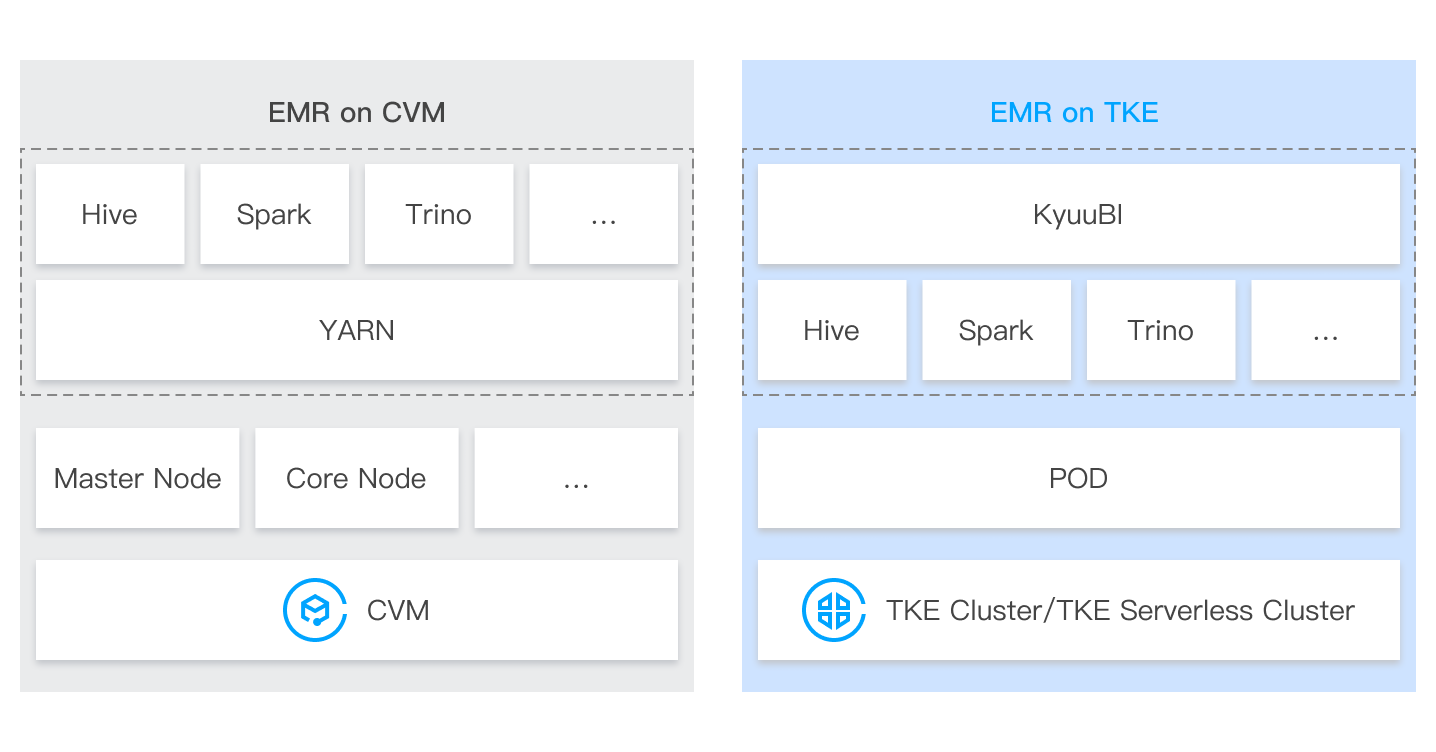
Tencent Cloud's EMR offers two deployment and operation methods based on Cloud Virtual Machine (CVM) and Tencent Kubernetes Engine (TKE):
Modalities
Description
EMR on CVM
EMR is responsible for installing and deploying open-source big data components on CVM, and initiating the corresponding services. You can carry out operations and maintenance tasks for the cluster CVM and services through the EMR console.
EMR on TKE
If you have prepared a standard TKE cluster or a Serverless cluster, EMR will install and deploy open-source big data components based on TKE resources, realizing the containerized operation of the open-source big data platform, thereby reducing your operational focus on underlying resources.
When components such as Hive, Hue, and Ranger are deployed in the EMR cluster, the cluster will concurrently purchase a Cloud Database MySQL for storing component metadata.
Metric and event monitoring data from the EMR cluster are reported to TCOP. Through TCOP, cluster monitoring data can be retrieved and alarm notification strategies can be configured for key observability metrics.