The content of this page has been automatically translated by AI. If you encounter any problems while reading, you can view the corresponding content in Chinese.

Voice Assistant

Last updated: 2026-03-27 17:28:12
This document shows you how to open and use the voice assistant service of Tencent Cloud IoT Explorer.

Prerequisites

Activating devices to enable the voice assistant service is only supported in the following regions:
Chinese mainland (excluding Hong Kong, Macao, and Taiwan region)

Apply for Enabling Voice Assistant Service

The voice assistant service is a paid value-added service and does not offer a free trial. You can Online Consultation to ask for help. The staff will connect with you on service purchase matters.

Voice Assistant Service Access Guide

Step 1: Enabling Voice Assistant Service

1. Log in to the IoT Explorer console, select the region "China", and create a project and product. For details, see Product Definition.
Note:
When creating a product, it is recommended to select the product category as: intelligent life/audio-visual office/smart speaker. Developers can also choose other categories for customized development.
2. Select a created project to enter the project details page, and click Product Development in the left sidebar to enter the product list page.
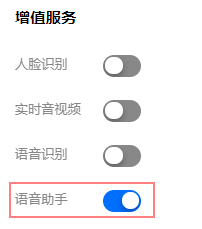
3. Click the name of the created product to enter the product detail page. In the Value-added Service menu bar on the right, click the button at "Voice Assistant". Activation is successful just.


Step Two: Bind the Platform Application Information of Cloud Xiaowei Open Platform

Note:
Ensure that the App Key and App Secret are not leaked.
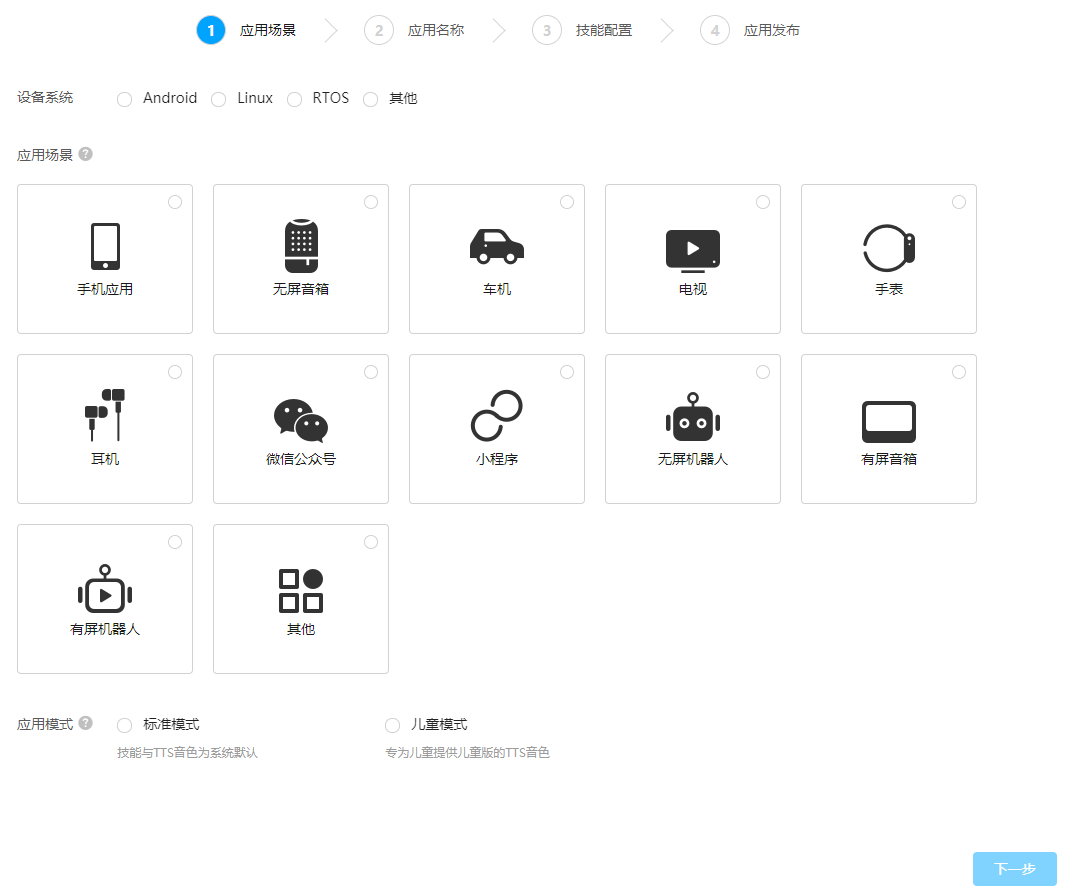
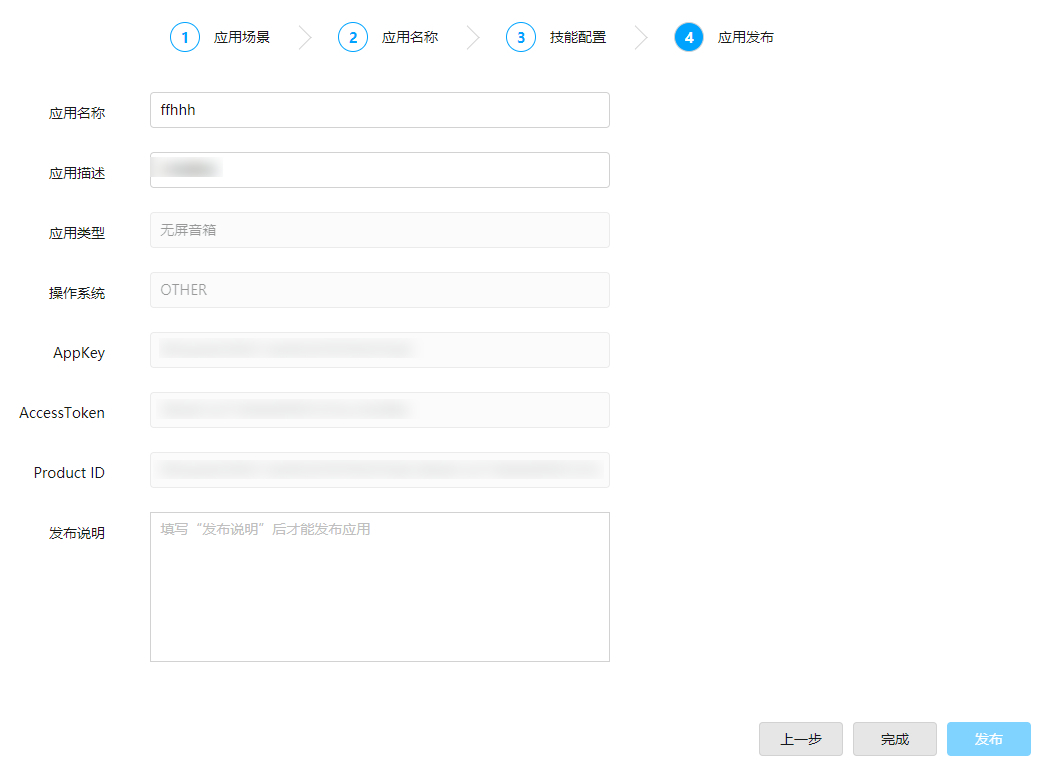
1. Log in to the open platform of Tencent Cloud Xiaowei, click Device Platform > Create Application to enter the application creation page and fill in relevant information.


Device system: including Android, Linux, RTOS, and others.
Application scenarios: including mobile applications, audio without screen, in-vehicle entertainment systems, etc. This time, select "audio without screen".
Application mode: Includes "standard mode" and "Child Mode".
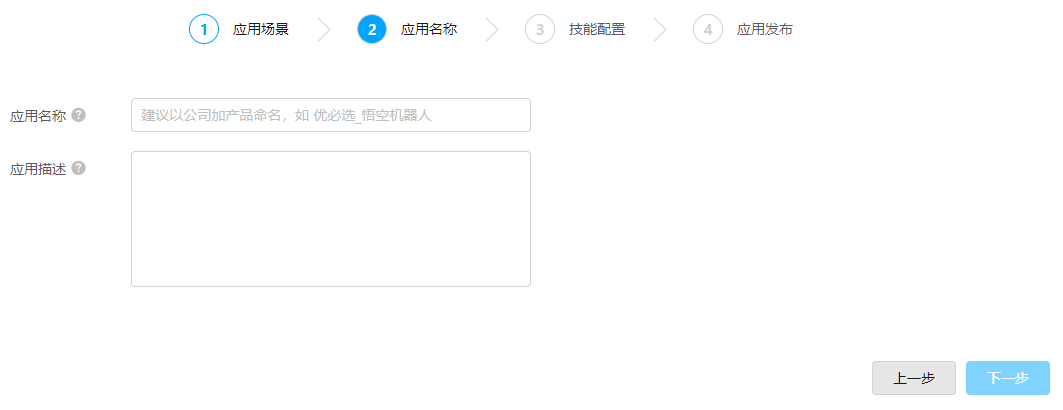
2. Click Next, and enter the application name and application description.


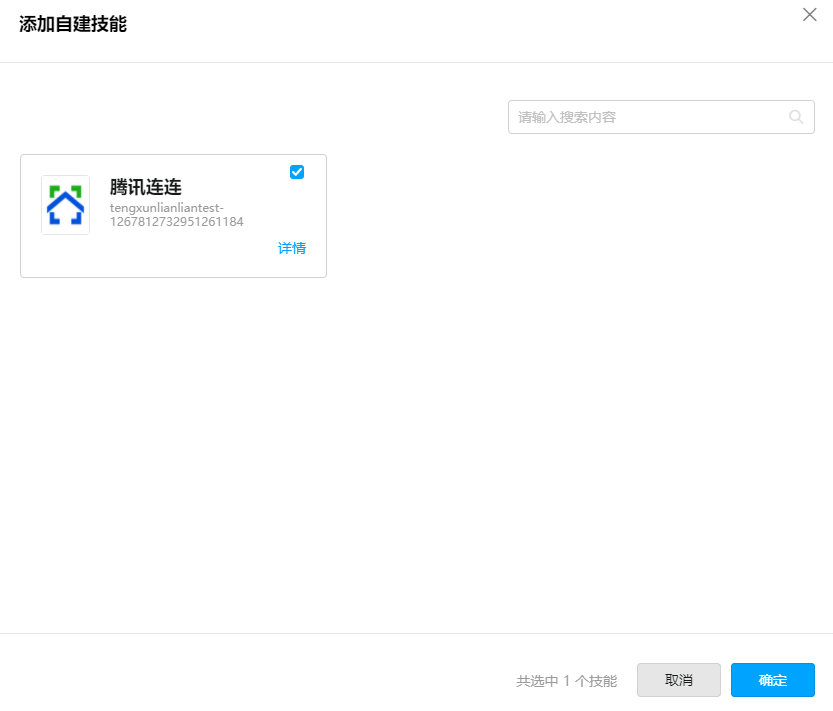
3. Click Next, select Customization > Import from custom skill library, check Tencent Lianlian and click Confirm.


4. Enter the version number in the format of x.x.x.x, for example, 1.0.0.0. The version number cannot be changed after it takes effect. The version number is primarily used to cooperate with the update of the terminal version and can also be used to distinguish the created applications. Click Next.


5. Fill in the release note. Click Complete, and then click Publish to successfully create the application.


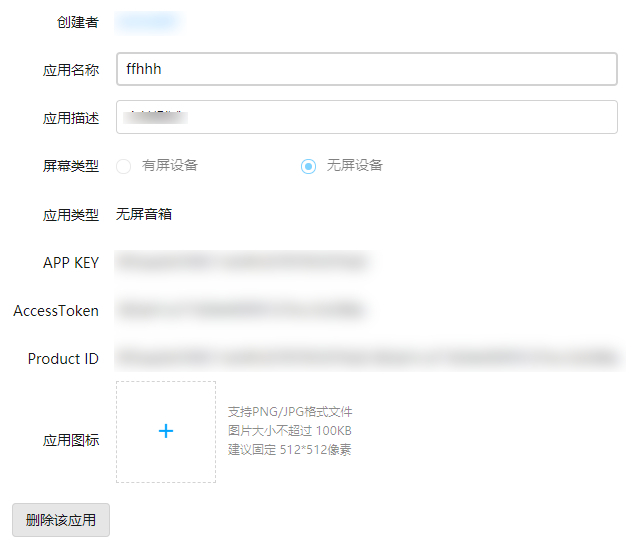
6. Click Application Overview to see the newly created application. Thereby obtain the App Key, App Secret, and Product ID corresponding to the application. Ensure that the App Key and App Secret are not leaked, and contact Tencent Cloud IoT development engineers offline.


Step 3: Control Device Connectivity

1. Develop based on the fusion version SDK of Tencent Cloud IoT and Cloud Xiaowei. For the SDK, please contact Tencent Cloud colleagues or agents offline to obtain.
2. Perform device-side integration development based on Tencent Cloud triplet information (device name, device key, and product ID), Cloud Xiaowei tvs_pid, and DSN.
Note:
- Triplet information retrieval. For more details, see device information.
DSN is composed of product ID_device name.
The controlled device supports Cloud Xiaowei skills. You need to apply for enabling Cloud Xiaowei Voice Skill Service in advance. Once the service is activated, you need to contact Tencent Cloud IoT development engineers offline.

Step Four: Mass Production of Devices

Log in to the IoT Explorer Console. On the products with the "language assistant" activated, submit a mass production application. After review passed, mass production can be carried out. For more details, see batch production.

Mini Program Operation Guide

1. Network Configuration Binding of the master control device. Use the Tencent Lianlian Mini Program to perform network configuration binding by scanning and binding the network configuration QR code of the master control device.
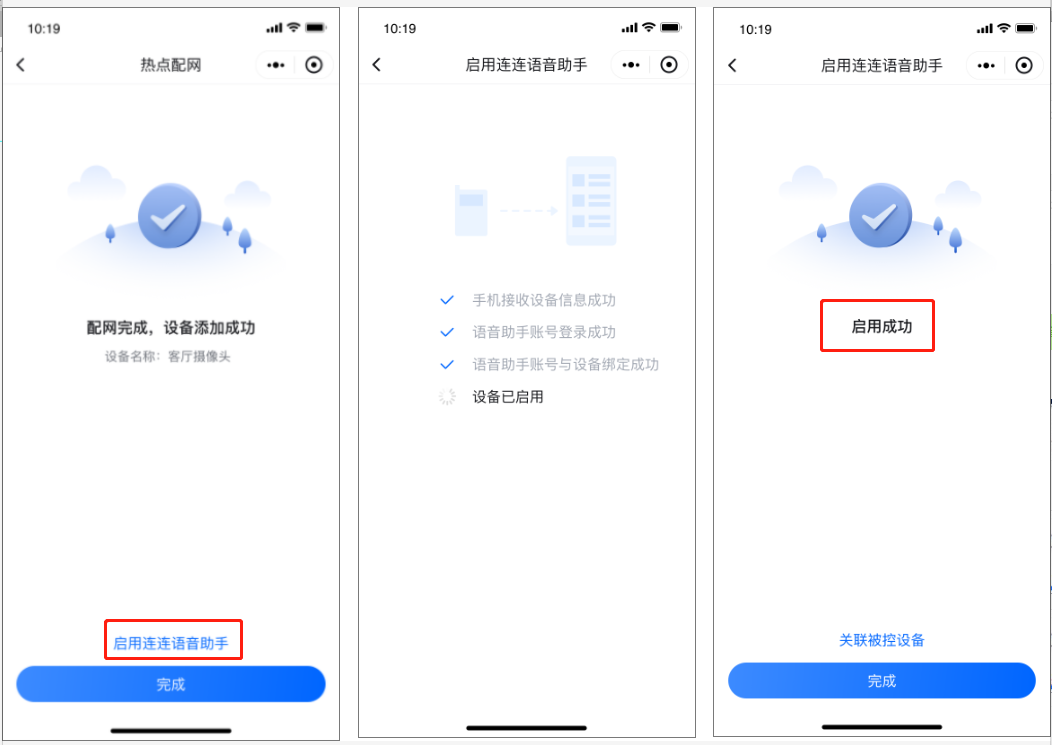
2. Activate the master control device.


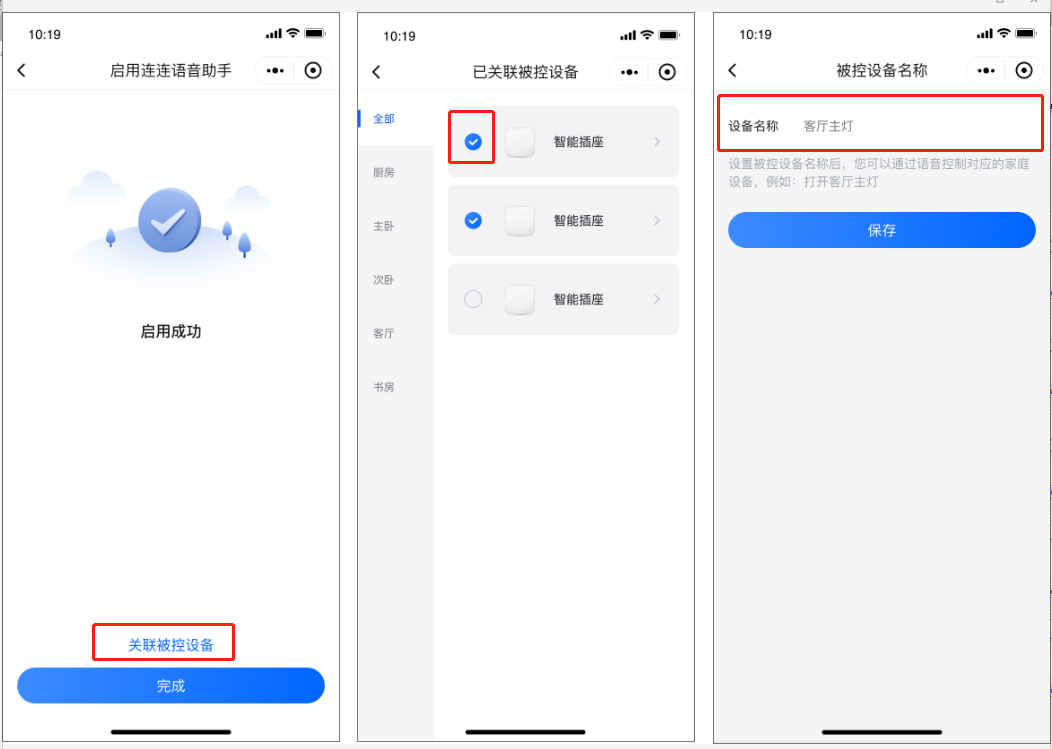
3. Associate the master control device with the controlled device. After the master control device is activated, it can be associated with the controlled device. After successful association, you can proceed with voice control.


Note:
Before adding a controlled device, you need to rename the controlled device before you can control the smart device.
4. Authorize the use of QQ Music. If a developer integrates a music skill in step two and clicks "QQ Music" on the master control device panel in the mini program and authorizes it, the music skill can be used.
Note:
The standard control panel for mini program Music on Demand is under development and will be published subsequently. Developers can also choose custom H5 panel development.
- Music skill access guide: Select QQ Music skill in the version management of Cloud Xiaowei Skill Platform. For details, see Music Service.

Custom H5 Development

Developers can custom develop the control panel of the master control device or the controlled device. For details, see Custom H5 Development.