The content of this page has been automatically translated by AI. If you encounter any problems while reading, you can view the corresponding content in Chinese.

Account Settings

Last updated: 2024-08-28 11:29:43

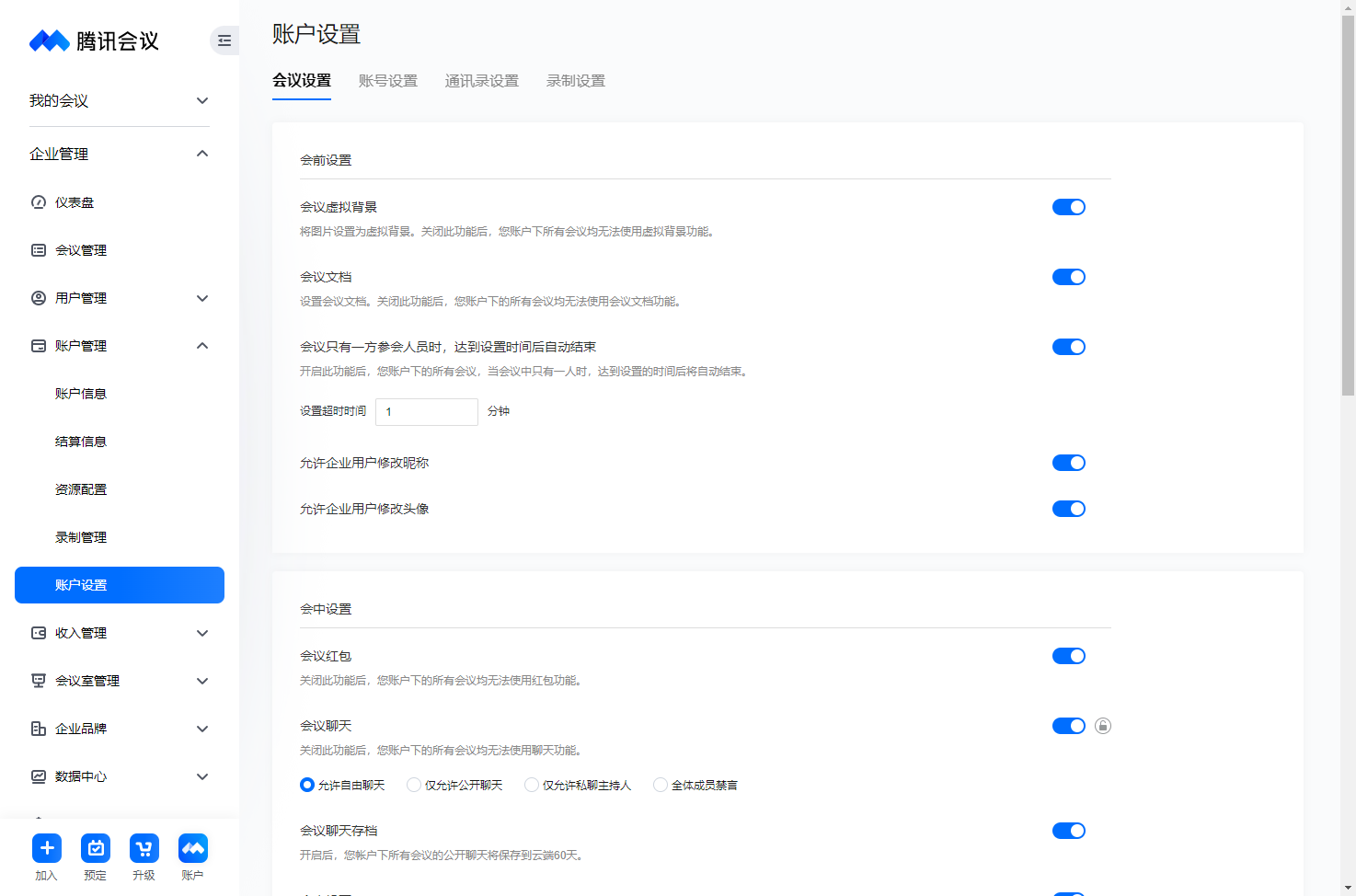
Meeting Settings

Unified enterprise meeting feature settings for secure and efficient meeting management.

Pre-meeting settings

Includes Virtual Background, Meeting Documents, Automatic End Time, Modify Nickname, and Change Avatar.
Virtual Background: Once enabled, all meetings under the enterprise can set images as virtual backgrounds.
Meeting Documents: Once enabled, all meetings under the enterprise can set meeting documents.
Automatic End Time: Once enabled and a timeout period is set, meetings under the enterprise with only one participant will automatically end after the set time.
Modify Nickname: Once enabled, all members under the enterprise are allowed to modify their nicknames.
Change Avatar: Once enabled, all members under the enterprise are allowed to change their avatars.


In-meeting settings

Includes Meeting Red Envelopes, Meeting Chat, and Vote During Meeting.
Meeting Red Envelopes: Once enabled, all meetings under the enterprise can use the red envelope feature.
Meeting Chat: Once enabled, all meetings under the enterprise can set user chat permissions.
Chat permissions can be set as: Free Chat, Public Chat Only, Private Message to Host Only, Mute All Participants.
Once locked, all meetings under the enterprise will follow these chat settings.
Meeting Chat Archiving: Once enabled, public chats in all meetings under your account will be saved to the cloud for 60 days.
In-meeting Voting: Once this feature is enabled, all meetings under the enterprise can initiate voting.
Subtitles: Once this feature is disabled, all meetings under your account will not have the subtitle feature.
Real-time Transcription: Once this feature is disabled, all meetings under your account will not have the real-time transcription feature.
Simultaneous Interpretation Language Designation: Once enabled, the interpretation language will be limited to the specified language; once this feature is disabled, the interpretation language supports the default 17 languages.
Default Languages: Chinese, English, Japanese, Korean, German, French, Russian, Portuguese, Spanish, Italian, Arabic, Indonesian, Hindi, Thai, Vietnamese, Malay, Turkish.
Add Application Entry: Once this feature is disabled, the add application entry will not be shown in any meeting under your account and third-party applications cannot be added.
Interactive Annotation: Allows hosts and participants to use the interactive annotation feature during screen sharing.
Option Selection: By default, only the user currently sharing can use the interactive annotation feature.


Security settings

Member Admission Restrictions, Meeting Watermark, Multi-Factor Authentication, Remote Control.
Member Admission Restrictions: All meetings under the enterprise can choose member admission restrictions.
Selectable Admission Criteria: Only allow enterprise internal members to join, or allow all members to join.
Once the admission method is locked, all meetings under the enterprise will follow this method.
Meeting Watermark: Once this feature is enabled, all members will see a watermark embedded in the meeting screen during meetings under the enterprise.
Selectable Watermark Modes: Single-row watermark, Multi-row watermark.
Once locked, all meetings under the enterprise will only use this watermark mode.
Multi-Factor Authentication: After enabling this feature, using SMS Captcha or account password to log in to the management platform will require multiple identity verifications. At least two authentication methods must be selected when enabling.
Remote Control: After enabling this feature, selected members can use the remote control feature, and you can choose whether it is enabled only for internal enterprise users or for all members.


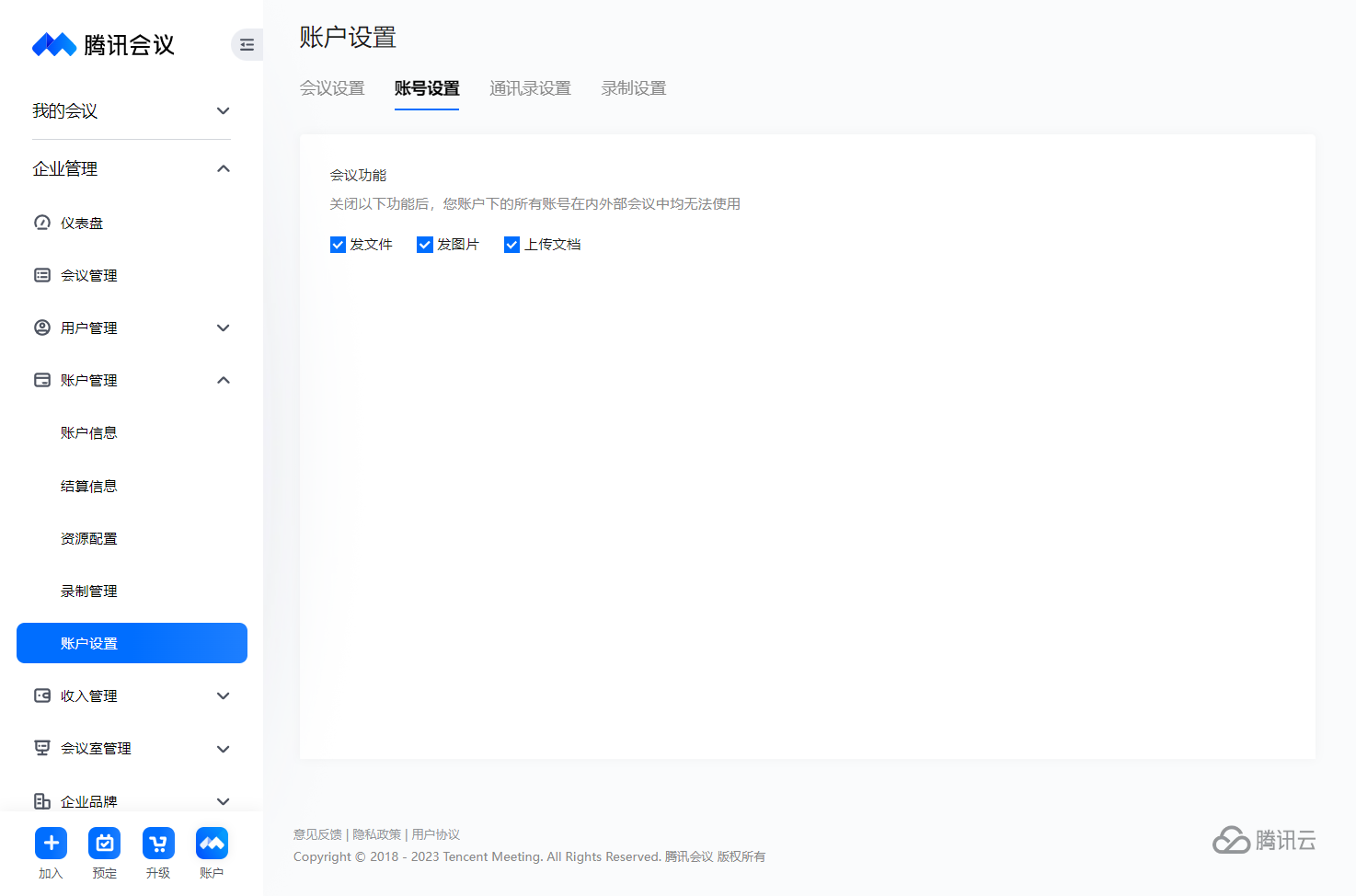
Account Settings

Meeting Features: Send files, Send images, upload files. Once any feature is disabled, all accounts under the enterprise will be unable to use the feature in both internal and external meetings.


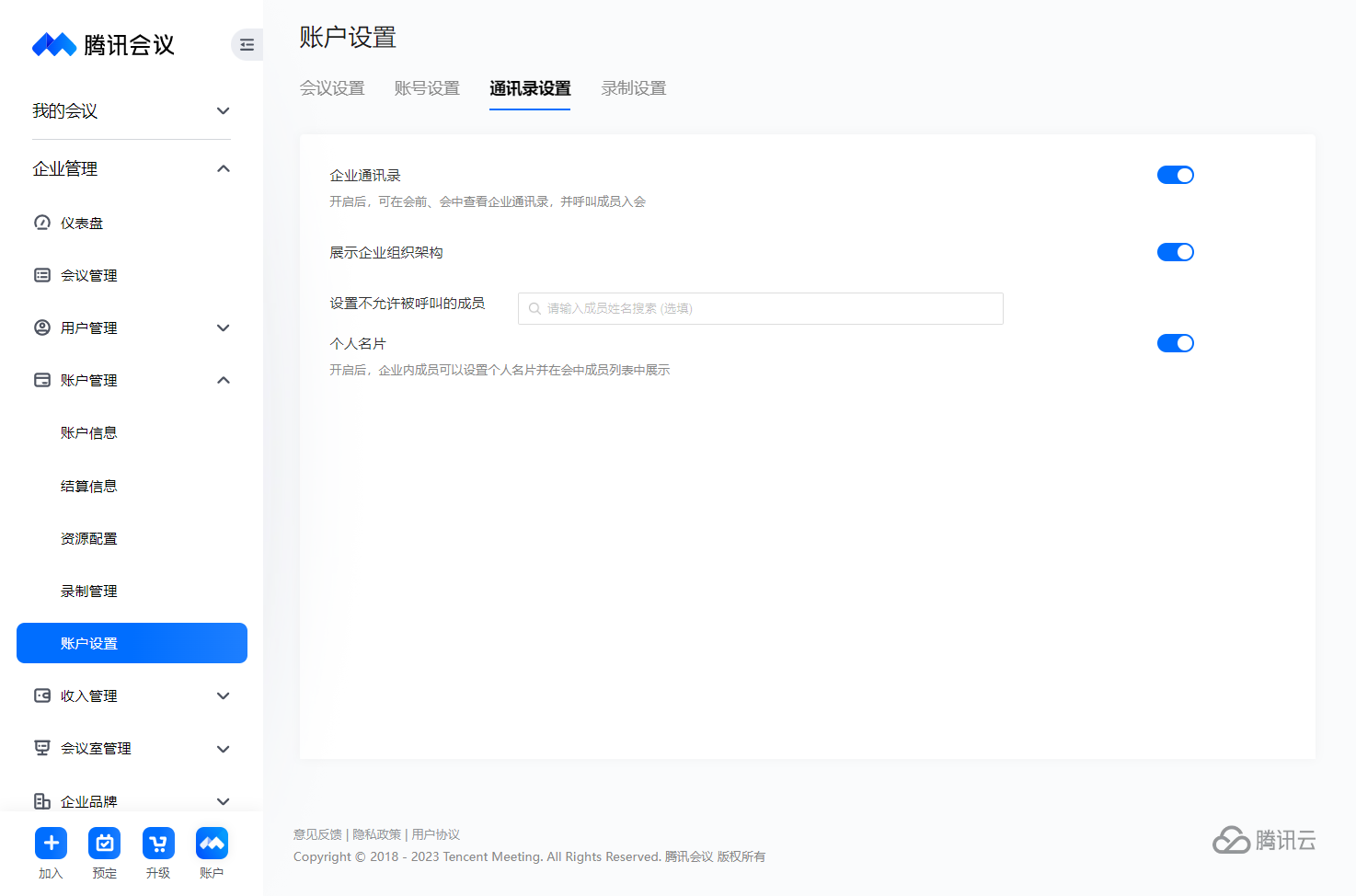
Directory Settings

Corporate Directory: After enabling, you can view the corporate directory before and during the meeting, and call members to join, making it convenient for corporate members to view the organizational structure.
Display Corporate Organizational Structure: After enabling, the directory will display the organizational structure and member information of the enterprise.
Set Members Not Allowed to Be Called: Set invisible members. Members in the enterprise directory will not be able to directly view these members, protecting special personnel and executives. You can flexibly set the visibility of internal members in the directory.
Personal Business Card: After enabling, corporate members can set personal business cards and display them in the member list during the meeting.


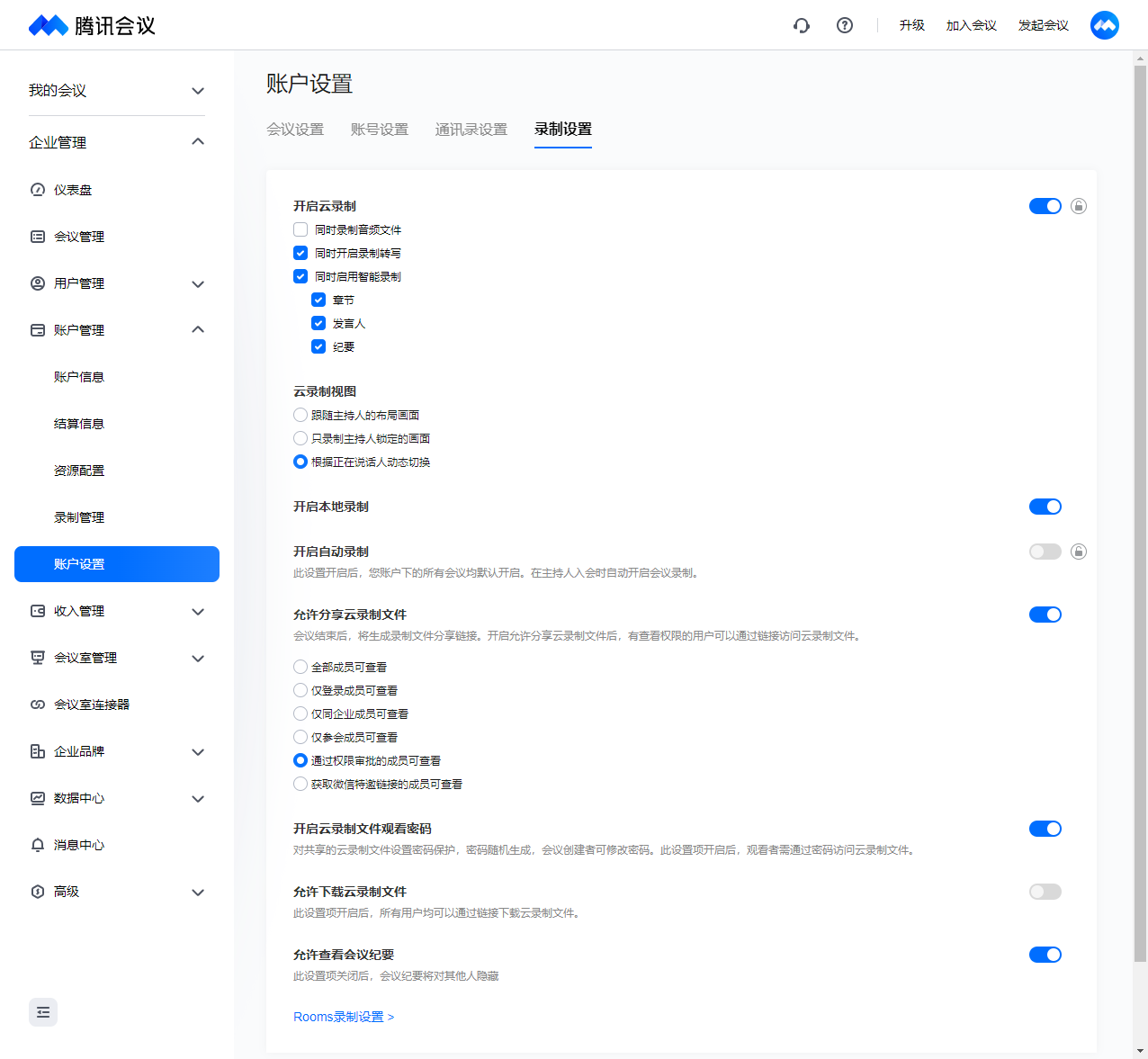
Recording Settings

Unified enterprise meeting recording feature settings for secure management of meeting recordings.

Cloud Recording and View

Enable Cloud Recording: After enabling this feature, all meetings under the enterprise can use cloud recording.
Option to simultaneously record audio files with cloud recording, enable transcription during recording, and enable intelligent recording.
Once locked, all meetings under the enterprise will only use this configuration for recording meetings.
Cloud Recording View:
After enabling cloud recording, you can choose to enable the cloud recording view mode.
View options: Follow the host's layout, record only the host's locked screen, or switch dynamically based on the speaker with three mode options.
Enable Local Recording: After enabling this feature, all meetings under the enterprise can use local recording.
Enable Automatic Recording:
Once automatic recording is enabled, all meetings under your account will automatically start recording when the host joins the meeting by default.
Automatic Recording Options: Cloud Recording, Local Recording.
Cloud Recording: To choose this option, cloud recording must be enabled first.
Support setting to start cloud recording immediately when attendees join; if there are no attendees, recording will start automatically when the host joins.
Support setting for the host to pause or stop cloud recording. Once set, the host can pause or stop cloud recording during the meeting.
Local Recording: To choose this option, local recording must be enabled first.
Once the automatic recording method is locked, all meetings under the enterprise will default to this method and automatically start recording during the meeting.
Recording File Settings:
Allow Sharing of Cloud Recording Files:
After the meeting ends, a share link for the recording file will be generated. When allowing sharing of cloud recording files is enabled, users with view permissions can access the cloud recording files through the link.
User Sharing Permissions: All members can view, only logged-in members can view, only members of the same enterprise can view, only attendees can view, members approved for access can view, members with a special WeChat invitation link can view.
Enable Cloud Recording File Viewing Password: Set a password to protect the shared cloud recording file. The password is randomly generated, and the meeting creator can modify it. Once this setting is enabled, viewers need the password to access the cloud recording file.
Allow Download of Cloud Recording Files: When this setting is enabled, all users can download the cloud recording file via the link.
Allow Viewing of Meeting Minutes: When this setting is disabled, the meeting minutes will be hidden from others.