操作场景
该任务以 C++ 客户端为例,指导您使用公网 SASL_PLAINTEXT 方式接入消息队列 CKafka 版并收发消息。
前提条件
下载 Demo
操作步骤
步骤1:安装 C/C++ 依赖库
步骤2:安装 SSL/SASL 依赖
yum install openssl openssl-develyum install cyrus-sasl{,-plain}
步骤3:发送消息
1. 创建 producer.c 文件。
/** librdkafka - Apache Kafka C library** Copyright (c) 2017, Magnus Edenhill* All rights reserved.** Redistribution and use in source and binary forms, with or without* modification, are permitted provided that the following conditions are met:** 1. Redistributions of source code must retain the above copyright notice,* this list of conditions and the following disclaimer.* 2. Redistributions in binary form must reproduce the above copyright notice,* this list of conditions and the following disclaimer in the documentation* and/or other materials provided with the distribution.** THIS SOFTWARE IS PROVIDED BY THE COPYRIGHT HOLDERS AND CONTRIBUTORS "AS IS"* AND ANY EXPRESS OR IMPLIED WARRANTIES, INCLUDING, BUT NOT LIMITED TO, THE* IMPLIED WARRANTIES OF MERCHANTABILITY AND FITNESS FOR A PARTICULAR PURPOSE* ARE DISCLAIMED. IN NO EVENT SHALL THE COPYRIGHT OWNER OR CONTRIBUTORS BE* LIABLE FOR ANY DIRECT, INDIRECT, INCIDENTAL, SPECIAL, EXEMPLARY, OR* CONSEQUENTIAL DAMAGES (INCLUDING, BUT NOT LIMITED TO, PROCUREMENT OF* SUBSTITUTE GOODS OR SERVICES; LOSS OF USE, DATA, OR PROFITS; OR BUSINESS* INTERRUPTION) HOWEVER CAUSED AND ON ANY THEORY OF LIABILITY, WHETHER IN* CONTRACT, STRICT LIABILITY, OR TORT (INCLUDING NEGLIGENCE OR OTHERWISE)* ARISING IN ANY WAY OUT OF THE USE OF THIS SOFTWARE, EVEN IF ADVISED OF THE* POSSIBILITY OF SUCH DAMAGE.*//*** Simple Apache Kafka producer* using the Kafka driver from librdkafka* (https://github.com/edenhill/librdkafka)*/#include <stdio.h>#include <signal.h>#include <string.h>#include <librdkafka/rdkafka.h>static volatile sig_atomic_t run = 1;/*** @brief Signal termination of program*/static void stop (int sig) {run = 0;fclose(stdin); /* abort fgets() */}/*** @brief Message delivery report callback.** This callback is called exactly once per message, indicating if* the message was succesfully delivered* (rkmessage->err == RD_KAFKA_RESP_ERR_NO_ERROR) or permanently* failed delivery (rkmessage->err != RD_KAFKA_RESP_ERR_NO_ERROR).** The callback is triggered from rd_kafka_poll() and executes on* the application's thread.*/static void dr_msg_cb (rd_kafka_t *rk,const rd_kafka_message_t *rkmessage, void *opaque) {if (rkmessage->err)fprintf(stderr, "%% Message delivery failed: %s\\n",rd_kafka_err2str(rkmessage->err));elsefprintf(stderr,"%% Message delivered (%zd bytes, ""partition %"PRId32")\\n",rkmessage->len, rkmessage->partition);/* The rkmessage is destroyed automatically by librdkafka */}int main (int argc, char **argv) {rd_kafka_t *rk; /* Producer instance handle */rd_kafka_conf_t *conf; /* Temporary configuration object */char errstr[512]; /* librdkafka API error reporting buffer */char buf[512]; /* Message value temporary buffer */const char *brokers; /* Argument: broker list */const char *topic; /* Argument: topic to produce to */const char *user; /* Argument: sasl username */const char *passwd; /* Argument: sasl password *//** Argument validation*/if (argc < 3) {fprintf(stderr, "%% Usage: %s <broker> <topic> <username> <password> \\n Optional:username password\\n", argv[0]);return 1;}brokers = argv[1];topic = argv[2];if(argc == 5) {user = argv[3];passwd = argv[4];}/** Create Kafka client configuration place-holder*/conf = rd_kafka_conf_new();/* Set bootstrap broker(s) as a comma-separated list of* host or host:port (default port 9092).* librdkafka will use the bootstrap brokers to acquire the full* set of brokers from the cluster. */if (rd_kafka_conf_set(conf, "bootstrap.servers", brokers,errstr, sizeof(errstr)) != RD_KAFKA_CONF_OK) {fprintf(stderr, "%s\\n", errstr);return 1;}/* Set sasl config*/if( user && passwd ) {if(rd_kafka_conf_set(conf,"security.protocol","sasl_plaintext",errstr,sizeof(errstr)) !=RD_KAFKA_CONF_OK) {fprintf(stderr,"%s\\n",errstr);return 1;}if(rd_kafka_conf_set(conf, "sasl.mechanism", "PLAIN", errstr, sizeof(errstr)) != RD_KAFKA_CONF_OK) {fprintf(stderr,"%s\\n",errstr);return 1;}if(rd_kafka_conf_set(conf,"sasl.username",user,errstr,sizeof(errstr)) !=RD_KAFKA_CONF_OK) {fprintf(stderr,"%s\\n",errstr);return 1;}if(rd_kafka_conf_set(conf,"sasl.password",passwd,errstr,sizeof(errstr)) !=RD_KAFKA_CONF_OK) {fprintf(stderr,"%s\\n",errstr);return 1;}}/* Tencent Cloud recommended configuration parameters* https://cloud.tencent.com/document/product/597/30203*///if(rd_kafka_conf_set(conf,"debug","none",errstr,sizeof(errstr))!= RD_KAFKA_CONF_OK) { // 注意 线上环境需要谨慎评估开启debug。// fprintf(stderr,"%s\\n",errstr);// return 1;// }if(rd_kafka_conf_set(conf,"acks","1",errstr,sizeof(errstr)) != RD_KAFKA_CONF_OK) {fprintf(stderr,"%s\\n",errstr);return 1;}if(rd_kafka_conf_set(conf,"request.timeout.ms","30000",errstr,sizeof(errstr)) != RD_KAFKA_CONF_OK) {fprintf(stderr,"%s\\n",errstr);return 1;}if(rd_kafka_conf_set(conf,"retries","3",errstr,sizeof(errstr)) != RD_KAFKA_CONF_OK) {fprintf(stderr,"%s\\n",errstr);return 1;}if(rd_kafka_conf_set(conf,"retry.backoff.ms","1000",errstr,sizeof(errstr)) != RD_KAFKA_CONF_OK) {fprintf(stderr,"%s\\n",errstr);return 1;}/* Set the delivery report callback.* This callback will be called once per message to inform* the application if delivery succeeded or failed.* See dr_msg_cb() above.* The callback is only triggered from rd_kafka_poll() and* rd_kafka_flush(). */rd_kafka_conf_set_dr_msg_cb(conf, dr_msg_cb);/** Create producer instance.** NOTE: rd_kafka_new() takes ownership of the conf object* and the application must not reference it again after* this call.*/rk = rd_kafka_new(RD_KAFKA_PRODUCER, conf, errstr, sizeof(errstr));if (!rk) {fprintf(stderr,"%% Failed to create new producer: %s\\n", errstr);return 1;}/* Signal handler for clean shutdown */signal(SIGINT, stop);fprintf(stderr,"%% Type some text and hit enter to produce message\\n""%% Or just hit enter to only serve delivery reports\\n""%% Press Ctrl-C or Ctrl-D to exit\\n");while (run && fgets(buf, sizeof(buf), stdin)) {size_t len = strlen(buf);rd_kafka_resp_err_t err;if (buf[len-1] == '\\n') /* Remove newline */buf[--len] = '\\0';if (len == 0) {/* Empty line: only serve delivery reports */rd_kafka_poll(rk, 0/*non-blocking */);continue;}/** Send/Produce message.* This is an asynchronous call, on success it will only* enqueue the message on the internal producer queue.* The actual delivery attempts to the broker are handled* by background threads.* The previously registered delivery report callback* (dr_msg_cb) is used to signal back to the application* when the message has been delivered (or failed).*/retry:err = rd_kafka_producev(/* Producer handle */rk,/* Topic name */RD_KAFKA_V_TOPIC(topic),/* Make a copy of the payload. */RD_KAFKA_V_MSGFLAGS(RD_KAFKA_MSG_F_COPY),/* Message value and length */RD_KAFKA_V_VALUE(buf, len),/* Per-Message opaque, provided in* delivery report callback as* msg_opaque. */RD_KAFKA_V_OPAQUE(NULL),/* End sentinel */RD_KAFKA_V_END);if (err) {/** Failed to *enqueue* message for producing.*/fprintf(stderr,"%% Failed to produce to topic %s: %s\\n",topic, rd_kafka_err2str(err));if (err == RD_KAFKA_RESP_ERR__QUEUE_FULL) {/* If the internal queue is full, wait for* messages to be delivered and then retry.* The internal queue represents both* messages to be sent and messages that have* been sent or failed, awaiting their* delivery report callback to be called.** The internal queue is limited by the* configuration property* queue.buffering.max.messages */rd_kafka_poll(rk, 1000/*block for max 1000ms*/);goto retry;}} else {fprintf(stderr, "%% Enqueued message (%zd bytes) ""for topic %s\\n",len, topic);}/* A producer application should continually serve* the delivery report queue by calling rd_kafka_poll()* at frequent intervals.* Either put the poll call in your main loop, or in a* dedicated thread, or call it after every* rd_kafka_produce() call.* Just make sure that rd_kafka_poll() is still called* during periods where you are not producing any messages* to make sure previously produced messages have their* delivery report callback served (and any other callbacks* you register). */rd_kafka_poll(rk, 0/*non-blocking*/);}/* Wait for final messages to be delivered or fail.* rd_kafka_flush() is an abstraction over rd_kafka_poll() which* waits for all messages to be delivered. */fprintf(stderr, "%% Flushing final messages..\\n");rd_kafka_flush(rk, 10*1000 /* wait for max 10 seconds */);/* If the output queue is still not empty there is an issue* with producing messages to the clusters. */if (rd_kafka_outq_len(rk) > 0)fprintf(stderr, "%% %d message(s) were not delivered\\n",rd_kafka_outq_len(rk));/* Destroy the producer instance */rd_kafka_destroy(rk);return 0;}
2. 执行以下命令编译 producer.c。
gcc -lrdkafka ./producer.c -o producer
3. 执行以下命令发送消息。
./produce <broker> <topic> <username> <password>
参数 | 描述 |
broker | 接入网络,在控制台的实例详情页面接入方式模块的网络列复制。 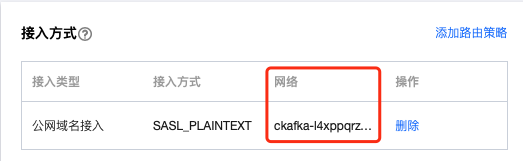 |
topic | Topic 名称,您可以在控制台上topic管理页面复制。  |
username | username 是 实例 ID + # + 配置的用户名,实例 ID 在 CKafka 控制台的实例详情页面的基本信息获取,用户名在控制台 ACL 策略管理下的用户管理页面创建用户时设置 |
password | password 是配置的用户密码,在控制台 ACL 策略管理下的用户管理页面创建用户时设置。 |
运行结果如下:
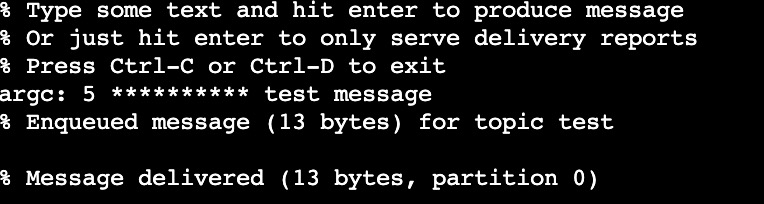
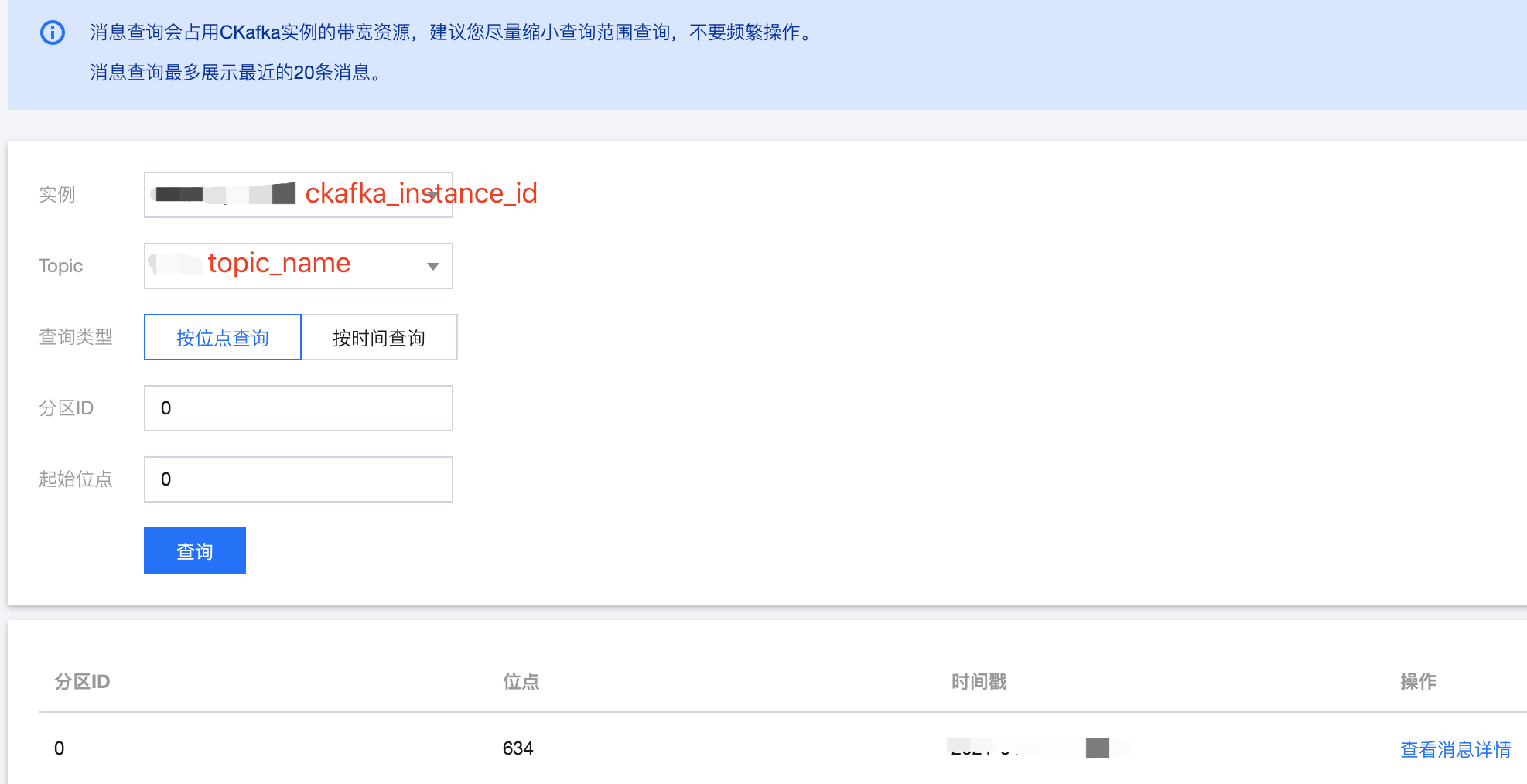
4. 在 CKafka 控制台topic 管理页面,选择对应的 Topic,单击更多 > 消息查询,查看刚刚发送的消息。
步骤4:消费消息
1. 创建 consumer.c 文件。
/** librdkafka - Apache Kafka C library** Copyright (c) 2019, Magnus Edenhill* All rights reserved.** Redistribution and use in source and binary forms, with or without* modification, are permitted provided that the following conditions are met:** 1. Redistributions of source code must retain the above copyright notice,* this list of conditions and the following disclaimer.* 2. Redistributions in binary form must reproduce the above copyright notice,* this list of conditions and the following disclaimer in the documentation* and/or other materials provided with the distribution.** THIS SOFTWARE IS PROVIDED BY THE COPYRIGHT HOLDERS AND CONTRIBUTORS "AS IS"* AND ANY EXPRESS OR IMPLIED WARRANTIES, INCLUDING, BUT NOT LIMITED TO, THE* IMPLIED WARRANTIES OF MERCHANTABILITY AND FITNESS FOR A PARTICULAR PURPOSE* ARE DISCLAIMED. IN NO EVENT SHALL THE COPYRIGHT OWNER OR CONTRIBUTORS BE* LIABLE FOR ANY DIRECT, INDIRECT, INCIDENTAL, SPECIAL, EXEMPLARY, OR* CONSEQUENTIAL DAMAGES (INCLUDING, BUT NOT LIMITED TO, PROCUREMENT OF* SUBSTITUTE GOODS OR SERVICES; LOSS OF USE, DATA, OR PROFITS; OR BUSINESS* INTERRUPTION) HOWEVER CAUSED AND ON ANY THEORY OF LIABILITY, WHETHER IN* CONTRACT, STRICT LIABILITY, OR TORT (INCLUDING NEGLIGENCE OR OTHERWISE)* ARISING IN ANY WAY OUT OF THE USE OF THIS SOFTWARE, EVEN IF ADVISED OF THE* POSSIBILITY OF SUCH DAMAGE.*//*** Simple high-level balanced Apache Kafka consumer* using the Kafka driver from librdkafka* (https://github.com/edenhill/librdkafka)*/#include <stdio.h>#include <signal.h>#include <string.h>#include <ctype.h>#include <librdkafka/rdkafka.h>static volatile sig_atomic_t run = 1;/*** @brief Signal termination of program*/static void stop (int sig) {run = 0;}/*** @returns 1 if all bytes are printable, else 0.*/static int is_printable (const char *buf, size_t size) {size_t i;for (i = 0 ; i < size ; i++)if (!isprint((int)buf[i]))return 0;return 1;}int main (int argc, char **argv) {rd_kafka_t *rk; /* Consumer instance handle */rd_kafka_conf_t *conf; /* Temporary configuration object */rd_kafka_resp_err_t err; /* librdkafka API error code */char errstr[512]; /* librdkafka API error reporting buffer */const char * user; /*Argument: sasl username*/const char * password; /*Argument: sasl password*/const char *brokers; /* Argument: broker list */const char *groupid; /* Argument: Consumer group id */char **topics; /* Argument: list of topics to subscribe to */int topic_cnt; /* Number of topics to subscribe to */rd_kafka_topic_partition_list_t *subscription; /* Subscribed topics */int i;/** Argument validation*/if (argc < 6) {fprintf(stderr,"%% Usage: ""%s <broker> <group.id> <username> <password> <topic1> <topic2>..\\n",argv[0]);return 1;}brokers = argv[1];groupid = argv[2];user = argv[3];password = argv[4];topics = &argv[5];topic_cnt = argc - 5;/** Create Kafka client configuration place-holder*/conf = rd_kafka_conf_new();/* Set bootstrap broker(s) as a comma-separated list of* host or host:port (default port 9092).* librdkafka will use the bootstrap brokers to acquire the full* set of brokers from the cluster. */if (rd_kafka_conf_set(conf, "bootstrap.servers", brokers,errstr, sizeof(errstr)) != RD_KAFKA_CONF_OK) {fprintf(stderr, "%s\\n", errstr);rd_kafka_conf_destroy(conf);return 1;}/* Set the consumer group id.* All consumers sharing the same group id will join the same* group, and the subscribed topic' partitions will be assigned* according to the partition.assignment.strategy* (consumer config property) to the consumers in the group. */if (rd_kafka_conf_set(conf, "group.id", groupid,errstr, sizeof(errstr)) != RD_KAFKA_CONF_OK) {fprintf(stderr, "%s\\n", errstr);rd_kafka_conf_destroy(conf);return 1;}/* If there is no previously committed offset for a partition* the auto.offset.reset strategy will be used to decide where* in the partition to start fetching messages.* By setting this to earliest the consumer will read all messages* in the partition if there was no previously committed offset. */if (rd_kafka_conf_set(conf, "auto.offset.reset", "earliest",errstr, sizeof(errstr)) != RD_KAFKA_CONF_OK) {fprintf(stderr, "%s\\n", errstr);rd_kafka_conf_destroy(conf);return 1;}/* Tencent Cloud recommended configuration parameters* https://cloud.tencent.com/document/product/597/30203*/if(rd_kafka_conf_set(conf,"debug","all",errstr,sizeof(errstr))!= RD_KAFKA_CONF_OK) {fprintf(stderr,"%s\\n",errstr);return 1;}if(rd_kafka_conf_set(conf,"session.timeout.ms","10000",errstr,sizeof(errstr)) != RD_KAFKA_CONF_OK) {fprintf(stderr,"%s\\n",errstr);return 1;}if(rd_kafka_conf_set(conf,"heartbeat.interval.ms","3000",errstr,sizeof(errstr)) != RD_KAFKA_CONF_OK) {fprintf(stderr,"%s\\n",errstr);return 1;}/*Set sasl config*/if(rd_kafka_conf_set(conf,"security.protocol","sasl_plaintext",errstr,sizeof(errstr)) !=RD_KAFKA_CONF_OK) {fprintf(stderr,"%s\\n",errstr);return 1;}if(rd_kafka_conf_set(conf, "sasl.mechanism", "PLAIN", errstr, sizeof(errstr)) != RD_KAFKA_CONF_OK) {fprintf(stderr,"%s\\n",errstr);return 1;}if(rd_kafka_conf_set(conf,"sasl.username",user,errstr,sizeof(errstr)) !=RD_KAFKA_CONF_OK) {fprintf(stderr,"%s\\n",errstr);return 1;}if(rd_kafka_conf_set(conf,"sasl.password",password,errstr,sizeof(errstr)) !=RD_KAFKA_CONF_OK) {fprintf(stderr,"%s\\n",errstr);return 1;}/** Create consumer instance.** NOTE: rd_kafka_new() takes ownership of the conf object* and the application must not reference it again after* this call.*/rk = rd_kafka_new(RD_KAFKA_CONSUMER, conf, errstr, sizeof(errstr));if (!rk) {fprintf(stderr,"%% Failed to create new consumer: %s\\n", errstr);return 1;}conf = NULL; /* Configuration object is now owned, and freed,* by the rd_kafka_t instance. *//* Redirect all messages from per-partition queues to* the main queue so that messages can be consumed with one* call from all assigned partitions.** The alternative is to poll the main queue (for events)* and each partition queue separately, which requires setting* up a rebalance callback and keeping track of the assignment:* but that is more complex and typically not recommended. */rd_kafka_poll_set_consumer(rk);/* Convert the list of topics to a format suitable for librdkafka */subscription = rd_kafka_topic_partition_list_new(topic_cnt);for (i = 0 ; i < topic_cnt ; i++)rd_kafka_topic_partition_list_add(subscription,topics[i],/* the partition is ignored* by subscribe() */RD_KAFKA_PARTITION_UA);/* Subscribe to the list of topics */err = rd_kafka_subscribe(rk, subscription);if (err) {fprintf(stderr,"%% Failed to subscribe to %d topics: %s\\n",subscription->cnt, rd_kafka_err2str(err));rd_kafka_topic_partition_list_destroy(subscription);rd_kafka_destroy(rk);return 1;}fprintf(stderr,"%% Subscribed to %d topic(s), ""waiting for rebalance and messages...\\n",subscription->cnt);rd_kafka_topic_partition_list_destroy(subscription);/* Signal handler for clean shutdown */signal(SIGINT, stop);/* Subscribing to topics will trigger a group rebalance* which may take some time to finish, but there is no need* for the application to handle this idle period in a special way* since a rebalance may happen at any time.* Start polling for messages. */while (run) {rd_kafka_message_t *rkm;rkm = rd_kafka_consumer_poll(rk, 100);if (!rkm)continue; /* Timeout: no message within 100ms,* try again. This short timeout allows* checking for `run` at frequent intervals.*//* consumer_poll() will return either a proper message* or a consumer error (rkm->err is set). */if (rkm->err) {/* Consumer errors are generally to be considered* informational as the consumer will automatically* try to recover from all types of errors. */fprintf(stderr,"%% Consumer error: %s\\n",rd_kafka_message_errstr(rkm));rd_kafka_message_destroy(rkm);continue;}/* Proper message. */printf("Message on %s [%"PRId32"] at offset %"PRId64":\\n",rd_kafka_topic_name(rkm->rkt), rkm->partition,rkm->offset);/* Print the message key. */if (rkm->key && is_printable(rkm->key, rkm->key_len))printf(" Key: %.*s\\n",(int)rkm->key_len, (const char *)rkm->key);else if (rkm->key)printf(" Key: (%d bytes)\\n", (int)rkm->key_len);/* Print the message value/payload. */if (rkm->payload && is_printable(rkm->payload, rkm->len))printf(" Value: %.*s\\n",(int)rkm->len, (const char *)rkm->payload);else if (rkm->payload)printf(" Value: (%d bytes)\\n", (int)rkm->len);rd_kafka_message_destroy(rkm);}/* Close the consumer: commit final offsets and leave the group. */fprintf(stderr, "%% Closing consumer\\n");rd_kafka_consumer_close(rk);/* Destroy the consumer */rd_kafka_destroy(rk);return 0;}
2. 执行以下命令编译 consumer.c。
gcc -lrdkafka ./consumer.c -o consumer
3. 执行以下命令发送消息。
./consumer <broker> <group.id> <username> <password> <topic1> <topic2>..
参数 | 描述 |
broker | 接入网络,在控制台的实例详情页面接入方式模块的网络列复制。 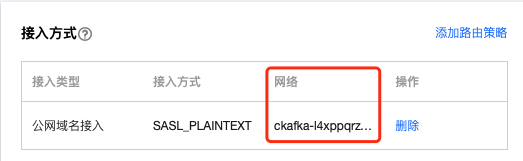 |
group.id | 消费分组名称,您可以自定义设置,Demo 运行成功后可以在 Consumer Group 页面看到该消费者。 |
username | username 是 实例 ID + # + 配置的用户名,实例 ID 在 CKafka 控制台的实例详情页面的基本信息获取,用户名在控制台 ACL 策略管理下的用户管理页面创建用户时设置 |
password | password 是配置的用户密码,在控制台 ACL 策略管理下的用户管理页面创建用户时设置。 |
topic1 topic2.. | Topic 名称,您可以在控制台上topic管理页面复制。  |
运行结果如下:

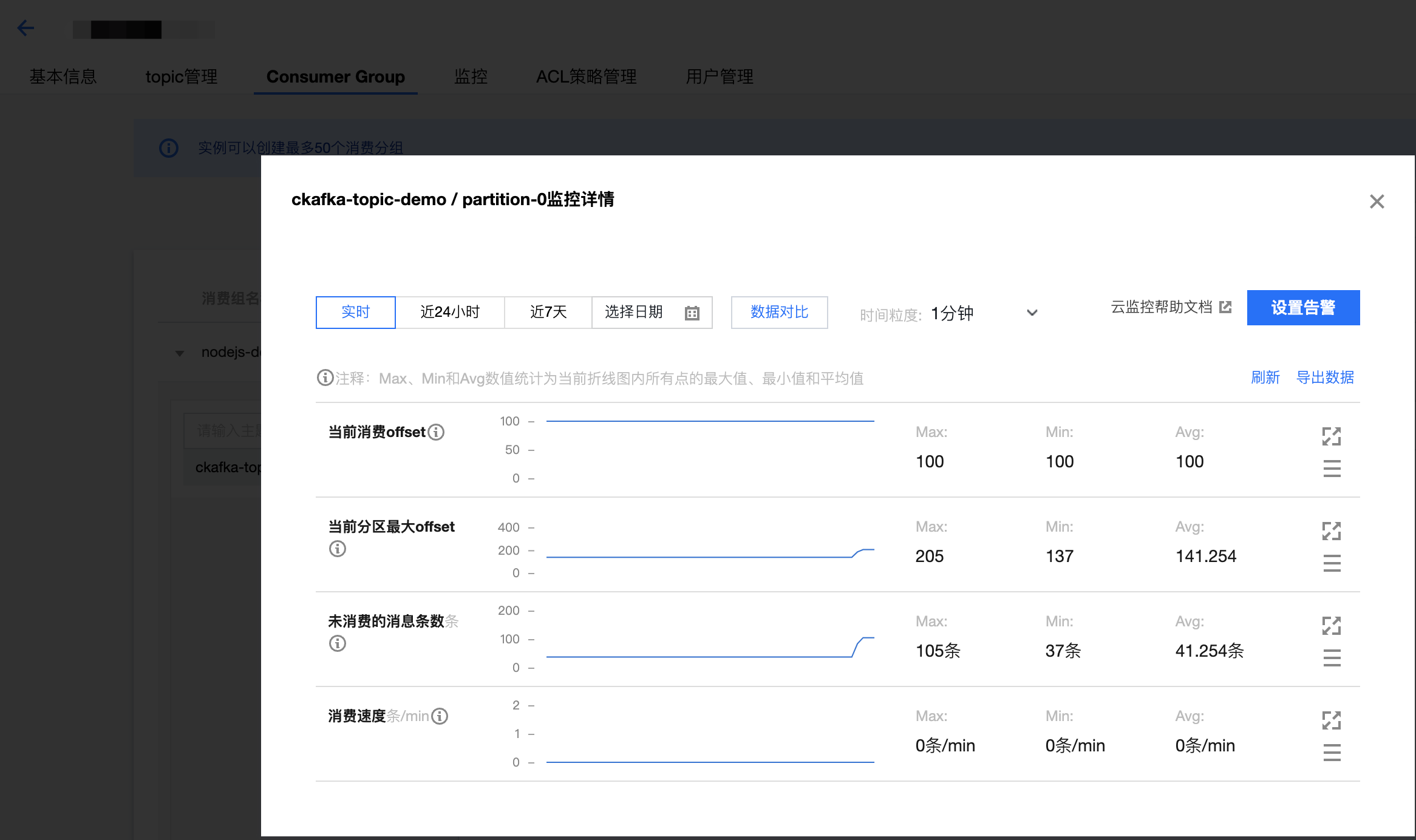
4. 在 CKafka 控制台的 Consumer Group 页面,选择对应的消费者组名称,在主题名称输入 Topic ,单击查询详情查看消费详情。