The content of this page has been automatically translated by AI. If you encounter any problems while reading, you can view the corresponding content in Chinese.

Configuring Alarm

Last updated: 2024-10-15 17:32:44

Overview

You can create alarm policies to trigger alarms and send relevant messages when the status of cloud products changes. The created alarms determine whether to trigger notifications based on the monitoring metrics compared to the given threshold at intervals. When the status change triggers an alarm, you can take appropriate preventive or remedial measures in time. Therefore, properly creating alarm policies can help you enhance the robustness and reliability of manufacturing process control systems. For more information on alarms, see TCOP's alarm configurations.
To send an alarm for a specific status of a product, you need to create an alarm policy at first. An alarm policy is composed of three compulsory components, that is, the name, type and alarm triggering conditions. Each alarm policy is a set of alarm triggering conditions with the logical relationship "or", that is, as long as one of the conditions is met, an alarm will be triggered. The alarm will be sent to all users associated with the alarm policy. Upon receiving the alarm, the user can view the alarm and take appropriate actions in time.
Note
Make sure that you have set the default alarm recipient; otherwise, the default alarm policy of TencentDB won't be able to send notifications.

Directions

Creating Alarm Policy

1. log in to the TCOP Console, and select alarm configurations > alarm policies from the left navigation.
2. In the alarm policy list, click Create.
3. Set the policy name, policy type, target product, alarm object, and trigger condition.
Policy Type: select CDB | TDSQL.
Alarm Object: select all objects or specified tables. The object to be associated with can be found by selecting the region where the object is located or searching for the ID of the object.
Trigger Condition: an alarm trigger is a semantic condition consisting of metric, comparison relationship, threshold, statistical period, and duration.
Supported alarm channels include SMS, email, and WeChat notifications.
4. After confirming everything is correct, click Complete.

Associated Object

After the alarm policy is created, you can associate alarm objects with it. When an alarm object satisfies an alarm trigger condition, an alarm notification will be sent.
1. In the alarm policy list, click the name of an alarm policy to enter the alarm policy management page.
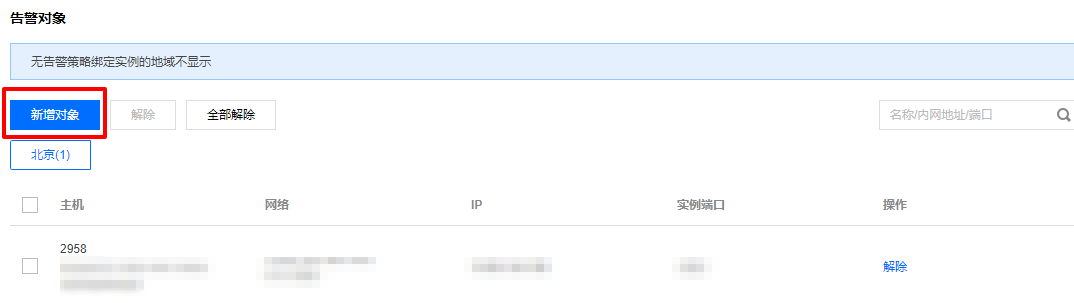
2. In the alarm policy management page, click Add Object.

3. Select the cloud products to associate, click Apply to link the alarm objects.

Setting alarm recipient

Alarm recipients are those who will receive alarm messages.
1. In the alarm policy list, click the name of an alarm policy.
2. In the alarm policy management page, in the Alarm Recipients column, click Edit.
3. Select the user group to be notified, set the relevant information, and click Save to complete the alarm recipient settings.