【2023】选择题刷题程序python实现


一. 从CSV文件中加载题目(load_questions)
1. 代码
def load_questions(file_path):
    questions = []

    with open(file_path, 'r', encoding='utf-8') as file:
        reader = csv.reader(file)
        next(reader)  # 跳过表头

        for row in reader:
            question = {
                'topic': row[0],
                'content': row[1],
                'options': row[2:6],
                'answer': row[6]
            }
            questions.append(question)

    return questions
2. 功能
从题目文件中加载题目列表,使用csv模块读取CSV文件,并将每一行的数据转化为题目字典。题目字典包括题目的标题、内容、选项和答案,并将所有题目字典存储在一个列表中。
3. 解析
-
load_questions函数接受一个文件路径作为参数,并返回一个题目列表。 - 使用
open函数打开文件,并使用csv.reader函数将文件转换为一个可迭代的Reader对象。 - 使用
next(reader)跳过表头,即读取文件中的第一行数据,通常是标题行。 - 遍历
reader对象,对于每一行数据,将题目的各个字段存储在一个字典中,并将该字典添加到题目列表中。 - 返回题目列表。
对于每一行数据,通过索引方法row[x]来获取相应的字段,将这些字段存储在一个字典中,然后将字典添加到题目列表中。
在这里,CSV文件的结构如下:
通过使用CSV模块的reader函数,我们可以方便地处理CSV文件,并将每一行数据转换为一个列表。然后可以使用列表的索引来获取特定的字段值。在这种情况下,题目的内容、选项和答案分别位于索引1到6的位置,因此可以通过切片操作将这些字段提取出来。最后,将提取出的字段分别存储在一个字典中,并将该字典添加到题目列表中。
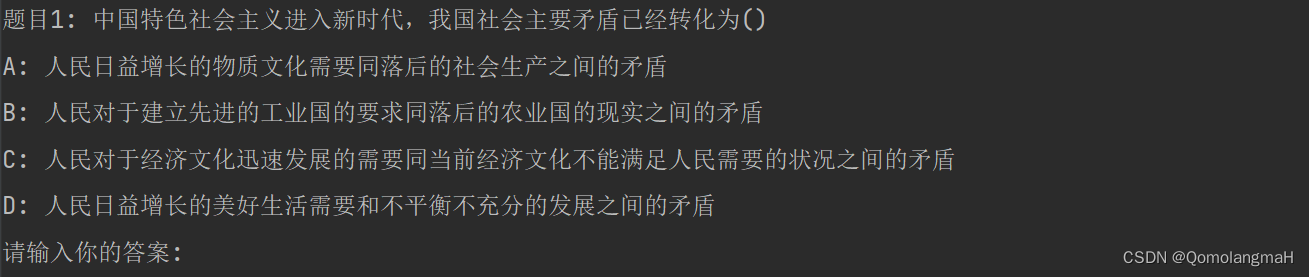
二、在控制台上显示题目和选项(display_question)
1. 代码
def display_question(question_number, question):
    print(f'题目{question_number}: {question["content"]}')
    for i, option in enumerate(question['options']):
        print('{}: {}'.format(chr(ord('A') + i), option))
2. 功能
显示题目的内容,包括题目标题、选项和题号。通过循环遍历选项列表,并使用enumerate函数来获取选项的索引和选项内容,按照题号和选项的格式进行打印。
3. 解析
- 接收题目编号
question_number和题目信息字典question作为参数。 - 使用
print函数打印题目编号和题目内容,格式为题目{question_number}: {question["content"]}。 - 使用
enumerate函数遍历题目的选项列表question['options']。enumerate函数返回一个迭代器,该迭代器会在每次迭代时返回一个包含索引和元素的元组。 - 使用
chr(ord('A') + i)来生成选项的字母标识,ord('A')表示字母'A'的ASCII码,ord('A') + i表示字母依次递增。 - 使用
print函数打印选项的字母标识和选项内容,格式为字母标识: 选项内容。
三、检查答案是否正确(check_answer)
1. 代码
def check_answer(question, user_answer):
    correct_answer = question['answer']
    return user_answer.upper() == correct_answer.upper()
2. 功能
判断用户的答案是否正确,并给与相应的反馈。
3. 解析
- 接收题目信息字典
question和用户答案user_answer作为参数。 - 从题目信息字典
question中获取正确答案correct_answer。 - 使用
user_answer.upper()和correct_answer.upper()将用户答案和正确答案转换为大写字母。 - 比较转换后的用户答案
user_answer.upper()和正确答案correct_answer.upper()是否相等。 - 返回比较结果的布尔值,表示用户的答案是否正确。
四、刷题程序主函数
1. 代码
def main():
    file_path = '单选题.csv'
    questions = load_questions(file_path)

    print('欢迎使用毛概刷题程序!')
    print('请阅读题目并输入你的答案(A、B、C或D)')

    correct_answers = 0

    for i, question in enumerate(questions, 1):
        display_question(i, question)
        user_answer = input('请输入你的答案: ')
        if check_answer(question, user_answer):
            print('回答正确!')
            correct_answers += 1
        else:
            correct_answer = question['answer']
            print(f'回答错误!正确答案是: {correct_answer}')
            file_path = '单选_1.csv'
            with open(file_path, 'a', encoding='utf-8', newline='') as file:
                writer = csv.writer(file)
                writer.writerow([question['topic'], question['content'], question['options'][1], question['options'][0],
                                 question['options'][2], question['options'][3], question['answer']])

    print(f'你答对了 {correct_answers} 道题目。')
2. 功能
先加载题目并打印欢迎信息,之后循环显示题目、接受用户答案、判断答案、给出反馈……
3. 解析
- 定义了一个文件路径
file_path,指定了题目文件的位置。 - 调用
load_questions函数从指定的文件路径中加载题目信息,将加载的题目存储在questions列表中。 - 使用
print函数打印欢迎信息和提示用户输入答案的说明。 - 定义了一个变量
correct_answers,用于记录用户回答正确的题目数量,初始值为0。 - 使用
enumerate函数遍历题目列表questions,同时获取题目的索引i和题目信息字典question。 - 使用
display_question函数打印题目和选项。 - 使用
input函数等待用户输入答案,并将用户输入的答案存储在变量user_answer中。 - 使用
check_answer函数检查用户的答案是否正确。 - 如果用户的答案正确,使用
print函数打印回答正确的提示信息,并将correct_answers加1。 - 如果用户的答案错误,使用
print函数打印回答错误的提示信息,以及正确答案。 - 将题目信息写入到名为
单选_1.csv的文件中,以便后续参考。 - 最后,使用
print函数打印用户答对的题目数量。
本文参与 腾讯云自媒体同步曝光计划,分享自作者个人站点/博客。
原始发表:2023-08-17,如有侵权请联系 cloudcommunity@tencent.com 删除
目录
腾讯云开发者

Copyright © 2013 - 2026 Tencent Cloud. All Rights Reserved. 腾讯云 版权所有
深圳市腾讯计算机系统有限公司 ICP备案/许可证号:粤B2-20090059  粤公网安备44030502008569号
腾讯云计算(北京)有限责任公司 京ICP证150476号 | 京ICP备11018762号