【项目日志|苍穹外卖】Day4:异常处理与SQL操作

【项目日志|苍穹外卖】Day4:异常处理与SQL操作

超级苦力怕
发布于 2025-12-24 08:47:42
发布于 2025-12-24 08:47:42
本文记录了苍穹外卖项目第四天的学习内容,重点介绍了项目异常处理机制以及MyBatis的精细化SQL控制技术。

完成任务清单
- 新增套餐接口
- 套餐分页查询接口
- 删除套餐接口
- 修改套餐接口
- 起售停售套餐功能
主要功能展示
在今日的学习中,主要是更加熟悉crud,同时需求分析的能力相较于之前有了很大的提升。在进行编写的过程中,我对项目的一些相关知识点更加了解,如异常处理机制,同时整理了MyBatis XML相关操作。
1. 异常处理机制
作为涵盖了项目的机制,我主要学习了异常体系架构与具体业务异常类。
异常体系架构
异常体系架构分为基础异常类与具体业务异常类。
基础异常类
基础异常类由BaseException组成,因为只有该异常作为基础异常类,因此便于全局异常处理器统一管理。
public class BaseException extends RuntimeException {
    public BaseException() {}
    public BaseException(String msg) {
        super(msg);
    }
}
具体业务异常类
具体业务异常类多以具体业务命名,且每个异常类只处理特定类型错误,因此有着异常分类明确、语义化命名、单一职责的特征。
// 登录相关异常
public class LoginFailedException extends BaseException {
    public LoginFailedException(String msg) {
        super(msg);
    }
}

// 业务操作异常
public class DeletionNotAllowedException extends BaseException {
    public DeletionNotAllowedException(String msg) {
        super(msg);
    }
}
异常信息传递
这里了解了正常传递流程、全局异常处理器、异常管理几个方面。
正常传递流程 在参数验证异常以及业务操作异常时,我们将抛出具体异常。
throw new AccountNotFoundException(MessageConstant.ACCOUNT_NOT_FOUND);此时调用该异常内的有参构造函数,进行层层传递
AccountNotFoundException(String msg)
    ↓ 调用super(msg)
BaseException(String msg)
    ↓ 调用super(msg)
RuntimeException(String message)
    ↓ 调用super(message)
Exception(String message)
    ↓ 调用super(message)
Throwable(String message)
全局异常处理器
全局异常处理器不仅可以处理指定的异常类型,还可以处理其他未被单独捕获的异常。
全局异常处理器通过@RestControllerAdivce扫描文件,@ExceptionHandler指定异常类型,同时将异常都转为Result对象返回,并记录异常信息,便于问题排查。
@RestControllerAdvice
@Slf4j
public class GlobalExceptionHandler {

    /**
     * 捕获业务异常
     */
    @ExceptionHandler
    public Result exceptionHandler(BaseException ex){
        log.error("异常信息:{}", ex.getMessage());
        return Result.error(ex.getMessage());
    }

    /**
     * 捕获数据库约束异常
     */
    @ExceptionHandler
    public Result exceptionHandler(SQLIntegrityConstraintViolationException ex){
        log.info("错误信息:{}",ex.getMessage());
        String message = ex.getMessage();
        if (message.contains("Duplicate entry")){
            String[] split = message.split(" ");
            String username = split[2];
            String msg = username + MessageConstant.ALREADY_EXISTS;
            return Result.error(msg);
        }else{
            return Result.error(MessageConstant.UNKNOWN_ERROR);
        }
    }
}

@ExceptionHandler(Exception.class)
public Result handleException(Exception ex) {
    // 处理所有未被其他@ExceptionHandler捕获的异常
}
异常管理
在发生问题时,我们采用调用异常处理,有着可读性强、便于统一管理、便于复用的优点。
// 使用异常处理
if (employee == null) {
    throw new AccountNotFoundException(MessageConstant.ACCOUNT_NOT_FOUND);
}

// 不使用异常处理(传统方式)
if (employee == null) {
    return Result.error(MessageConstant.ACCOUNT_NOT_FOUND);
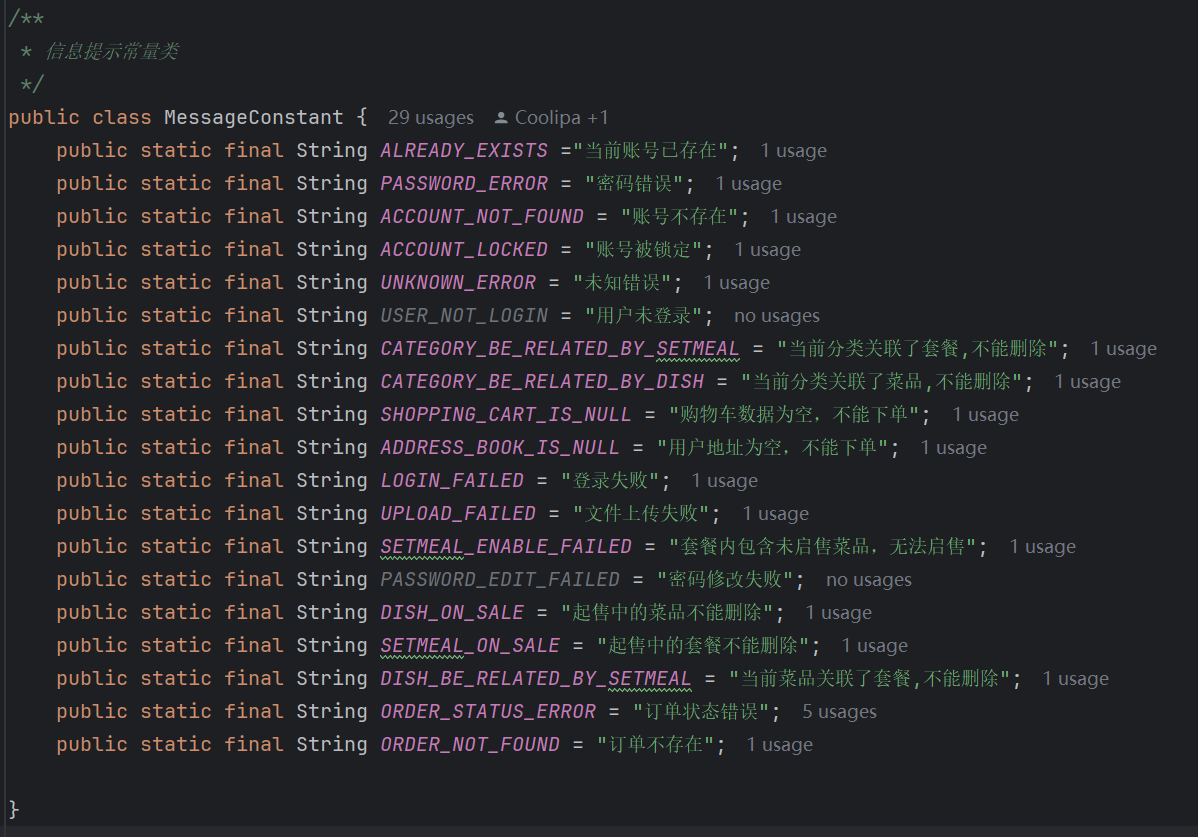
}同时,我们采用常量类存储异常,有着便于管理,可维护性强,灵活性高的优点
在这里插入图片描述
2. MyBatis XML相关操作
批量插入操作
这里主要介绍foreach标签功能
collection:指定要遍历的集合 item:当前遍历的元素别名 separator:元素间的分隔符 open/close:开始和结束符号
<insert id="insertBatch" parameterType="list">
    insert into setmeal_dish
    (setmeal_id,dish_id,name,price,copies)
    values
    <foreach collection="setmealDishes" item="sd" separator=",">
        (#{sd.setmealId},#{sd.dishId},#{sd.name},#{sd.price},#{sd.copies})
    </foreach>
</insert>
动态SQL查询
where标签动态条件
where标签:自动处理AND关键字 if标签:条件判断 test属性:判断条件表达式
<select id="page" resultType="com.sky.entity.Setmeal">
    select * from setmeal
    <where>
        <if test="name != null and name !=''">
            AND name like concat('%',#{name},'%')
        </if>
    </where>
    order by create_time desc
</select>
set标签动态更新
set标签:自动处理逗号(专门用于 UPDATE 语句中的 SET 部分)
<update id="update" parameterType="SetMeal">
    update setmeal
    <set>
        <if test="name != null">
            name = #{name},
        </if>
        <if test="categoryId != null">
            category_id = #{categoryId},
        </if>
        <if test="price != null">
            price = #{price},
        </if>
        <if test="status != null">
            status = #{status},
        </if>
        <if test="description != null">
            description = #{description},
        </if>
        <if test="image != null">
            image = #{image},
        </if>
        <if test="updateTime != null">
            update_time = #{updateTime},
        </if>
        <if test="updateUser != null">
            update_user = #{updateUser}
        </if>
    </set>
    where id = #{id}
</update>
参数绑定与结果映射
#{}:预编译参数,防止SQL注入 useGeneratedKeys:获取自增主键 keyProperty:指定主键属性名
参数绑定
<!-- 基本参数绑定 -->
<select id="getById" resultType="com.sky.vo.SetmealVO">
    select * from setmeal where id=#{id}
</select>

<!-- 对象参数绑定 -->
<insert id="insert" useGeneratedKeys="true" keyProperty="id">
    insert into setmeal(category_id,name,price,status,description,image)
    values(#{categoryId},#{name},#{price},#{status},#{description},#{image})
</insert>
结果映射
<!-- 基本结果映射 -->
<select id="list" resultType="Setmeal">
    select * from setmeal
</select>

<!-- 复杂结果映射 -->
<select id="page" resultType="com.sky.vo.DishVO">
    select d.* , c.name as categoryName
    from dish d left outer join category c on d.category_id = c.id
</select>本文为苍穹外卖项目学习笔记,持续更新中…
如果我的内容对你有帮助,希望可以收获你的点赞、评论、收藏。
本文参与 腾讯云自媒体同步曝光计划,分享自作者个人站点/博客。
原始发表:2025-08-06,如有侵权请联系 cloudcommunity@tencent.com 删除
评论
登录后参与评论
推荐阅读
目录
腾讯云开发者

Copyright © 2013 - 2026 Tencent Cloud. All Rights Reserved. 腾讯云 版权所有
深圳市腾讯计算机系统有限公司 ICP备案/许可证号:粤B2-20090059  粤公网安备44030502008569号
腾讯云计算(北京)有限责任公司 京ICP证150476号 | 京ICP备11018762号