
如何使用Python将嵌套的Hive查询模式转换为Bigquery模式?
如何使用Python将嵌套的Hive查询模式转换为Bigquery模式?
提问于 2022-02-04 05:44:10
问题面前的快速注释:在从on实例迁移到BigQuery期间,我们需要将许多Hive转换为BigQuery模式。对于非嵌套模式转换,我问了类似的问题,@Anjela善意地回答了这个非常有用的问题。但是还有另一种将嵌套的结构类型模式转换为BigQuery模式的用例,如下所示
示例蜂巢模式:
样本=
"reports array<struct<orderlineid:string,ordernumber:string,price:struct<currencycode:string,value:double>,quantity:int,serialnumbers:array<string>,sku:string>>"必需的BigQuery模式:
bigquery.SchemaField("reports", "RECORD", mode="REPEATED",
        fields=(
             bigquery.SchemaField('orderline', 'STRING'),
             bigquery.SchemaField('ordernumber', 'STRING'),
             bigquery.SchemaField('price', 'RECORD'),
                 fields=(
                     bigquery.SchemaField('currencyCode', 'STRING'),
                     bigquery.SchemaField('value', 'FLOAT')
               )
             bigquery.SchemaField('quantity', 'INTEGER'),
             bigquery.SchemaField('serialnumbers', 'STRING', mode=REPEATED),
             bigquery.SchemaField('sku', 'STRING'),
               )
     )
我们从前面的问题中得到了什么,这对于将非嵌套模式转换为bigquery非常有用:
import re

from google.cloud import bigquery


def is_even(number):
    if (number % 2) == 0:
        return True
    else:
        return False

def clean_string(str_value):
    return re.sub(r'[\W_]+', '', str_value)

def convert_to_bqdict(api_string):
    """
    This only works for a struct with multiple fields
    This could give you an idea on constructing a schema dict for BigQuery
    """
    num_even = True
    main_dict = {}
    struct_dict = {}
    field_arr = []
    schema_arr = []

# Hard coded this since not sure what the string will look like if there are more inputs
init_struct = sample.split(' ')
main_dict["name"] = init_struct[0]
main_dict["type"] = "RECORD"
main_dict["mode"] = "NULLABLE"

cont_struct = init_struct[1].split('<')
num_elem = len(cont_struct)

# parse fields inside of struct<
for i in range(0,num_elem):
    num_even = is_even(i)
    # fields are seen on even indices
    if num_even and i != 0:
        temp = list(filter(None,cont_struct[i].split(','))) # remove blank elements
        for elem in temp:
            fields = list(filter(None,elem.split(':')))

            struct_dict["name"] = clean_string(fields[0])
            # "type" works for STRING as of the moment refer to
            # https://cloud.google.com/bigquery/docs/schemas#standard_sql_data_types
            # for the accepted data types
            struct_dict["type"] = clean_string(fields[1]).upper()
            struct_dict["mode"] = "NULLABLE"

            field_arr.append(struct_dict)
            struct_dict = {}

main_dict["fields"] = field_arr # assign dict to array of fields
schema_arr.append(main_dict)

return schema_arr

sample = "reports array<struct<imageUrl:string,reportedBy:string,newfield:bool>>"

bq_dict = convert_to_bqdict(sample)

client = bigquery.Client()
project = client.project
dataset_ref = bigquery.DatasetReference(project, '20211228')
table_ref = dataset_ref.table("20220203")
table = bigquery.Table(table_ref, schema=bq_dict)
table = client.create_table(table) @Anjela中的脚本正在将未嵌套的查询从单元模式转换为bigquery,如下所示:
"name":"reports"
"col_type":"array<struct<imageUrl:string,reportedBy:string>>"
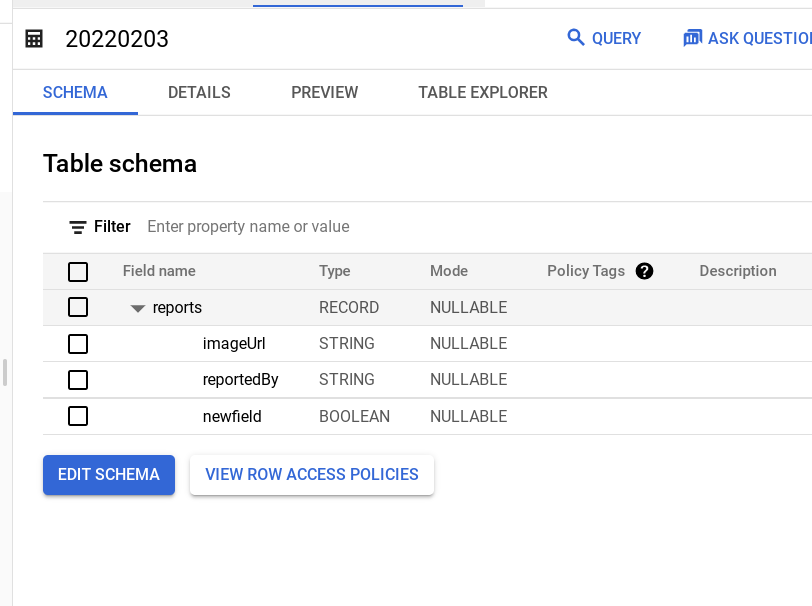
如有任何帮助/建议,将不胜感激。
Stack Overflow用户
回答已采纳
发布于 2022-02-05 13:24:37
以下是解决办法:
    def getSchema2(self):
    try:
        getJsonUrl = requests.get(self.urlAddress)
    except requests.exceptions.Timeout:
        time.sleep(300)
        try:
            getJsonUrl = requests.get(self.urlAddress)
        except requests.exceptions.Timeout as e:
            logger.error("Communication error: {}".format(e))
            raise SystemExit(e)
    except requests.exceptions.TooManyRedirects:
        logger.info("URL is not correct check your variables")
    except requests.exceptions.RequestException as e:
        logger.info("Communication error: {}".format(e))
        raise SystemExit(e)
    print(getJsonUrl.json()["tableData"]["columns"])

    main_dict = {}
    struct_dict = {}
    subfield_struct_dict = {}
    field_arr = []
    subfield_arr = []
    schema_arr = []

    partition = None
    for i in range(len(getJsonUrl.json()["tableData"]["columns"])):
        if len(getJsonUrl.json()["tableData"]["columns"][i]["badges"]) > 0:
            partition = True
            col_name = getJsonUrl.json()["tableData"]["columns"][i]["name"]
            col_type = 'partition'
            main_dict["name"] = col_name
            main_dict["mode"] = "NULLABLE"
            main_dict["type"] = col_type
        else:
            col_name = getJsonUrl.json()["tableData"]["columns"][i]["name"]
            col_type = getJsonUrl.json()["tableData"]["columns"][i]["col_type"]
            if 'map' in col_type:
                col_type = 'string'
                main_dict["name"] = col_name
                main_dict["type"] = col_type
            elif 'bigint' == col_type:
                col_type = 'integer'
                main_dict["name"] = col_name
                main_dict["type"] = col_type
            elif 'int' == col_type:
                col_type = 'integer'
                main_dict["name"] = col_name
                main_dict["type"] = col_type
            elif 'double' == col_type:
                col_type = 'float'
                main_dict["name"] = col_name
                main_dict["type"] = col_type
            elif 'array<string>' == col_type:
                col_type = 'string'
                main_dict["name"] = col_name
                main_dict["type"] = col_type
                main_dict["mode"] = 'REPEATED'
            elif ('array<struct' in col_type or 'struct<' in col_type):
                main_dict["name"] = col_name
                main_dict["type"] = 'RECORD'
                if 'array<struct' in col_type:
                    main_dict["mode"] = 'REPEATED'
                else:
                    main_dict["mode"] = 'NULLABLE'
                raw_value = extractField(col_type)
                for i in raw_value:
                    if 'struct' not in i:
                        field_col_name = i.split(":")[0]
                        field_col_type = i.split(":")[1]
                        field_mode = 'NULLABLE'
                        struct_dict["name"] = field_col_name
                        struct_dict["type"] = field_col_type
                        struct_dict["mode"] = field_mode
                        field_arr.append(struct_dict)
                        struct_dict = {}
                    else:
                        subfield_col_name = i.split(":")[0]
                        subfield_col_tpye = "RECORD"
                        subfield_col_mode = 'NULLABLE'
                        struct_dict["name"] = subfield_col_name
                        struct_dict["type"] = subfield_col_tpye
                        struct_dict["mode"] = subfield_col_mode
                        raw_subfield_types = i.split("struct")[1].split(",")
                        for i in raw_subfield_types:
                            raw_subfield_name = cleanString(i.split(":")[0])
                            raw_subfield_type = cleanString(i.split(":")[1])
                            raw_subfield_mode = "NULLABLE"
                            subfield_struct_dict["name"] = raw_subfield_name
                            subfield_struct_dict["type"] = raw_subfield_type
                            subfield_struct_dict["mode"] = raw_subfield_mode
                            subfield_arr.append(subfield_struct_dict)
                        struct_dict["fields"] = subfield_arr
                        field_arr.append(struct_dict)
                        struct_dict = {}

                main_dict["fields"] = field_arr
                schema_arr.append(main_dict)
                main_dict = {}

            else:
                main_dict["name"] = col_name
                main_dict["type"] = col_type
                main_dict["mode"] = "NULLABLE"
                schema_arr.append(main_dict)
                main_dict = {}

    if len(main_dict) != 0:
        schema_arr.append(main_dict)

    logger.info("Schema definition succesfully extracted from Amundsen")
    return schema_arr, partition
代码解释:
第一部分( First part,Request.get):该部分仅用于提取问题中给出的示例字符串。
第二部分:第二部分,灵感来自@Anjela .,他解决了这个问题的未嵌套类型。我只是为嵌套字段多添加了一个字典和数组结构,每次我们检查字段是否包含嵌套结构。
第三部分:看到我们使用extractField函数来解析嵌套结构,然后我们可以使用简单的拆分函数来获得子字段的col_names、col_types。
from itertools import accumulate
import re

def extractField(S):
    levels = accumulate((c == "<") - (n == ">") for c, n in zip(' ' + S, S + ' '))
    delim = "".join([c, "\n"][c == "," and lv == 2] for c, lv in zip(S, levels) if lv >= 2)
    fields = delim.split("\n")
    return fields

def cleanString(str_value):
    return re.sub(r'[\W_]+','', str_value)
最后,这里还有生成bigquery的功能:
def generate2(self):
    client = bigquery.Client()

    dataset = bigquery.Dataset(self.database)
    dataset.location = "EU"
    dataset = client.create_dataset(dataset, timeout=30, exists_ok=True)
    query = bigquery.Table(self.database + "." + self.table, schema=self.schema)
    query = client.create_table(query, exists_ok=True)
    logger.info("Schema created under google cloud project id as: {}".format(self.database))
    logger.info("Bigquery schema generated succesfully.")
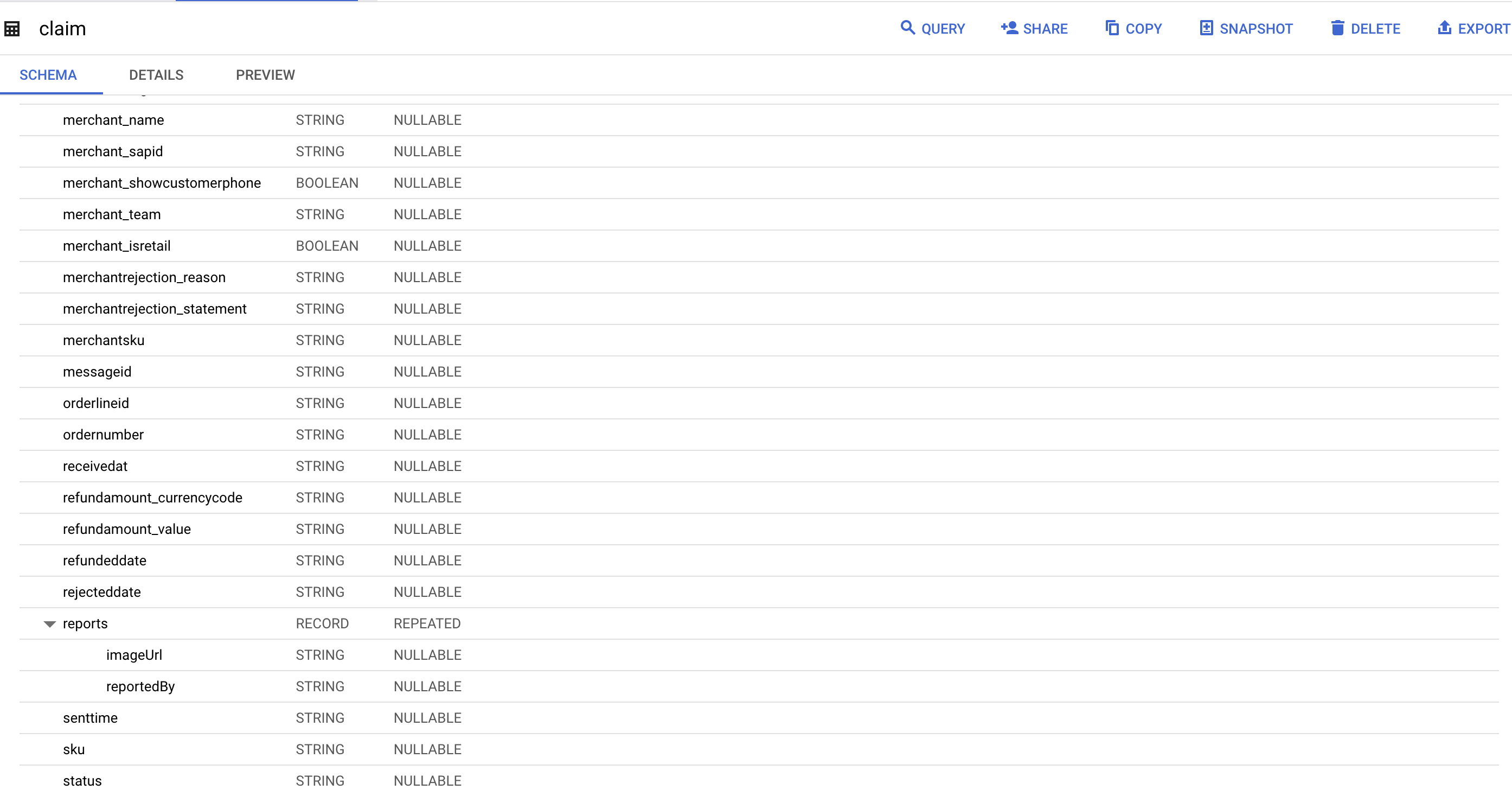
结果:
页面原文内容由Stack Overflow提供。腾讯云小微IT领域专用引擎提供翻译支持
原文链接:
https://stackoverflow.com/questions/70981937
复制相关文章
相似问题
腾讯云开发者

Copyright © 2013 - 2026 Tencent Cloud. All Rights Reserved. 腾讯云 版权所有
深圳市腾讯计算机系统有限公司 ICP备案/许可证号:粤B2-20090059  粤公网安备44030502008569号
腾讯云计算(北京)有限责任公司 京ICP证150476号 | 京ICP备11018762号