
如何拟合考虑不确定性的指数衰减曲线?
如何拟合考虑不确定性的指数衰减曲线?
提问于 2021-02-11 12:22:47
我有一些放射性衰变数据,x和y都有不确定性。图本身都很好,但我需要绘制指数衰变曲线并返回拟合的报告,以求半衰期,并将chi^2化简。
图的代码是:
 fig, ax = plt.subplots(figsize=(14, 8))
    ax.errorbar(ts, amps, xerr=2, yerr=sqrt(amps), fmt="ko-", capsize = 5, capthick= 2, elinewidth=3, markersize=5)
    plt.xlabel('Time  /s', fontsize=14)
    plt.ylabel('Counts Recorded in the Previous 15 seconds', fontsize=16)
    plt.title("Decay curve of P-31 by $β^+$ emission", fontsize=16)
我使用的模型(诚然,我对这里的编程不太自信)是:
def expdecay(x, t, A):
     return A*exp(-x/t)

    decayresult = emodel.fit(amps, x=ts, t=150, A=140)
    ax.plot(ts, decayresult.best_fit, 'r-', label='best fit')

    print(decayresult.fit_report())
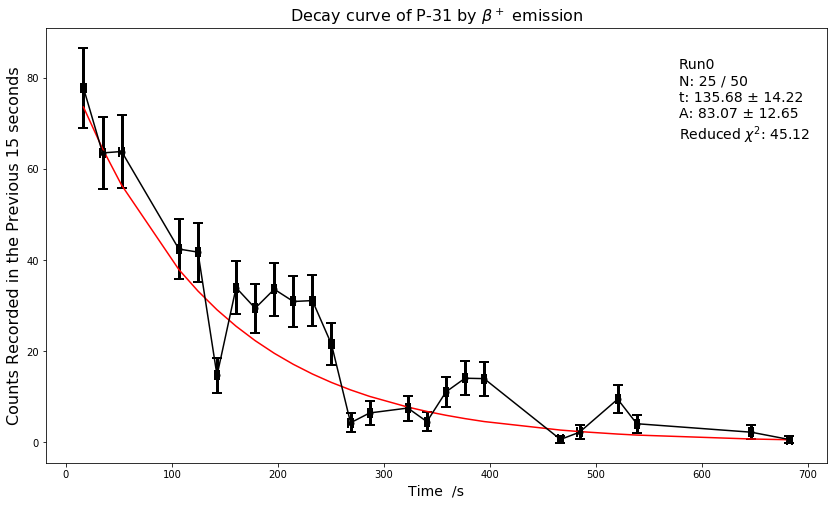
但我认为这并没有考虑到不确定性,只是在图表上绘制了它们。我希望它拟合指数衰减曲线,考虑了不确定因素,返回半衰期(在这种情况下t),并用它们各自的不确定性来降低chi^2。
以下面的图片为目标,但考虑到拟合过程中的不确定性:
使用weight=1/sqrt(amps)建议和完整的数据集,我得到:
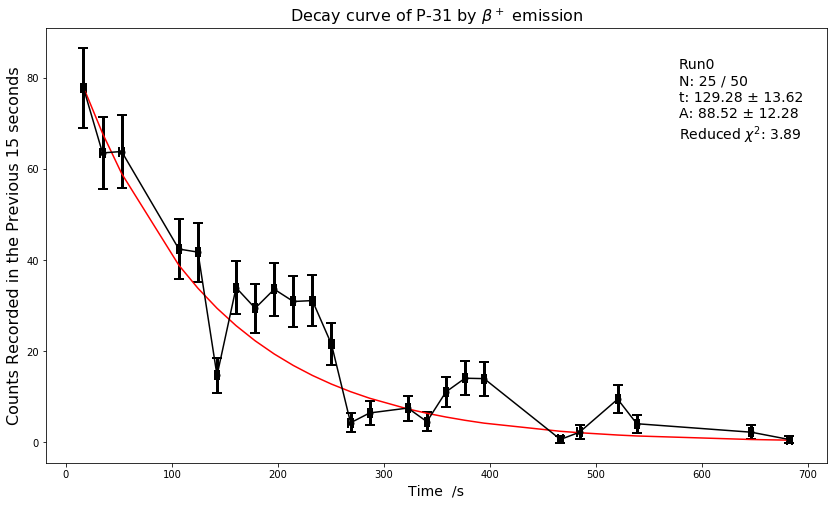
我想,这是从这些数据中得到的最佳拟合值(将chi^s降为3.89)。我希望它能给我t=150s,但是嘿,那个正在做实验。谢谢大家的帮助。
回答 1
Stack Overflow用户
回答已采纳
发布于 2021-02-11 16:28:08
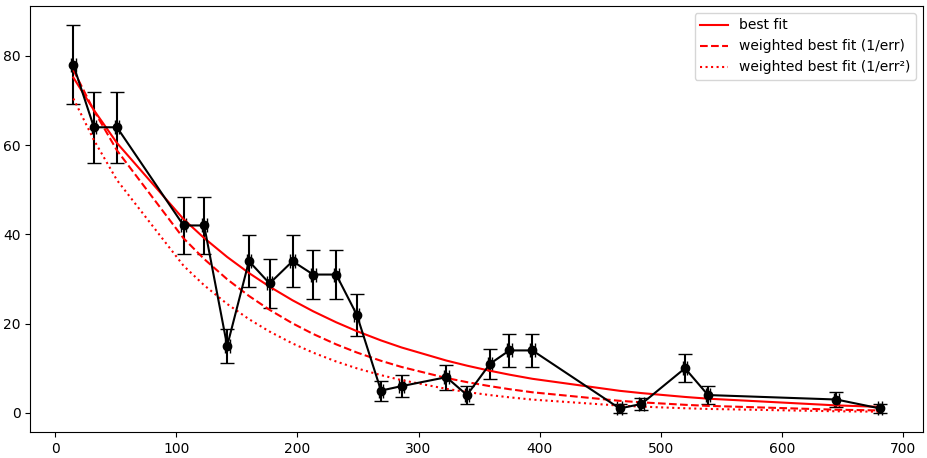
可以使用weights参数指定权重。为了给小不确定性的值赋予更多的权重,例如使用1/uncertainty。
但是,这个例子中的不确定性的问题是,它们直接依赖于振幅(uncertainty=np.sqrt(amps))的值。如果你使用这种不确定因素,它们只会将你的拟合曲线向下移动。因此,只有当你的不确定性是从某种测量中获得的真实不确定性时,这种方法才有意义。
示例:
import matplotlib.pyplot as plt
import numpy as np
import lmfit

ts = np.array([ 15,  32,  51, 106, 123, 142, 160, 177, 196, 213, 232, 249, 269, 286, 323, 340, 359, 375, 394, 466, 484, 520, 539, 645, 681])
amps = np.array([78, 64, 64, 42, 42, 15, 34, 29, 34, 31, 31, 22,  5,  6,  8,  4, 11, 14, 14,  1,  2, 10,  4,  3,  1])
emodel = lmfit.Model(lambda x,t,A: A*np.exp(-x/t))

plt.errorbar(ts, amps, xerr=2, yerr=np.sqrt(amps), fmt="ko-", capsize = 5)
plt.plot(ts, emodel.fit(amps, x=ts, t=150, A=140).best_fit, 'r-', label='best fit')
plt.plot(ts, emodel.fit(amps, x=ts, weights=1/np.sqrt(amps), t=150, A=140).best_fit, 'r--', label='weighted best fit (1/err)')
plt.plot(ts, emodel.fit(amps, x=ts, weights=1/amps, t=150, A=140).best_fit, 'r:', label='weighted best fit (1/err²)')
plt.legend()
页面原文内容由Stack Overflow提供。腾讯云小微IT领域专用引擎提供翻译支持
原文链接:
https://stackoverflow.com/questions/66154701
复制相关文章
相似问题
腾讯云开发者

Copyright © 2013 - 2026 Tencent Cloud. All Rights Reserved. 腾讯云 版权所有
深圳市腾讯计算机系统有限公司 ICP备案/许可证号:粤B2-20090059  粤公网安备44030502008569号
腾讯云计算(北京)有限责任公司 京ICP证150476号 | 京ICP备11018762号