
为什么在Prim的MST算法中得到最小顶点?
据我所知,Prim的MST算法将遍历图中的所有顶点,选择一个最佳的边去每个顶点。因此,每一次迭代都会为每个相邻顶点选择一个最优代价。因此,无论首先使用哪个顶点,最终结果都应该是相同的,因为在选择下一个顶点之前就已经选择了最优代价。
因此,我不明白为什么算法必须选择在每次迭代中代价最小的顶点。为了使我的描述更加清晰,我包含了来自geeksforgeeks.org的示例代码和图表:
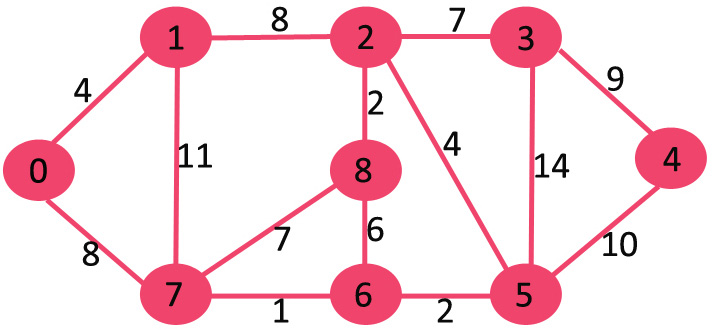
// A C / C++ program for Prim's Minimum Spanning Tree (MST) algorithm.
// The program is for adjacency matrix representation of the graph

#include <stdio.h>
#include <limits.h>

// Number of vertices in the graph
#define V 5

// A utility function to find the vertex with minimum key value, from
// the set of vertices not yet included in MST
int minKey(int key[], bool mstSet[])
{
   // Initialize min value
   int min = INT_MAX, min_index;

   for (int v = 0; v < V; v++)
     if (mstSet[v] == false && key[v] < min)
         min = key[v], min_index = v;

   return min_index;
}

// A utility function to print the constructed MST stored in parent[]
int printMST(int parent[], int n, int graph[V][V])
{
   printf("Edge   Weight\n");
   for (int i = 1; i < V; i++)
      printf("%d - %d    %d \n", parent[i], i, graph[i][parent[i]]);
}

// Function to construct and print MST for a graph represented using adjacency
// matrix representation
void primMST(int graph[V][V])
{
     int parent[V]; // Array to store constructed MST
     int key[V];   // Key values used to pick minimum weight edge in cut
     bool mstSet[V];  // To represent set of vertices not yet included in MST

     // Initialize all keys as INFINITE
     for (int i = 0; i < V; i++)
        key[i] = INT_MAX, mstSet[i] = false;

     // Always include first 1st vertex in MST.
     key[0] = 0;     // Make key 0 so that this vertex is picked as first vertex
     parent[0] = -1; // First node is always root of MST

     // The MST will have V vertices
     for (int count = 0; count < V-1; count++)
     {
        // Pick thd minimum key vertex from the set of vertices
        // not yet included in MST
        int u = minKey(key, mstSet);

        // Add the picked vertex to the MST Set
        mstSet[u] = true;

        // Update key value and parent index of the adjacent vertices of
        // the picked vertex. Consider only those vertices which are not yet
        // included in MST
        for (int v = 0; v < V; v++)

           // graph[u][v] is non zero only for adjacent vertices of m
           // mstSet[v] is false for vertices not yet included in MST
           // Update the key only if graph[u][v] is smaller than key[v]
          if (graph[u][v] && mstSet[v] == false && graph[u][v] <  key[v])
             parent[v]  = u, key[v] = graph[u][v];
     }

     // print the constructed MST
     printMST(parent, V, graph);
}


// driver program to test above function
int main()
{
   /* Let us create the following graph
          2    3
      (0)--(1)--(2)
       |   / \   |
      6| 8/   \5 |7
       | /     \ |
      (3)-------(4)
            9          */
   int graph[V][V] = {{0, 2, 0, 6, 0},
                      {2, 0, 3, 8, 5},
                      {0, 3, 0, 0, 7},
                      {6, 8, 0, 0, 9},
                      {0, 5, 7, 9, 0},
                     };

    // Print the solution
    primMST(graph);

    return 0;
}
从下面的代码块中可以看出,每一次迭代都将为每个邻域选择最佳权重(在本例中,任何两个顶点只有一个边连接):
if (graph[u][v] && mstSet[v] == false && graph[u][v] < key[v])
    parent[v] = u, key[v] = graph[u][v];
让我们以顶点7为例,它有三个边。最终将从边缘0-7、8-7和6-7中选择边缘6-7作为其重量最小,而不管我们是首先评估顶点0-7、8-7还是6-7,因为最优权重=min(所有相邻边缘的权重)。因此,每次迭代选择最小权顶点似乎是多余的。
请有人向我解释一下,为每一次迭代选择最小权顶点的目的是什么,如下面的代码块所示?
// Pick thd minimum key vertex from the set of vertices
// not yet included in MST
int u = minKey(key, mstSet);回答 1
Stack Overflow用户
发布于 2016-08-14 07:04:37
让我们以顶点7为例,它有三个边。最终将从边缘0-7、8-7和6-7中选择边缘6-7作为其重量最小,而不管我们是首先评估顶点0-7、8-7还是6-7,因为最优权重=min(所有相邻边缘的权重)。因此,每次迭代选择最小权顶点似乎是多余的。
看起来你混淆了这两个循环的目的。内环不选择任何内容。它只是计算重量。是外部循环完成了选择。
从这边看。想象一下,只要一个循环就开始了,我们已经得到了一个随机的开始顶点。现在这个循环需要取一个边缘。当然,它会越过相邻的边缘,得到最小值。它是如何做的并不重要:是将权重分配给顶点,还是只在边上循环并挑选出最好的。
然而,当有越来越多的顶点时,事情变得复杂起来。一旦添加了另一个顶点,您可能已经找到了一个更好的方法来获得一个新的顶点。假设你从顶点2开始。你添加顶点8。现在你可以从2(重量8),3从2(重量7),6从8(重量6),7从8(重量7)到1。然而,一旦你从8到6,你现在有一个更好的方法去7从6与重量只有1,而不是重量7(边8-7)。因此,您需要更新最佳路径的概念。
一种方法是简单地对每个迭代中已经包含在MST集合中的每个顶点相邻的所有边进行迭代,并选择最佳的一个。这引入了两个内环来寻找最小值:一个在MST集中的顶点上,另一个在每个这样的顶点附近的边缘上。对于一个具有n顶点和关于n^2边的几乎完全图,您将得到总体上的O(n^3)。
所以这个算法所做的是,它只遍历顶点而不是边。每个顶点保持从当前MST集到那里的最简单方法的权重。这使得我们可以将内部循环分成两部分。通过对所有顶点进行迭代,可以找到最佳的下一个顶点。它选择最佳相邻的一个,因为不相邻有无穷大的权重。这正是令人困惑的线条所做的。我是O(n)。
另一个内循环更新权重。但是,由于更新可能仅由新顶点的添加引起,因此只需要考虑与该特定顶点相邻的边!这又是O(n) (假设是一个几乎完全的图)。因此,将所有三个循环的复杂度降到O(n^2)。
事实上,如果使用邻接矩阵,甚至不重要图是否完成。要摆脱这个minKey部分,您需要做三个嵌套循环:第一个内部循环将遍历MST集中的所有顶点,最内部的一个将迭代其相邻的边缘,包括不存在的边。minKey技巧只允许这样做:
    // Update key value and parent index of the adjacent vertices of
    // the picked vertex. Consider only those vertices which are not yet
    // included in MST
for (int v = 0; v < V; v++) // note there is no loop over `u`!https://stackoverflow.com/questions/38939497
复制相似问题
腾讯云开发者

Copyright © 2013 - 2026 Tencent Cloud. All Rights Reserved. 腾讯云 版权所有
深圳市腾讯计算机系统有限公司 ICP备案/许可证号:粤B2-20090059  粤公网安备44030502008569号
腾讯云计算(北京)有限责任公司 京ICP证150476号 | 京ICP备11018762号