
如何使用openCV的SphericalWarper?
如何使用openCV的SphericalWarper?
提问于 2017-08-18 16:30:58
我有一个等长线拼接全景图像,我想用球面投影显示。我以前用openCV的imshow显示图像为-is(用等矩形投影),但是图像的顶部和底部都是扭曲的(就像任何等矩形投影一样),我想要消除这种失真。
我在openCV中找到了可以帮助我做到这一点的openCV。但是,我在正确理解如何使用warp时遇到了一些问题。
现在,我的代码中进行扭曲的部分如下所示:
    Mat panorama;
    Mat K = Mat::zeros(3, 3, CV_32F);
    Mat R = Mat::eye(3, 3, CV_32F);
    detail::SphericalWarper warper = detail::SphericalWarper(1.0f);
    warper.warp(imgBgr, K, R, INTER_LINEAR, BORDER_DEFAULT,panorama);

    imshow("Display frame", panorama);
waitKey(0);我的源图像,imgBgr看起来像这样(不完全是我的,只是一个例子):
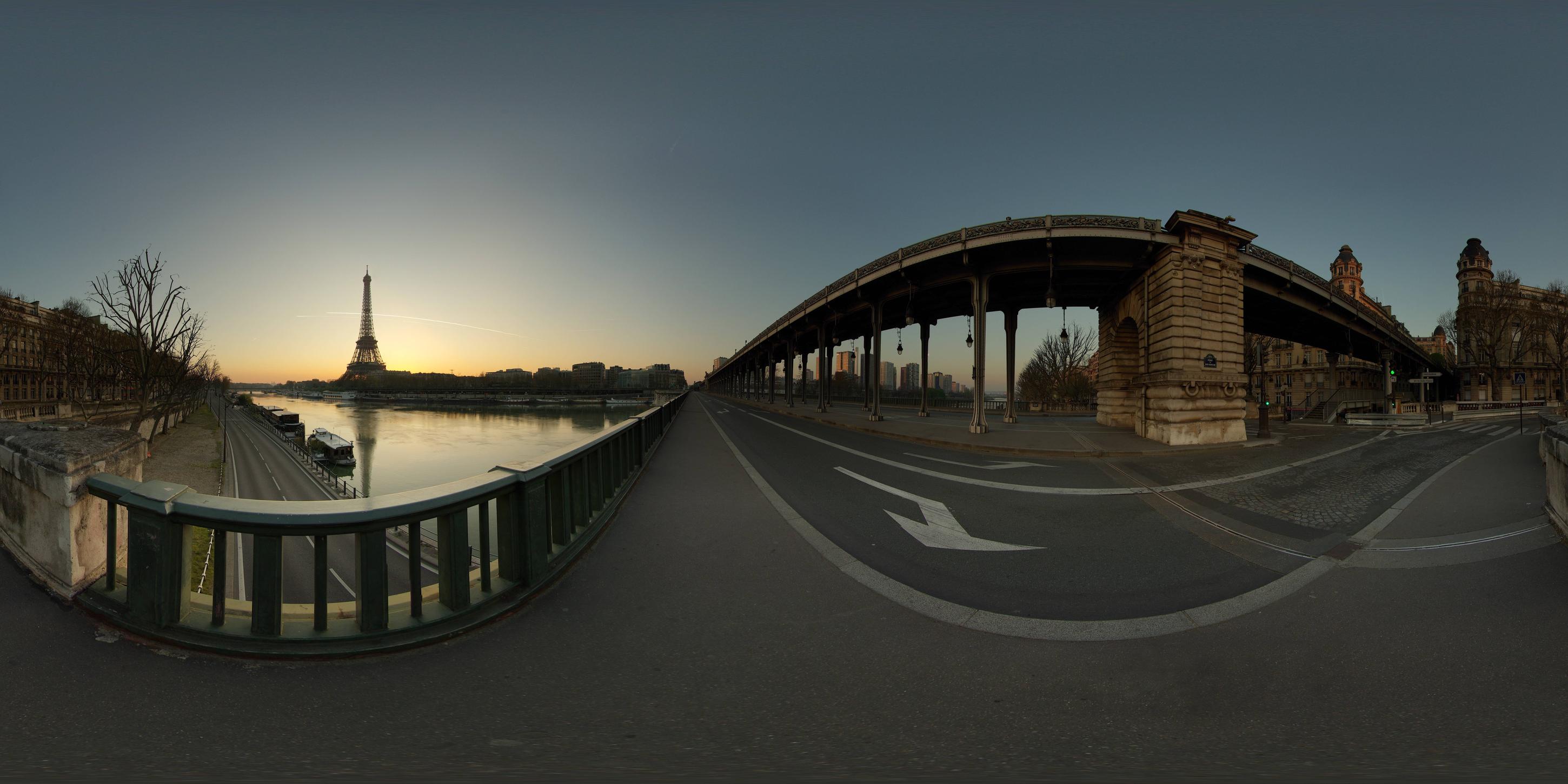
目前,我得到的输出图像panorama看起来就像图像传感器中没有任何镜头的图像:

我想这是有意义的,因为目前我的相机内禀矩阵是所有零的3x3矩阵。因此,我的问题是:相机的内在矩阵应该包含什么?我有相机的内在参数,为相机拍摄的图像是缝制的,以产生我的源等矩形图像(imgBgr),但我不确定warper是否需要这些相同的参数。我只想用球面投影来查看我的源图像,这样由等长线投影引起的失真就不再存在了。我希望输出图像类似于谷歌的街景。
回答 1
Stack Overflow用户
发布于 2018-05-07 13:16:33
我坚持同样的问题,但经过一些实验后,从洞里出来。本质矩阵看起来如下:
fx,  0, cx,
 0, fy, cy,
 0,  0,  1
其中f(x,y)是标度因子,c(x,y)是中心偏移量。您可以使用代码中的所有参数:
#include <iostream>
#include <opencv2/core.hpp>
#include <opencv2/highgui.hpp>
#include <opencv2/imgproc.hpp>
#include <opencv2/stitching/warpers.hpp>

using namespace std;
using namespace cv;

// Calculates rotation matrix given euler angles.
Mat eulerAnglesToRotationMatrix(Vec3f &theta)
{
    // Calculate rotation about x axis
    Mat R_x = (Mat_<float>(3,3) <<
               1,       0,              0,
               0,       cosf(theta[0]),   -sinf(theta[0]),
               0,       sinf(theta[0]),   cosf(theta[0])
               );

    // Calculate rotation about y axis
    Mat R_y = (Mat_<float>(3,3) <<
               cosf(theta[1]),    0,      sinf(theta[1]),
               0,               1,      0,
               -sinf(theta[1]),   0,      cosf(theta[1])
               );

    // Calculate rotation about z axis
    Mat R_z = (Mat_<float>(3,3) <<
               cosf(theta[2]),    -sinf(theta[2]),      0,
               sinf(theta[2]),    cosf(theta[2]),       0,
               0,               0,                  1);


    // Combined rotation matrix
    Mat R = R_z * R_y * R_x;

    return R;

}

int main(int argc, const char * argv[]) {
    // insert code here...
    std::cout << "Hello, World!\n";

    Mat origImg = imread("..path to file..");
    imshow("src", origImg);

    float scale = 100.0;
    float fx = 100, fy = 100, cx = 500, cy = 300;
    Vec3f rot = {};

    while (true) {
        cout << "•" << endl;
        cout << "Fx: " << fx << "; Fy: " << fy << endl;
        cout << "Cx: " << fx << "; Cy: " << fy << endl;
        cout << "Scale: " << scale << endl;
        cout << "Ang: " << rot << endl;

        detail::SphericalWarper wrap(scale);
        Mat K = (Mat_<float>(3,3) <<
                 fx, 0, cx,
                 0, fy, cy,
                 0, 0, 1);
        Mat R = eulerAnglesToRotationMatrix(rot);

        Mat dst;
        wrap.warp(origImg, K, R, INTER_LINEAR, BORDER_CONSTANT, dst);
        imshow("dst", dst);
        cout << dst.size() << endl;
        char c = waitKey();

        if (c == 'q') break;
        else if (c == 'a') fx += 10;
        else if (c == 'z') fx -= 10;
        else if (c == 's') fy += 10;
        else if (c == 'x') fy -= 10;
        else if (c == 'd') scale += 10;
        else if (c == 'c') scale -= 10;

        else if (c == 'f') rot[0] += 0.1;
        else if (c == 'v') rot[0] -= 0.1;
        else if (c == 'g') rot[1] += 0.1;
        else if (c == 'b') rot[1] -= 0.1;
        else if (c == 'h') rot[2] += 0.1;
        else if (c == 'n') rot[2] -= 0.1;
    }

    return 0;
}页面原文内容由Stack Overflow提供。腾讯云小微IT领域专用引擎提供翻译支持
原文链接:
https://stackoverflow.com/questions/45761194
复制相关文章
相似问题
腾讯云开发者
