
为什么datetime.utcnow()和datetime.now(时区(UTC))有区别?
为什么datetime.utcnow()和datetime.now(时区(UTC))有区别?
提问于 2017-09-02 22:58:51
从下面的片段中可以看到,这两个方法之间有一个小时的差异。原因是什么?
from datetime import datetime
from pytz import timezone
import time

def timestamp2date(timestamp):
    # function converts a UTC timestamp into Europe/Zurich Gregorian date
    DATE_TIME_FORMAT = "%Y-%m-%d %H:%M:%S"
    utcTimeStamp = datetime.fromtimestamp(int(timestamp)).replace(tzinfo=timezone('UTC'))
    return utcTimeStamp.astimezone(timezone('Europe/Zurich')).strftime(DATE_TIME_FORMAT)

timeStampUTC_1 = time.mktime(datetime.utcnow().timetuple())
print(timeStampUTC_1)
print(timestamp2date(timeStampUTC_1))
timeStampUTC_2 = time.mktime(datetime.now(timezone('UTC')).timetuple())
print(timeStampUTC_2)
print(timestamp2date(timeStampUTC_2))
print(timeStampUTC_2 - timeStampUTC_1)

# 1504385450.0
# 2017-09-03 00:50:50   this the right time
# 1504389050.0
# 2017-09-03 01:50:50
# 3600.0回答 2
Stack Overflow用户
发布于 2017-09-03 02:10:30
原因是,如果datetime.timetuple()没有偏移感知,则设置dst=-1,而当偏移感知时,设置dst=0 or 1。
从文件中:
结果的
tm_isdst标志是根据dst()方法设置的:tzinfoisNone或dst()返回None,tm_isdst设置为-1;否则,如果dst()返回非零值,tm_isdst设置为1;否则tm_isdst设置为0。
In []:
datetime.utcnow()
Out[]:
datetime.datetime(2017, 9, 2, 23, 9, 12, 715042)

In []:
print(datetime.utcnow().dst())
Out[]:
None

In []:
datetime.now(timezone('UTC'))
Out[]:
datetime.datetime(2017, 9, 2, 23, 9, 15, 856983, tzinfo=<UTC>)

In []:
datetime.now(timezone('UTC')).dst()
Out[]
datetime.timedelta(0)

In []:
datetime(2017, 9, 2, 23, 9, 15, 856983).timetuple()
Out[]:
time.struct_time(tm_year=2017, tm_mon=9, tm_mday=2, tm_hour=23, tm_min=9,
                 tm_sec=15, tm_wday=5, tm_yday=245, tm_isdst=-1)
                                                             ^^
In []:
datetime(2017, 9, 2, 23, 9, 15, 856983, timezone('UTC')).timetuple()
Out[]:
time.struct_time(tm_year=2017, tm_mon=9, tm_mday=2, tm_hour=23, tm_min=9,
                 tm_sec=15, tm_wday=5, tm_yday=245, tm_isdst=0)
^这将改变time.mktime()生成的time.mktime()生成的-1,因为mktime处理-1未知并使用本地时间,因此可以计算dst=1,因此它们可能有1小时不同(3600s):
In []:
time.mktime(datetime(2017, 9, 2, 23, 9, 15, 856983).timetuple())
Out[]:
1504411755.0

In []:
time.mktime(datetime(2017, 9, 2, 23, 9, 15, 856983, timezone('UTC')).timetuple())
Out[]:
1504415355.0Stack Overflow用户
发布于 2017-09-05 11:32:41
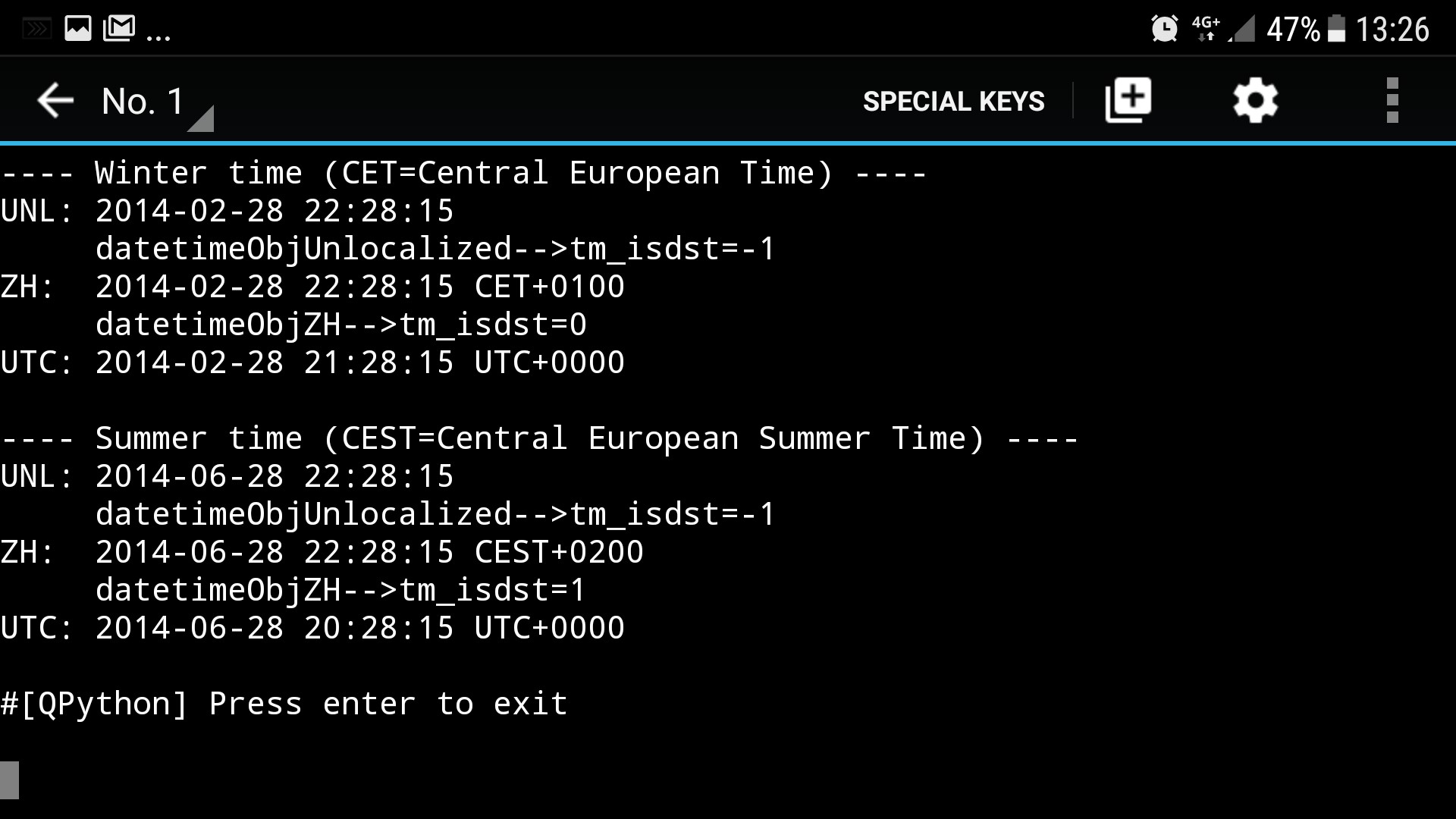
这是我进一步探索与夏令时标志相关的时区概念的结果。代码非常简单。
为了总结结果,有一种正确的方法来处理日期/时间信息:
- 日期/时间对象必须本地化。
- 如果本地化正确,则日期/时间对象显示正确的夏令时信息。
- 这反映在您将本地化的日期/时间对象转换为UTC日期/时间对象时,根据定义,该对象与DST无关。
- 当您访问股票或货币历史分钟汇率API时,所有这些注意事项都特别相关。
代码:
from datetime import datetime
from pytz import timezone
import time

print("---- Winter time (CET=Central European Time) ----")
dateStr = "2014-02-28 22:28:15"
datetimeObjUnlocalized = datetime.strptime(dateStr, "%Y-%m-%d %H:%M:%S")
print('UNL: ' + datetimeObjUnlocalized.strftime("%Y-%m-%d %H:%M:%S %Z%z"))
print('     datetimeObjUnlocalized-->tm_isdst=' + str(datetimeObjUnlocalized.timetuple()[8]))
datetimeObjZH = timezone('Europe/Zurich').localize(datetimeObjUnlocalized)
print('ZH:  ' + datetimeObjZH.strftime("%Y-%m-%d %H:%M:%S %Z%z"))
print('     datetimeObjZH-->tm_isdst=' + str(datetimeObjZH.timetuple()[8]))
print("UTC: " + datetimeObjZH.astimezone(timezone('UTC')).strftime("%Y-%m-%d %H:%M:%S %Z%z"))

print("\n---- Summer time (CEST=Central European Summer Time) ----")
dateStr = "2014-06-28 22:28:15"
datetimeObjUnlocalized = datetime.strptime(dateStr, "%Y-%m-%d %H:%M:%S")
print('UNL: ' + datetimeObjUnlocalized.strftime("%Y-%m-%d %H:%M:%S %Z%z"))
print('     datetimeObjUnlocalized-->tm_isdst=' + str(datetimeObjUnlocalized.timetuple()[8]))
datetimeObjZH = timezone('Europe/Zurich').localize(datetimeObjUnlocalized)
print('ZH:  ' + datetimeObjZH.strftime("%Y-%m-%d %H:%M:%S %Z%z"))
print('     datetimeObjZH-->tm_isdst=' + str(datetimeObjZH.timetuple()[8]))
print("UTC: " + datetimeObjZH.astimezone(timezone('UTC')).strftime("%Y-%m-%d %H:%M:%S %Z%z"))
页面原文内容由Stack Overflow提供。腾讯云小微IT领域专用引擎提供翻译支持
原文链接:
https://stackoverflow.com/questions/46018931
复制相关文章
相似问题
腾讯云开发者

Copyright © 2013 - 2026 Tencent Cloud. All Rights Reserved. 腾讯云 版权所有
深圳市腾讯计算机系统有限公司 ICP备案/许可证号:粤B2-20090059  粤公网安备44030502008569号
腾讯云计算(北京)有限责任公司 京ICP证150476号 | 京ICP备11018762号