The content of this page has been automatically translated by AI. If you encounter any problems while reading, you can view the corresponding content in Chinese.
What should I do if there is no sound when joining a meeting?
If there is no sound after joining the meeting, please check whether you have selected the correct audio method, and verify your system default audio device. If no audio method is selected, then there will be no sound.
How can the host mute other attendees?
In the meeting interface, click Manage Members. In the member list, you can select Mute All, or move the mouse to a specific member and click the microphone icon to mute that member.
How can the host unmute others?
When you receive a request from a participant to unmute, you can choose Agree to unmute.
You can also select Unmute All in the "Manage Participants" interface, or move the mouse over a participant to actively unmute their microphone.
I have been muted by the host, how do I request to be unmuted?
App or PC users: click Microphone > Request to Speak and wait for the host's approval.
Telephone callers: After being muted, press the "1" key to request to speak, and wait for the host to approve.
Why can't I hear other participants during the meeting?
Follow the steps below to troubleshoot:
First step, check for device anomalies: (iOS and Android can skip to the second step)
1. Click the bottom menu bar Settings, select Speaker, click Check Speaker. If you hear a piece of music, the speaker is functioning properly.
2. If you cannot hear the music, select another audio device from the speaker drop-down menu for testing.
Second step, check for system permission anomalies: (Check sequentially for each platform)
Mac: System Preferences > Sound > Output, unmute and drag the output volume slider to the maximum (adjust later if it is too loud).
Windows: Right-click the Speaker icon > Playback > Check if the corresponding device is disabled.
iOS and Android: Please turn the volume up to maximum, the top left Speaker icon allows you to switch between handset and speaker mode.
Why can't other participants hear my voice during the meeting?
Follow the steps below to troubleshoot:
First step, check for device anomalies: (iOS and Android can skip to the second step)
1. Please first check the menu bar at the bottom of the screen to see if mute is enabled. If the host has muted you, please request to be unmuted.
2. Click the menu bar at the bottom of the screen, select Settings, choose Microphone, click Detect Microphone, and start speaking to test. The green indicator bar moving indicates that the microphone is working properly.
3. If the green indicator bar is not moving, please select another recording device from the microphone dropdown menu for testing.
Second step, check for system permission anomalies: (Check sequentially for each platform)
Mac:
3.1 System Preferences > Sound > Input, drag the input volume to the maximum (you can adjust it lower later if needed).
3.2 System Preferences > Security & Privacy > Microphone > Tencent Meeting, then rejoin the meeting.
Windows:
3.1 Right-click the Speaker icon > Recording Device > Check if the corresponding device is disabled.
3.2 For Win10 only: System Settings > Microphone > Allow apps to access your microphone.
iOS and Android: Please check whether the microphone permission is enabled in the system applications.
Why is my voice quiet during the meeting?
Windows: Right-click the Speaker icon > Recording Devices > Click the corresponding device > Properties > Level, and increase the volume as needed.
Mac: System Preferences > Sound > Input, drag the input volume to the right to increase it as needed.
What should I do if there is feedback noise during the meeting?
Howling can be divided into multi-device meetings in the same location (multiple devices connected to the online meeting in the same venue) and single device join (only one device is connected to the online meeting in the same venue). Below are the corresponding resolutions:
Single device join howling:
1. Check if there are high-power audio output devices like speakers in the meeting room.
1.1 If such devices are present, first, quickly lower the speaker volume to avoid howling that may cause hearing damage to participants.
1.2 Then ensure the mixing console settings and connections are correct; also, microphones and other pickup devices should not be placed directly in front of the speakers, it's recommended to keep a distance of more than 3 meters. Additionally, the host can lower the volume of the speakers or microphones to mitigate the howling situation.
2. If no high-power audio output devices are present, it may be that the local speaker is playing the sound picked up by the local microphone, causing local howling. The solution is to disconnect the video meeting, then speak directly into the microphone to see if the sound will come out of the local speaker. If it does, system settings need to be adjusted, usually by unchecking the option to Monitor this device in the sound options to avoid local amplification causing howling.
3. On the basis of excluding the above situations, if echo leakage occurs on devices at both ends of the meeting, it will also cause howling. The resolution measures for this issue can be referred to in What should I do if there is echo during the meeting?.
4. If howling still exists, it can be assumed that howling in other sub-venues is transmitted to this venue via the network. At this point, remind other sub-venue participants to follow the above processes, and lower the output volume to avoid howling causing hearing damage.
Multi-device meeting in the same location howling:
1. First, refer to the first point to exclude the possibility of incorrect operation causing howling during single device join.
2. After excluding single device join howling, it's likely that multiple participants in the venue have turned on microphones or speakers. In this case, the host should remind participants to turn off microphone input (mute mic) and mute speakers on their terminal devices. If this is not possible, use a headset to attend the Tencent Meeting.
3. If howling still exists at this point, there may be multiple devices joining the meeting in sub-venues. The host can use the "Mute All" feature in "Manage Members" and then unmute participants one by one to identify the sub-venue causing the howling. Provide a reminder or mute the problematic sub-venue.
What should I do if there is echo during the meeting?
In a meeting, echo can be categorized into two types: local echo and remote echo. Local echo refers to hearing one's own speech being transmitted back. Remote echo refers to a remote participant hearing their own speech. You can use the following methods to troubleshoot the issue:
Local echo:
1.1 First, follow the steps described for the howling problem to rule out system configuration anomalies or echo leakage caused by multiple devices in the same location.
1.2 Ask other meeting attendees to follow the remote echo troubleshooting measures to handle echo leakage.
Remote echo:
If other meeting attendees report hearing an echo, you can perform the following checks in your location:
1.1 Mute your microphone or speaker to determine if the echo heard by the other party is caused locally. If the other party still reports hearing an echo, it can be confirmed that the echo is caused by a third party in the meeting. Keep it muted and assist in identifying the source of the echo leakage. If the other party reports no more echo leakage, it confirms that the echo is caused locally, and you can take the following actions.
1.2 Keep the speaker and microphone as far apart as possible: Ensure no large obstacles within 30 cm in front of the speaker to avoid strong sound reflections; Reduce the speaker volume to no more than 80% of the maximum volume; Lower the microphone pickup volume, and if possible, use an extended microphone in the meeting room.
1.3 If the above actions do not resolve the issue and the other party still reports hearing an echo, you can take the following measures if conditions allow: Only turn on the microphone when speaking and turn it off immediately after; For individual attendees, consider using a headset; Leave Tencent Meeting and rejoin the meeting.
What should I do if there is a crackling noise during the meeting?
The noise in the meeting can generally be categorized into the following scenarios:
1. All or most participants hear the noise.
2. No noise is heard by other participants, only by a specific person.
3. Some participants hear the noise while others do not.
Troubleshooting for each scenario is as follows:
All or most participants hear the noise
This scenario may be caused by a participant's microphone (or phone) picking up noise. You can use the following methods to troubleshoot:
1. The host can check the noisy sound prompt report. If there is a noise report for a specific participant, mute their microphone and remind them to conduct a self-check.
2. The participant who was muted due to noise should first assess if their environment is indeed noisy. They can use the "Test Microphone" feature in the audio settings for a self-test of microphone quality and environmental noise. If the environment is noisy, consider changing the meeting location to a quieter place. If changing location is inconvenient, use a headset to join the meeting and reduce the microphone pickup volume.
3. After ruling out environmental noise, if the noise persists, consider the possibility of microphone quality issues. If possible, try changing the microphone, such as switching between a headset and the built-in microphone on the device to see if the noise is eliminated.
Only one person hears the noise
If other participants do not hear the noise, but only one specific person does, it is likely that the noise is coming from that person's phone or playback speaker. The participant should refer to the measures below to troubleshoot the noise issue:
1. First, check if any other playback software, such as music players or other voice chat tools, is running in the background and close these software.
2. Next, use the "Test Speaker" feature in the audio settings of Tencent Meeting to check if the playback volume and device are functioning properly. Adjust the playback volume to a normal level. If the sound is abnormal, there may be an issue with the playback device (speaker or sound card). In this case, it is recommended to switch to another playback device, such as using headphones instead of speakers.
3. If the playback sound is normal, but the meeting call audio has issues like stuttering, fast-forward, or slow play, it is likely a downstream network issue. Refer to solution steps in issue 7.
4. If some participants hear the noise while others don't, it is highly likely that multiple participants are experiencing the scenario described in point two. The host can ask the participants who hear the noise to follow the steps in point two for self-check.
What to do when there is audio stuttering, fast-forward, or slow play in meetings?
If the meeting call audio has issues like stuttering, fast-forward, or slow play, it is likely due to network connection problems. Possible causes include device network card issues, other applications consuming data bandwidth, poor upstream packet network connection, and network jitter or congestion. Specific solutions can be found in the steps below:
1. First, rule out the possibility that environment and devices are causing the abnormal sound.
2. Next, check if the Wi-Fi or 4G signal strength is normal. If the network condition is poor, switch to a better quality network, or use PSTN phone to join the meeting.
3. If the device network card's status is uncertain, try using WeChat, QQ, or other software to test if communication is normal.
4. If the problem still exists after the above steps, to ensure a smooth meeting, it is recommended to turn off high bandwidth-consuming features like video and screen sharing, and prioritize ensuring audio call quality.
When headphones are connected and the computer speaker still emits sound while the headphones are fine, how to fix it?
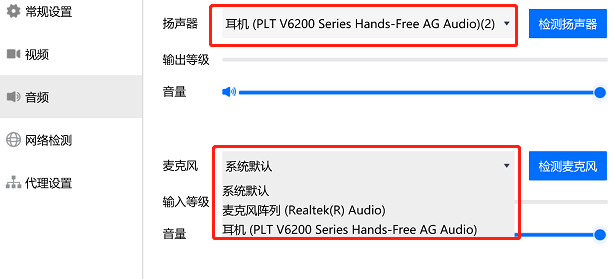
1. Before joining the meeting, click on My profile picture to enter the personal homepage, click on Settings on the page to enter the settings page.
2. Select Audio to enter the audio settings page.
3. Click the Speaker dropdown box and select the corresponding headphone device. At the same time, click the Microphone dropdown box and select the corresponding headphone device.
Using a mobile phone to join the meeting, what should I do if the other people's voices are particularly quiet?
Please check if the audio mode in the upper left corner of the meeting is set to Earpiece Mode. If it is set to Earpiece Mode, it is recommended that you click to switch to Speaker Mode.
What to do if the audio is abnormal and cannot be used normally?
If you encounter audio-related issues while using Tencent Meeting that cannot be resolved, please promptly record the problem and use Online Support for assistance. The maintenance personnel of Tencent Meeting will help you pinpoint and resolve the issue.