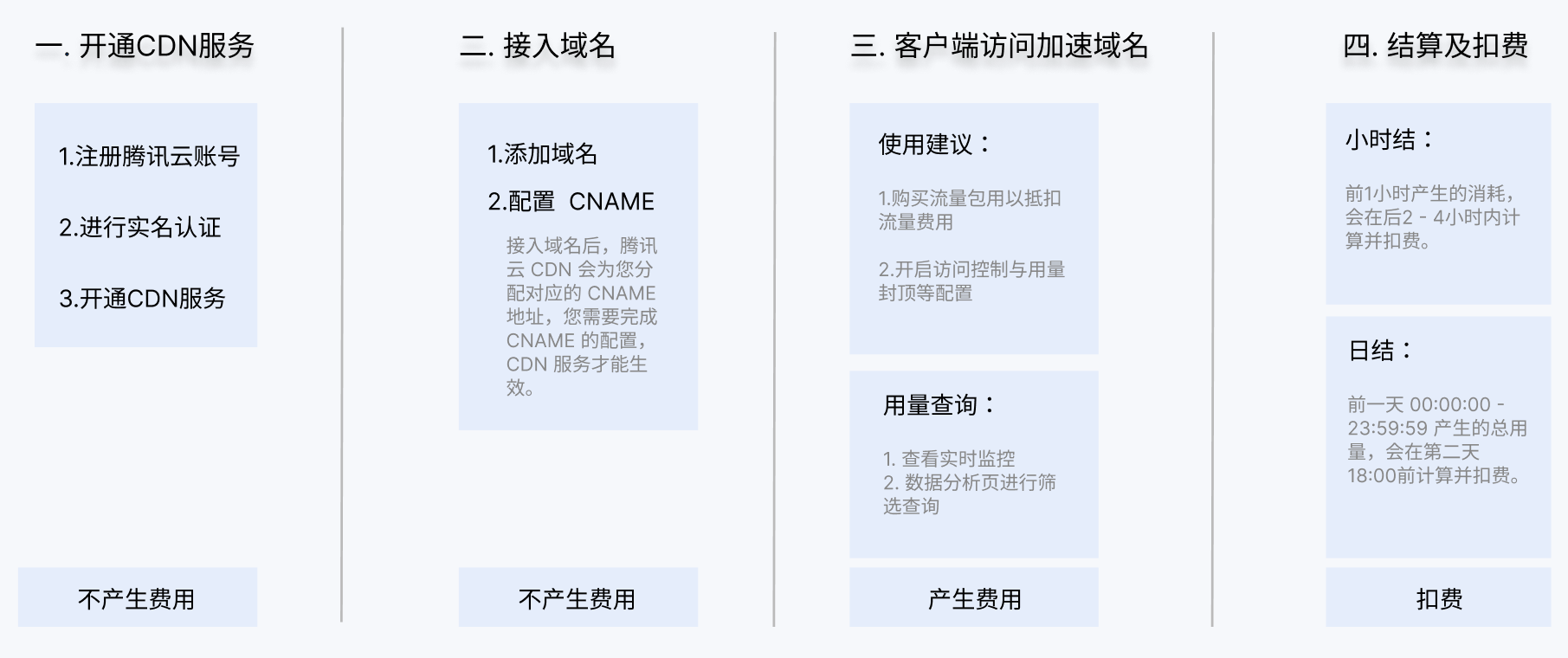
Tencent Cloud CDN billing consists of basic service billing and value-added service billing.
Basic Service Billing: Downstream traffic or bandwidth cost generated by using CDN.
Value-Added Service Billing: In addition to basic services, you can choose one or more value-added services as needed, such as QUIC access request count, APK dynamic packaging request count, etc.
CDN Product Billing Explanation
Scenario 1: The origin server of the acceleration domain name is a COS bucket
Users can leverage the capabilities of COS and CDN to host static content (including audio, video, images, etc.) in Cloud Object Storage (COS) and pre-deliver hot files to CDN edge nodes. This reduces storage costs and download latency, making it suitable for apps, audio and video platforms, websites, etc., with frequent download activities.
Description
When Cloud Object Storage (COS) is used as the customer's origin server, the following costs may apply: Content Delivery Network (CDN) fees + Cloud Object Storage (COS) fees
Description of billable items
Billing Item
Billing Products
Description
Pay-as-you-go
Content Delivery Network (CDN)
Basic Fees: Billing by traffic or billing by bandwidth
Customers billed by traffic can purchase traffic packages in advance to offset future traffic costs. For details, see CDN Traffic Packages.
Value-added fees: such as "QUIC access request count" and "APK dynamic packaging" and other fees. No usage, no charge.
As shown above, when users use COS as the CDN origin server, the origin-pull traffic generated from COS to Tencent Cloud CDN edge nodes is billed by COS. For pricing details, see COS - Traffic Fees - CDN Origin-Pull Traffic.
According to your actual business usage, there may be additional fees such as "storage fees, data retrieval fees, and management feature fees." For detailed billing items, please see COS Billing Overview.
Scenario 2: The origin server of the acceleration domain name is a CVM/Lighthouse
CDN supports access to any stably running business server (i.e., origin server). CDN stores your content according to the caching rules through high-performance edge nodes distributed around the world. When a user requests content, the request will be routed to the edge node closest to the user to speed up access and improve availability.
Description
When using Cloud Virtual Machine (CVM) or Lighthouse as the origin server, the following fees may apply: Content Delivery Network (CDN) fees + Cloud Virtual Machine (CVM)/Lighthouse fees.
Description of billable items
Billing Item
Billing Products
Description
Pay-as-you-go
Content Delivery Network (CDN)
Basic Fees: Billing by traffic or billing by bandwidth
Customers billed by traffic can purchase traffic packages in advance to offset future traffic costs. For details, see CDN Traffic Packages.
Value-added fees: such as "QUIC access request count" and "APK dynamic packaging" and other fees. No usage, no charge.
Monthly subscription is a prepaid mode for CVM instances, where you pay the fees for one or multiple months or even years in advance. For details, see Monthly Subscribed Instance Pricing.
Based on your actual business usage, there may also be value-added services. For detailed billing items, see CVM Billing Overview.
Scenario 3: The origin server of the acceleration domain name is a self-owned origin server
CDN supports the integration of any business server (i.e., origin server) with stable operation. CDN stores your content according to caching rules through high-performance edge nodes distributed globally. When a user requests content, the request will be routed to the edge node closest to the user for rapid response, effectively reducing user access latency and improving availability.
Description
When using a self-owned origin server as the CDN origin server, the following fees may apply: Content Delivery Network (CDN) Fees.
Description of billable items
Billing Item
Billing Products
Description
Pay-as-you-go
Content Delivery Network (CDN)
Basic Fees: Downstream traffic is billed by traffic or by bandwidth.
Customers billed by traffic can purchase traffic packages in advance to offset future traffic costs. For details, see CDN Traffic Package.
Value-Added Fees: Other fees such as "QUIC access request count" and "APK dynamic packaging" are not charged if not used. For details, see CDN Billing Explanation.
CDN Traffic Package Instructions
A CDN traffic package is a prepaid resource package used to offset traffic consumption under the CDN traffic billing model. Classified by billing region, there are 9 different types of CDN traffic packages. For more details, see CDN Traffic Package Introduction.
CDN Traffic Package Deduction Restrictions
CDN traffic packages can only be normally deducted when the billing method is CDN Traffic Billing. Customers billed by bandwidth need to change the billing method to traffic billing on the CDN Service Overview Page to use traffic packages.
After the traffic package expires or is used up, CDN will automatically switch to pay-as-you-go. Traffic generated in each billing region after the traffic package expires or is used up will be billed according to the pay-as-you-go tiered pricing for each region. For details on pay-as-you-go traffic billing, see Bill-by-Traffic.
CDN traffic packages do not support cross-region deductions. For example, a CDN traffic package for China can only be used to offset traffic generated in the China billing region and cannot be used for traffic generated in other billing regions.
Effective time of traffic package:
For hourly settlement customers, it is the whole hour of the purchase time. The traffic package cannot offset traffic costs incurred before the whole hour of the purchase time.
Note:
Note: Base conversion: 1 GB = 1,000 MB; 1 MB = 1,000 KB.
Deduction example for traffic packages
1. CDN user A, who uses hourly bandwidth settlement billing, has their main business distribution in China. Today, they changed the billing method to hourly traffic settlement and purchased a 100 GB CDN traffic package for China.
If the customer did not generate consumption on the day before changing the billing method, the new billing by traffic method will take effect today, and the purchased traffic package will also start effective deduction.
If consumption has already occurred on the day before changing the billing method, the consumption of that day will still be billed by bandwidth. The new billing by traffic method will take effect the next day, and the effective time of the purchased traffic package will align with the new billing method, starting to deduct from the next day.
When the CDN traffic package within China is used up, the traffic generated in the billing area within China will be billed according to postpaid tiered pricing.
2. Overseas acceleration user B, who is billed by hourly traffic, has main business distribution in the United States and purchased a 100GB CDN traffic package for the Asia Pacific Zone 1.
The United States belongs to the North America Zone in the CDN billing area outside China. A North America Zone CDN traffic package needs to be purchased, as the Asia Pacific Zone 1 traffic package will not deduct the traffic generated in the United States. The traffic generated will be billed according to postpaid tiered pricing.
3. Enterprise Content Delivery Network (ECDN) user C, who is billed by hourly traffic, has main business distribution within China and purchased a 100GB CDN traffic package within China.
CDN traffic packages can only be properly deducted for traffic-billedCDN services and cannot deduct traffic generated by ECDN services. User C is still billed postpaid by number of requests + excess traffic.
CDN Traffic Package Deduction Order
If there are multiple traffic packages under your account, the deduction order will follow the expiration time from nearest to farthest. When the expiration times are the same, the deduction will follow the effective time from farthest to nearest.
Deduction order example for traffic packages
For example, if you currently have a 1TB CDN traffic package within China with an effective time of October 1, 2021, 00:00:00, and an expiration time of September 30, 2022, 23:59:59, it will be referred to as traffic package A.
Another 10GB CDN traffic package within China with an effective time of September 1, 2022, 00:00:00, and an expiration time of September 30, 2022, 23:59:59, will be referred to as traffic package B;
Another 100GB CDN traffic package within China with an effective time of August 15, 2022, 00:00:00, and an expiration time of September 14, 2022, 23:59:59, will be referred to as traffic package C;
The deduction order of the three traffic packages is: C first, then A, and finally B.
CDN offers two automatic renewal modes: "renew upon usage or expiration" and "renew only upon expiration".
After enabling automatic renewal, if your account balance is sufficient, the system will automatically purchase a new resource package for you according to the automatic renewal rules, with the applicable region, traffic quota, and validity period consistent with the original CDN traffic package. For more details, see CDN Traffic Package Automatic Renewal.
CDN Traffic Package Refund Instructions
For a single account, not expired and unused CDN traffic packages are eligible for a refund. Go to Traffic Package Management and click Refund on the traffic package meeting conditions. For more details, see CDN Traffic Package Refund.