Changing instance specifications

Last updated: 2024-11-01 16:20:45

Scenario

TencentDB for Redis® supports adjusting instance specifications, offering flexible scaling operations. You can adapt the Redis instance specifications based on your business's actual needs, thereby better satisfying resource utilization and real-time cost optimization requirements. This document describes the process of modifying instance specifications in the TencentDB for Redis® console.
For instance specifications adjustment, an instance can be scaled quickly in the console without having to stop the services. No operations are required at your side.
Expand or reduce nodes: This refers to adjusting the memory capacity of instance nodes to meet ever-changing memory needs and avoid lags caused by insufficient memory.
Add or delete replicas: This refers to adjusting the number of instance replicas. Replicas are nodes other than the master node, and all replicas participate in supporting the system's high availability. Therefore, the more replicas, the higher the availability. When the number of replicas is greater than or equal to 1, read/write separation can be enabled to extend the read performance through replica nodes.
Add or delete shards: This refers to assigning different keys to multiple shard nodes in the sharding mode of instances in cluster architecture to adjust the number of shard nodes, so that the system performance can be horizontally scaled.

Release notes

Currently, Redis 4.0, 5.0, and 6.2 Standard Edition instances support expanding and reducing nodes as well as adding and deleting replicas.
Currently, Redis 4.0, 5.0, and 6.2 Cluster Edition instances support expanding and reducing nodes as well as adding and deleting replicas and shards.
Currently, Redis 2.8 Standard Edition instances only support expanding and reducing nodes.

Billing Overview

Monthly Subscription

Upgrade configuration: The system will calculate the price difference between instance specifications and deduct it from your cloud account. Subsequently, you will be charged according to the new specifications. If your account balance is insufficient, you will need to recharge it first.
Configuration downgrade: The price difference is calculated as follows: Refund = residual value of the original configuration - purchase price of the new configuration.
Residual value of the original configuration: Effective order amount of the original configuration - used value of the original configuration.
Effective order amount of the original configuration: The amount paid for the currently effective order, excluding discounts and vouchers.
Residual value of original configuration: As of the day when downgrade is initiated, if the usage has lasted for one month or longer, fees will be calculated at the corresponding monthly subscription price and discount listed on the official website; otherwise, fees will be calculated at the pay-as-you-go price. The usage is accurate down to the second.
Purchase price of the new configuration: Current official price of the new configuration * remaining validity period.
For monthly bill details, see Pricing.

Pay-as-You-Go

The instance will be billed hourly based on the new specification on the next hour under tier 1, and fees will be settled on each hour (Beijing Time). The pay-as-you-go billing mode adopts tiered pricing in three tiers as detailed in Billing Overview. For tiered prices, see Pricing.

Preparations

The instance and its associated instances are in Running status and are not executing any tasks.
You have calculated the required specifications and understood the fees. Make sure that your Tencent Cloud account balance is sufficient.

Redis Memory Edition (Standard Architecture)

Note:
After the configuration is adjusted, the instance will be charged at the price of the new specification.
To expand the capacity of a Memory Edition instance in standard architecture, if the remaining available capacity of the physical machine is insufficient, migration will occur, which will not affect your access to the instance. However, a momentary disconnection will occur after the migration is completed, so we recommend that your business have a reconnection mechanism.
As the maximum capacity of a Memory Edition instance in standard architecture is 64 GB, you cannot expand its capacity beyond that limit.
To avoid failure in capacity reduction, the capacity after reduction must be at least 1.3 times the amount of existing data. After the capacity reduction, you will receive an automatic refund.
As a trial version, the 256 MB specification of TencentDB for Redis® 4.0 or 5.0 is only suitable for product verification in testing environments. It is available only in the following AZs: Guangzhou (Zones 6 and 7), Shanghai (Zones 2, 3, 4 and 5), Beijing (Zones 1, 2, 3, 4, 5, 6, and 7), and Shenzhen Finance (Zones 1, 2, and 3). Other 1 GB and above specifications can be smoothly downgraded to the 256 MB specification.
2. Above the Instance List on the right, select the region.
3. In the instance list, find the target instance.
4. In the Operation column, perform actions such as expanding or reducing nodes, and adding or removing replicas.
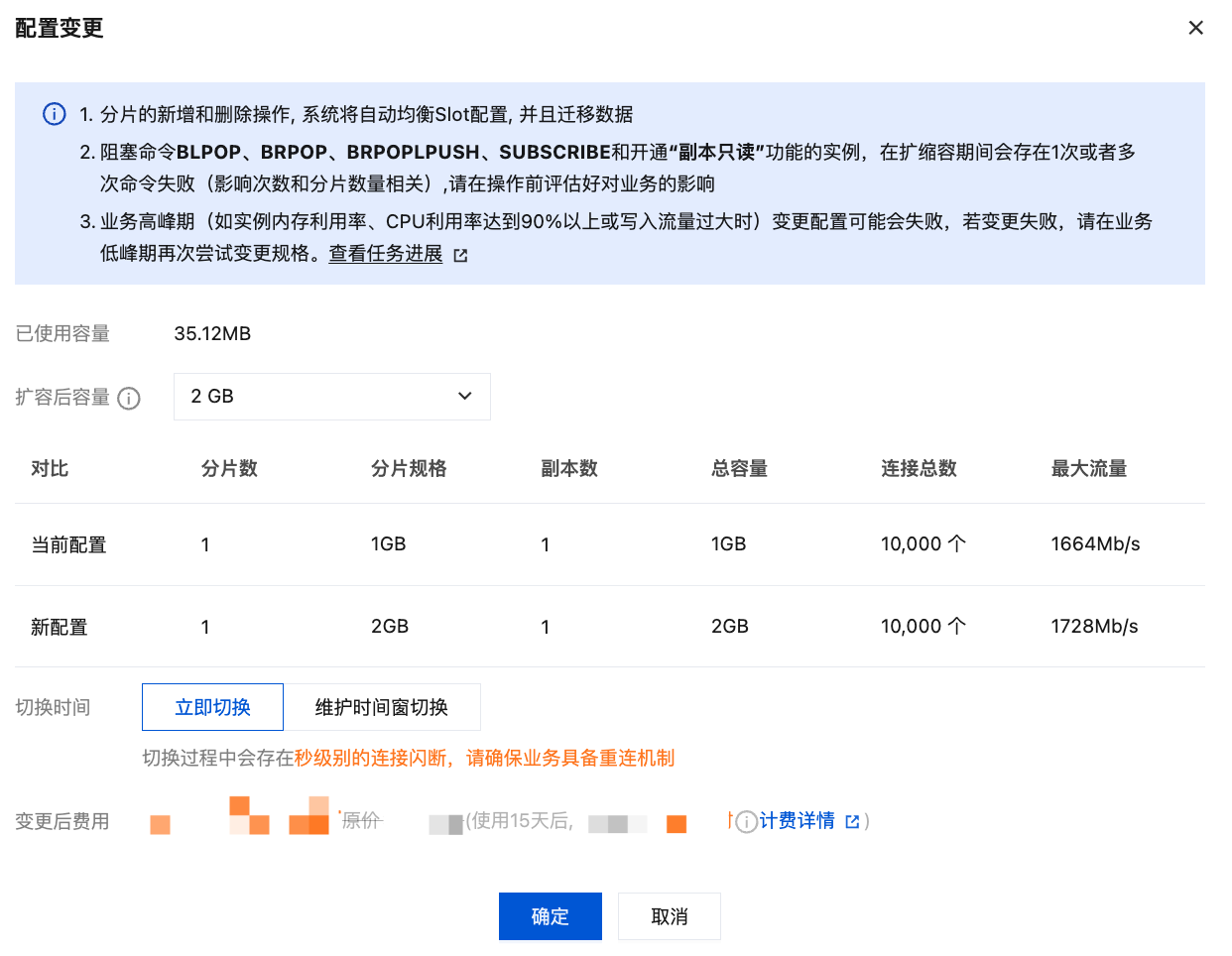
Select Configure > Expand Node to enter the TencentDB for Redis® Configuration Changes page and select the desired node capacity.
Select Configure > Reduce Node to enter the TencentDB for Redis® Configuration Changes page and select the desired node capacity for reduction. The configuration parameters for reducing nodes are similar to those for expanding nodes. The Capacity After Reduction refers to the capacity specification of each shard after reduction. The instance capacity after reduction must be greater than or equal to 1.3 times the used capacity. Please compare the capacity specifications before and after reduction to confirm if they meet the requirements.

Parameter
Description
Used Capacity
The used capacity of the current instance.
Min Memory
Minimum memory specification of the current instance required to prevent the disk space from being used up.
Capacity After Expansion
The capacity specification per shard after scaling.
Comparison
Compare the current configuration with the new configuration, including Shard Quantity, Shard Specs, Replica Quantity, Total Capacity, Total Connections, and Max Traffic.
Configuration Change Fees
This parameter will be displayed if the billing mode is yearly/monthly subscription. You need to pay the price difference in case of capacity expansion, and subsequent fees will be charged based on the new specification. In case of capacity reduction, the amount to be refunded will be displayed.
Fees after Configuration Change
This parameter will be displayed if the billing mode is pay-as-you-go, indicating the hourly unit price after instance configuration adjustment. You can click Billing Details to view the billable items and billing formula and confirm the fees.
Select Configure > Add Replica to enter the TencentDB for Redis® Configuration Changes page. Select the desired number of replicas in the drop-down list next to Replica Quantity. Other parameters are similar to those for node expansion. For specific operations on adding replicas to multi-Availability Zone instances, please see Adding Replicas to Multi-AZ Deployed Instances.
Select Configure > Delete Replica to enter the TencentDB for Redis® Configuration Changes page. Select the desired number of replicas in the drop-down list next to Replica Quantity. Other parameters are similar to those for node expansion.
5. Confirm the configuration adjustment and click OK.
6. Return to the instance list. After the instance becomes Running in the status, you can use it normally.

Memory Edition (Cluster Architecture)

Note:
After the configuration is adjusted, the instance will be charged at the price of the new specification.
To avoid failure in capacity reduction, the capacity after reduction must be at least 1.3 times the amount of existing data. After the capacity reduction, you will receive an automatic refund.
When shards are added or deleted, the system will automatically balance the slot configuration and migrate data, which may fail in rare cases. It is recommended to perform such operations during off-peak period so as to avoid the impact of migration on business access.
2. Above the Instance List on the right, select the region.
3. In the instance list, find the target instance.
4. In the Operation column, perform actions such as expanding or reducing nodes, adding or removing replicas, and increasing or decreasing shards.
Select Configure > Expand Node to enter the TencentDB for Redis® Configuration Changes page and select the desired node capacity per shard.
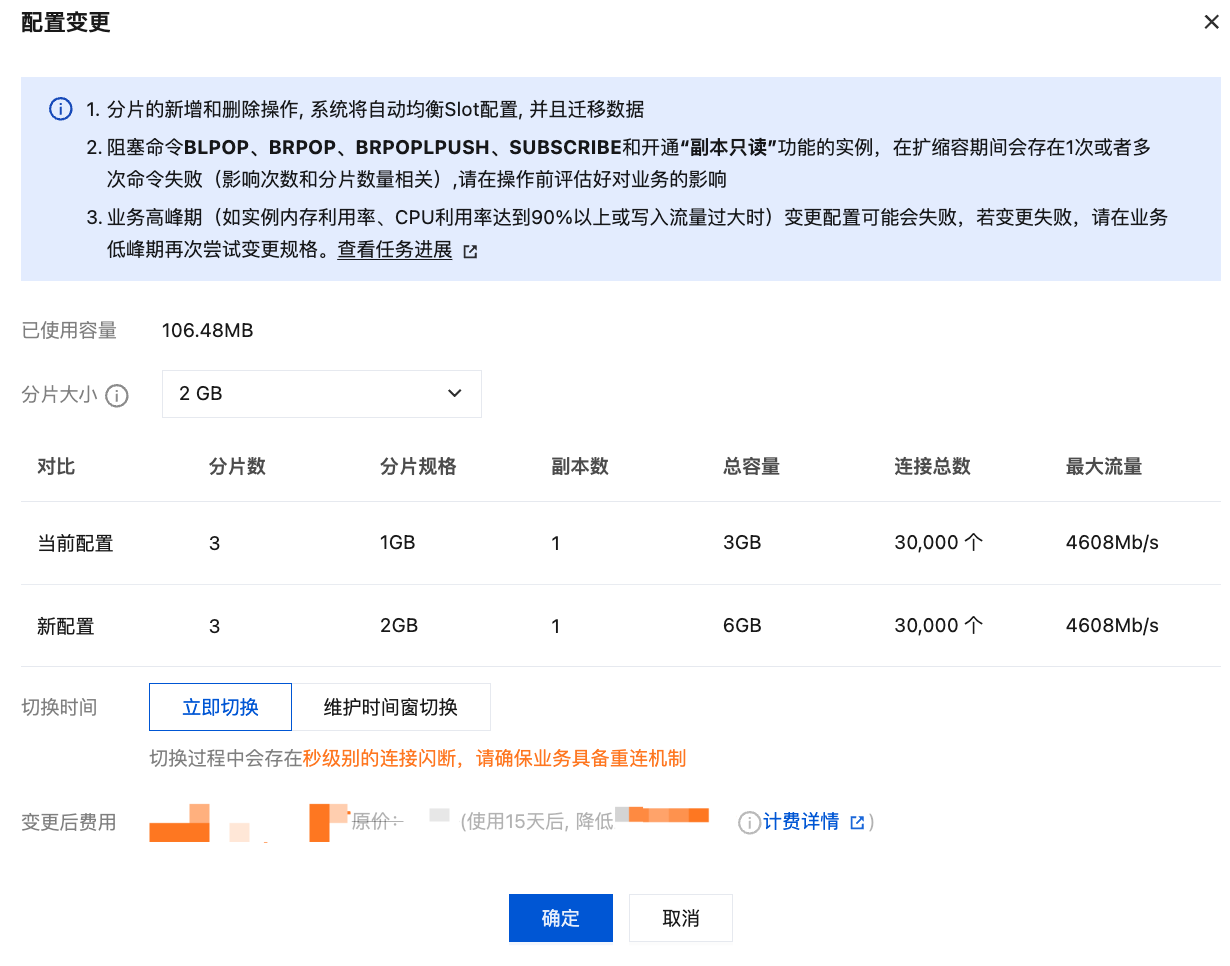
Select Configure > Reduce Node to enter the TencentDB for Redis® Configuration Changes page and reduce the capacity of each shard node. The configuration parameters for reducing nodes are similar to those for expanding nodes. The Shard Size refers to the capacity specification of each shard after reduction. The capacity of the instance after reduction must be greater than or equal to 1.3 times the used capacity. Please compare the capacity specifications before and after reduction to confirm whether they meet the requirements.

Parameter name
Description
Used Capacity
The used capacity of the current cluster instance.
Min Memory
The minimum memory specification per shard of the current cluster instance required to prevent the disk space from being used up.
Shard Size
The capacity specification per shard after scaling.
Comparison
Compare the current configuration with the new configuration, including Shard Quantity, Shard Specs, Replica Quantity, Total Capacity, Total Connections, and Max Traffic.
Configuration Change Fees
This parameter will be displayed if the billing mode is yearly/monthly subscription. You need to pay the price difference in case of capacity expansion, and subsequent fees will be charged based on the new specification. In case of capacity reduction, the amount to be refunded will be displayed.
Fees after Configuration Change
This parameter will be displayed if the billing mode is pay-as-you-go, indicating the hourly unit price after instance configuration adjustment. You can click Billing Details to view the billable items and billing formula and confirm the fees.
Select Configure > Add Replica to enter the TencentDB for Redis® Configuration Changes page. Select the desired number of replicas in the drop-down list next to Replica Quantity. Other parameters are similar to those for node expansion. For specific operations on adding replicas to multi-Availability Zone instances, please see Adding Replicas to Multi-AZ Deployed Instances.
Select Configure > Delete Replica to enter the TencentDB for Redis® Configuration Changes page. Select the desired number of replicas in the drop-down list next to Replica Quantity. Other parameters are similar to those for node expansion.
Select Configure > Add Shard to enter the TencentDB for Redis® Configuration Changes page. Select the desired number of shards in the drop-down list next to Shard Quantity. Other parameters are similar to those for node expansion.
Select Configure > Delete Shard to enter the TencentDB for Redis® Configuration Changes page. Select the desired number of shards in the drop-down list next to Shard Quantity. Other parameters are similar to those for node expansion.
5. Confirm the configuration adjustment and click OK.
6. Return to the instance list. After the instance becomes Running in the status, you can use it normally.

Related APIs

API Name
Feature
Upgrades the instance configuration