Replica Set
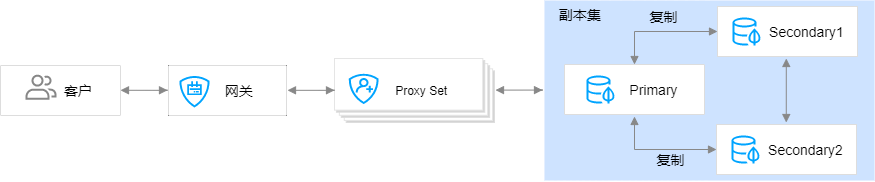
The replica set architecture of TencentDB for MongoDB achieves high availability by deploying multiple servers to store data replicas. Each replica set instance consists of one primary node and one or more secondary nodes.
Primary node: it is responsible for processing client read and write requests. There can be only one primary node in each replica set instance.
Secondary node: it replicates the data of the primary node by periodically polling the oplogs of the primary node with data consistency guaranteed. When the original primary node fails, a new primary node will be elected from multiple secondary nodes to ensure the high availability.
The architecture diagram of a replica set instance is as follows:

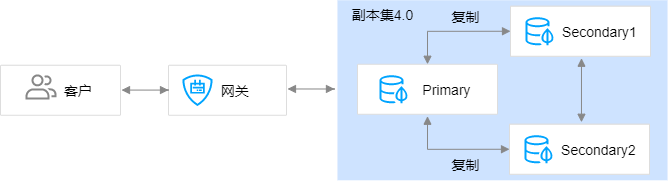
Replica set 4.0 simplifies the architecture by removing the proxy set component, allowing users to directly access each node, which improves performance.

Sharded Cluster
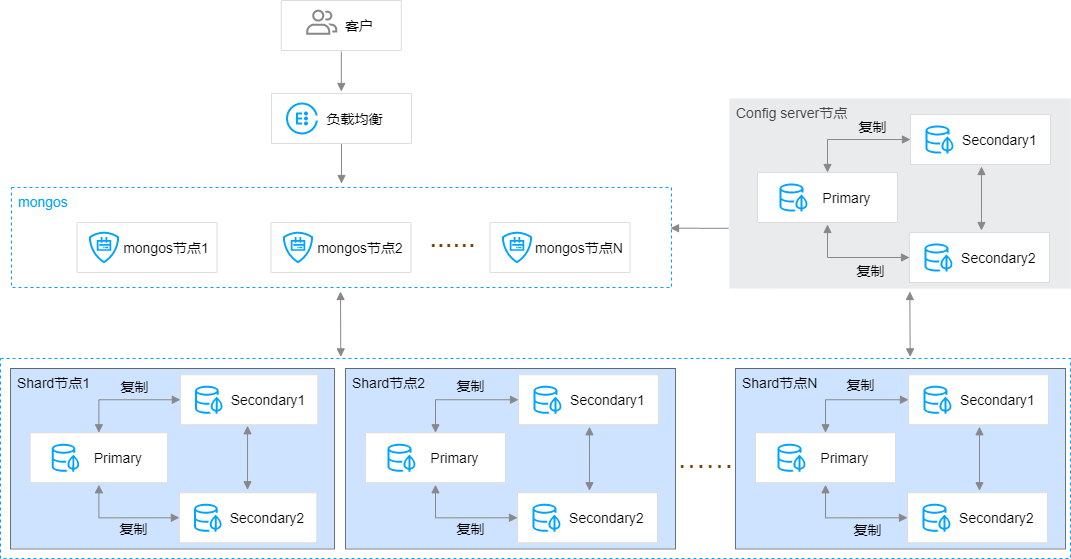
TencentDB for MongoDB's sharded cluster architecture implements the horizontal capacity expansion of data based on the replica set architecture by combining multiple replica sets. Each sharded cluster instance is composed of mongos nodes, config server nodes, shard nodes, and other components.
mongos node: responsible for receiving connection query requests from all client applications, routing the requests to the corresponding shards in the cluster, and splicing the received responses back to the clients. You can purchase multiple mongos nodes to achieve load balancing and failover. Each sharded cluster instance can contain 3–32 mongos nodes.
config server node: responsible for storing the metadata of the cluster and shard nodes, such as the cluster node information and routing information of sharded data. A config server node has a fixed specification of 1 CPU core, 2 GB memory, and 20 GB disk space in the form of 3-replica set by default, which cannot be modified.
shard node: responsible for sharding data storage on multiple servers. You can purchase multiple shard nodes to horizontally expand the data storage and read/write concurrency capabilities of the instance. Each sharded cluster instance can contain 2–20 shard nodes.

Product Specification Types
General Edition (Ten-Gigabit High IO)
TencentDB for MongoDB General Edition is a long-term stable database service deployed on high-performance, high-bandwidth servers. It uses local physical hard disks for data storage, achieving independent resource allocation and providing a dedicated runtime environment for each instance. It aims to offer high-performance, high-reliability, and easy-to-manage MongoDB managed services.
Cloud Disk Edition
TencentDB for MongoDB Cloud Disk Edition is a cloud-native architecture database service built on various cloud services such as Cloud Virtual Machine (CVM) and Cloud Block Storage (CBS). It fully integrates the capabilities of Tencent Cloud's underlying services, allowing for quick adjustment of computing specifications and rapid backup and restoration through cloud disk snapshots, providing more flexibility and convenience for product use.
The Cloud Disk Edition adopts a separated storage and computing architecture, allowing computing resources (such as CPU and memory) and storage resources (such as hard disk space) to be independently managed and scaled. Users can expand computing specifications within minutes without tedious data migration operations, greatly improving the flexibility and efficiency of database services.
The Cloud Disk Edition, through high-performance Cloud Block Storage (CBS) technology, supports efficient snapshot backup and snapshot rollback, quickly creating consistent snapshots of the database to ensure data integrity and consistency. When facing data recovery, the snapshot rollback feature allows you to conveniently restore the database to any historical point in time, achieving precise data recovery and significantly improving backup and rollback efficiency.
For the differences in features supported by the Cloud Disk Edition and the general version, see Feature.