The content of this page has been automatically translated by AI. If you encounter any problems while reading, you can view the corresponding content in Chinese.
This task is used in Web page performance experience scenarios. It can obtain users' experience data when accessing Web pages under different environments, such as ISPs, urban regions, browser versions, operating systems, and devices, to fully understand the page's performance. This document introduces how to create a page performance task.
3. Click Create Task at the top of the task list page.
4. Configure the basic information according to the following instructions.
Configuration Item
Description
Dial test type
Select "customized ping test".
Task type
Select the "page performance" task type.
probe address
Note:
When using TCP or UDP protocol for Ping monitoring, enter port.
Please enter the Web application address to be probed (must start with http:// or https://).
Example:
1. Domain name: http://www.tencent.com
2. Domain port: http://www.tencent.com:80Note: When using TCP or UDP protocol for Ping monitoring, the port must be specified.
Dial test task name
Custom ping test task name.
Test frequency
Supports dial test frequencies of 1 minute, 5 minutes, 10 minutes, 15 minutes, 30 minutes, 1 hour, 2 hours, and 4 hours. For example, selecting a 5-minute frequency means each dial test point is tested every 5 minutes.
Custom execution
Execute by default daily at a specified frequency. You can also customize the execution plan as needed. For example, you can set the dial test task to run from 8:00 AM to 9:00 AM every Monday. To learn about Cron expressions, please see Cron Expression Description.
Task tag
CAT combines with Tencent Cloud resource tag functionality to provide you with the ability to grant sub-account permissions by tag and tag accounting functionality. For more details, see Resource Tag to configure.
5. Configure the detection point according to the following instructions.
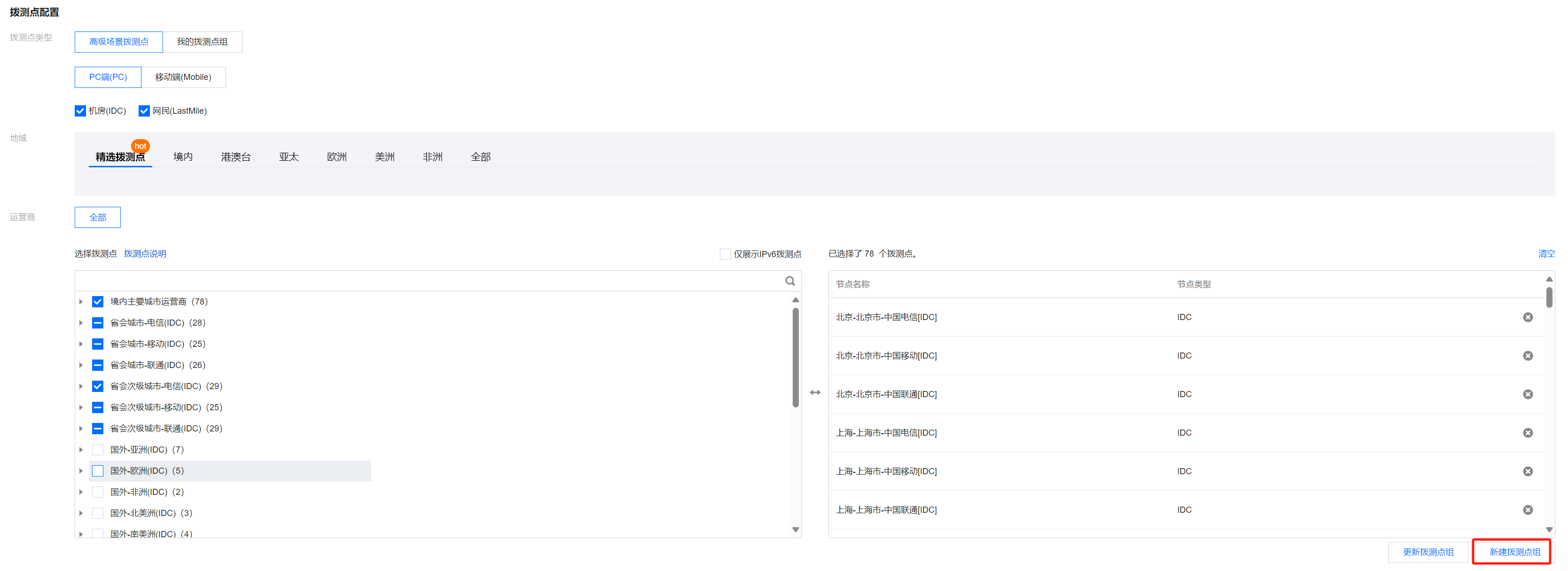
5.1 Selection method: Select a recommended test point group or a custom test point group (the recommended detection nodes are commonly used nodes).
5.2 Select a test point:
Advanced scenario test nodes: Page User Experience Monitoring, Streaming Lag Monitoring, Availability Testing under Poor Network Conditions, CDN Selection and Path Optimization. Covers IDCs, PC terminals, and mobile testing nodes inside and outside Chinese mainland.
Recommended test point group: Recommend commonly used test points.
Custom test point group: Select test point region > Select test point type > Check the test points in the box on the right. Test point type descriptions are as follows:
Dial Test Point Type
Description
PC client
IDC
The probe point deployed on a PC represents the PC user experience.
Internet users (LastMile)
The probe point deployed on the terminal user's PC represents the terminal PC user experience.
mobile terminal
The probe point deployed on the mobile terminal phone represents the mobile terminal customer.
My Testing Node Group: You can select commonly used testing node groups in "Advanced Scenario Test Point" and click Create Testing Node Group in the bottom-right corner. Next time you create a task, directly select my testing node group to quickly choose your created commonly used testing nodes.
Selection recommendation
Since the network environment of IDC is different from that of LastMile, IDC is more stable than LastMile.
If you want to monitor business availability, you can choose a relatively stable IDC.
To view the access experience and network conditions of end users, it is recommended to select LastMile or mobile terminals for multiple choices, and simulate the access experience of end users to applications.
6. Configure ping test parameters (optional). The system defaults to configuring commonly used ping test parameters for you. Alternatively, you can customize ping test rules. Configuration instructions are as follows:
Configuration Item
Description
Default Value
Ignore private IP
When the DNS resolution result is a private IP address (such as reserved addresses like 127.0.0.1 or 0.0.0.0), it will be judged as a probe failure. If this situation is not ignored, the test result will not be shown, and no alarm or probe cost will be generated.
-
Custom Host
Custom Host is used to specify the interpretation method of a domain name during probing, and is used to resolve the domain name to a static IP (or another domain name, similar to CNAME).
Support polling or random monitoring by IP address. For multiple IPs, use a half-width comma separator. For example:
When a page undergoes a 302 redirect, if the elements on the redirect page exceed the set value, the page is considered hijacked. Hijacking details can be checked by selecting options on the Multidimensional Analysis Page.
-
Traffic hijacking (hijacking flag)
Set matching key information. Traffic hijacking functionality, classify and count the situation of 302 redirects during page browsing. (The monitoring premise is the presence of a 302 element on the page; generally, monitor the situation after a 302 occurs in the base document.)
-
Page tampering
Supports multi-line input. Enter the page addresses that need to be monitored. Format: domain name:element. Elements can include wildcards. Multiple elements are allowed and separated by a vertical line (|).
The page address used for monitoring has displayed elements other than the domain name you entered. Common manifestations include behaviors such as pop-up ads, floating ads, and redirects.
For example: The page address you set is: www.cloud.tencent.com:|abc/efg/1.jpg. If elements other than the base documents under www.cloud.tencent.com or abc/efg/1.jpg appear, the page is considered tampered with.
-
DNS hijacking allowlist
When the DNS resolution result IP is not in this allowlist, it is considered hijacked. The hijacked result can be selected and viewed in the result details of Multidimensional Analysis.
-
DNS hijacking blocklist
Note:
Mobile page performance does not support blocklist setting.
When the DNS resolution result IP is in this blocklist, it is considered hijacked. The hijacked result can be selected and viewed in the result details of Multidimensional Analysis.
Mobile page performance does not support blocklist setting.