Help & Documentation>Tencent Kubernetes Engine>TKE General Cluster Guide>Network Management>GlobalRouter mode>Interconnection Between Intra-region and Cross-region Clusters in GlobalRouter Mode

Interconnection Between Intra-region and Cross-region Clusters in GlobalRouter Mode

Last updated: 2023-09-27 09:32:36

Scenario

Peering Connection is a high-bandwidth and high-quality connectivity service that supports communication among Tencent Cloud resources. You can achieve intra-region and cross-region communication among different clusters through a peering connection.

Preparations

The directions in this document are based on an existing cluster with nodes. If no such a cluster exists, create one by referring to Quickly Creating a Standard Cluster.
Refer to Creating a Peering Connection to establish a peering connection. Ensure that the peering connection is successfully established and that the instances can communicate with each other. If there are issues with the peering connection, check whether the console route table entries, CVM security group, and subnet ACL settings are configured correctly.

Instructions

Note
To achieve cross-region communication between clusters, please complete the following steps and then contact support to request the container routes to be connected, enabling container-to-container communication.

Getting container information

1. Log in to the TKE console and click Cluster in the left sidebar.
2. Click the ID or name of the cluster for which you need to set up inter-cluster communication to go to the details page of that cluster. For example, navigate to the "Basic Information" page of Cluster A.
3. Record the following information: Region, Node Network, and Container Network.
4. Repeat Step 3 - Step 4 to record the "Region", "Node Network", and "Container Network" information of another cluster's containers. For example, navigate to the "Basic Information" page of Cluster B and record the "Region", "Node Network", and "Container Network" information of Cluster B's containers.

Configuring route tables

1. Log in to the VPC console and select Peering Connection in the left sidebar.
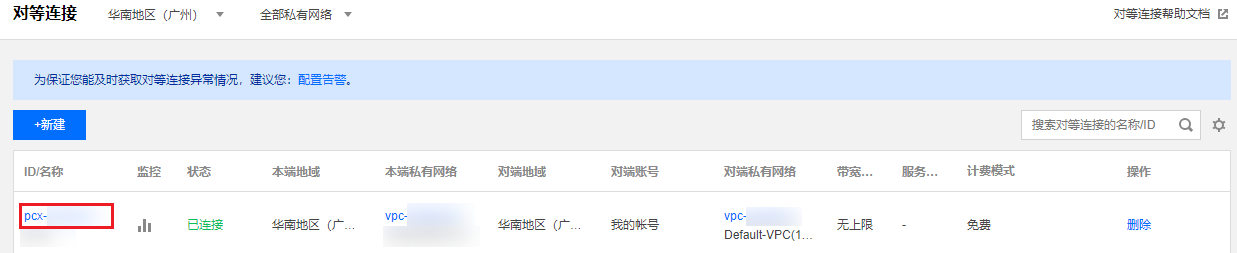
2. On the Peering Connection Management page, note down the ID/Name of the peering connection, as shown below:


3. In the left sidebar, click Subnets to access the subnet management page.
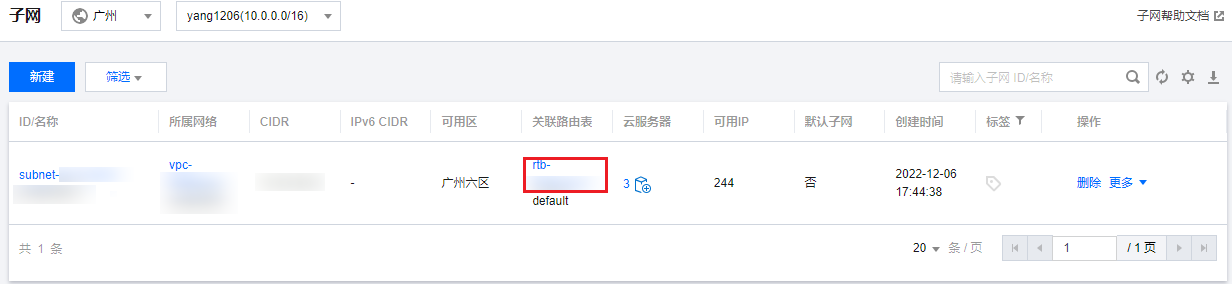
4. Click the associated route table for the local subnet of the peering connection, as shown below:


5. On the "Default Details" page of the associated route table, click +Add Routing Policy.
6. On the Add a route page, configure the following parameters:
Destination: Enter the IP address range of the container in Cluster B.
Next hop type: Select Peering connection.
Next hop: Select the established peering connection.
7. Click OK to complete the configuration of the local route table.
8. Repeat step 3 to step 7 to configure the route table of the opposite end.

Expected Result

Intro-region peering: the above directions should allow containers in different clusters to communicate.
Inter-region clusters: After the peering connection is successfully established, please contact support to enable container routing and achieve communication between containers.

Refer to Basic Remote Terminal Operations on how to log in to a container, and verify the peering connection as instructed below:
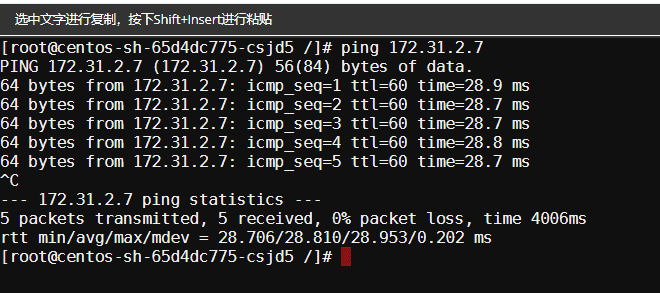
1. Log in to the container of Cluster A and access the container of Cluster B from within Cluster A's container, as shown in the following diagram:


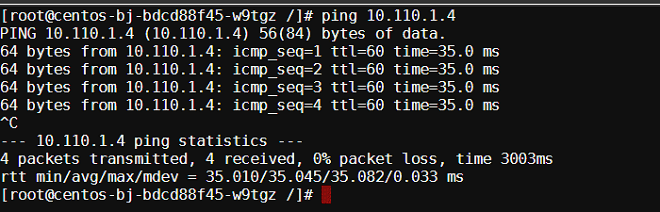
2. Log in to the container in Cluster B and access the container in Cluster A from within the container in Cluster B, as shown in the following diagram: