前提条件
在了解 TCR Addon 之前,建议您先完成以下准备工作:
2. 按照页面提示,开通容器镜像服务并完成相关服务授权操作。
简介
组件介绍
TCR Addon 是容器镜像服务 TCR 推出的容器镜像内网免密拉取的官方组件。在容器服务 TKE 集群中安装该组件后,集群节点可通过内网拉取企业版实例内容器镜像,且无需在集群资源 YAML 中显式配置 ImagePullSecret。可提高 TKE 集群内镜像拉取速度,简化镜像配置流程。
说明:
TKE 集群需为 v1.10.x 及以上版本。建议在v1.12.x 及以上版本中使用本组件。
Kubernetes 的
controller manager 组件的启动参数需要包含 authentication-kubeconfig 和 authorization-kubeconfig(TKE v1.12.x 默认启用)。部署在集群内的 Kubernetes 对象
名称 | 类型 | 资源量 | Namespace |
tcr-assistant-system | Namespace | 1 | - |
tcr-assistant-manager-role | ClusterRole | 1 | - |
tcr-assistant-manager-rolebinding | ClusterRoleBinding | 1 | - |
tcr-assistant-leader-election-role | Role | 1 | tcr-assistant-system |
tcr-assistant-leader-election-rolebinding | RoleBinding | 1 | tcr-assistant-system |
tcr-assistant-webhook-server-cert | Secret | 1 | tcr-assistant-system |
tcr-assistant-webhook-service | Service | 1 | tcr-assistant-system |
tcr-assistant-validating-webhook-configuration | ValidatingWebhookConfiguration | 1 | tcr-assistant-system |
imagepullsecrets.tcr.tencentcloudcr.com | CustomResourceDefinition | 1 | tcr-assistant-system |
tcr.ips* | ImagePullSecret CRD | (2-3) | tcr-assistant-system |
tcr.ips* | Secret | (2-3)*{Namespace No.} | tcr-assistant-system |
tcr-assistant-controller-manager | Deployment | 1 | tcr-assistant-system |
updater-config | ConfigMap | 1 | tcr-assistant-system |
hosts-updater | DaemonSet | {Node No.} | tcr-assistant-system |
组件资源用量
组件 | 资源用量 | 实例数量 |
tcr-assistant-controller-manager | CPU:500m memory:512Mi | 1 |
hosts-updater | CPU:100m memory:100Mi | 工作节点数 |
使用场景
免密拉取镜像
Kubernetes 集群拉取私有镜像需要创建访问凭证 Secret 资源,并配置资源 YAML 中的 ImagePullSecret 属性,显式指定已创建的 Secret。整体配置流程较为繁琐,且会因未配置 ImagePullSecret 或指定错误 Secret 而造成镜像拉取失败。
为解决以上问题,可在集群中安装 TCR 组件,组件将自动获取指定的 TCR 企业版实例的访问凭证,并下发至 TKE 集群指定命名空间内。在使用 YAML 创建或更新资源时,无需配置 ImagePullSecret,集群将会自动使用已下发的访问凭证拉取 TCR 企业版内镜像。
内网拉取镜像
组件将自动创建 DaemonSet 工作负载 host-updater,用于更新集群节点的 Host 配置,解析当前关联实例域名至已建立的内网访问链路专用内网 IP 上。请注意,本配置仅用于测试场景配置,建议直接使用 TCR 提供的内网链路自动解析功能,或直接使用 PrivateDNS 产品进行私有域解析配置,也可使用自建 DNS 服务自行管理解析。
限制条件
针对免密拉取镜像使用场景:
用户需具备指定 TCR 企业版实例的获取访问凭证的权限(即 CreateInstanceToken 接口调用权限)。建议具有 TCR 管理员权限的用户进行此组件的配置。
组件安装并生效后,请避免在资源 YAML 中重复指定 ImagePullSecret,以免节点使用错误的镜像拉取访问凭证导致镜像拉取失败。
组件权限说明
说明:
权限场景章节仅列举组件核心功能涉及的相关权限,完整权限列表请参考权限定义章节。
权限说明
该组件权限是当前功能实现的最小权限依赖。
权限场景
功能 | 涉及对象 | 涉及操作权限 |
需要免密拉取镜像功能,即主动帮客户管理镜像凭证(secret)。 | Secret | watch、create、update、patch、delete |
通过创建、更新 ConfigMap 来进行主控制器选举,保证组件高可用。 | ConfigMap | get、list、watch、create、update、patch、delete |
监听命名空间的创建和更新,在需要时自动注入镜像凭证。 | Namespace | get、list、watch |
查询和更新服务账号。 | ServiceAccount | get、list、watch、patch、update |
权限定义
apiVersion: rbac.authorization.k8s.io/v1kind: Rolemetadata:name: tcr-assistant-leader-election-rolenamespace: tcr-assistant-systemrules:- apiGroups:- ""resources:- configmapsverbs:- get- list- watch- create- update- patch- delete- apiGroups:- ""resources:- configmaps/statusverbs:- get- update- patch- apiGroups:- ""resources:- eventsverbs:- create---apiVersion: rbac.authorization.k8s.io/v1kind: ClusterRolemetadata:creationTimestamp: nullname: tcr-assistant-manager-rolenamespace: tcr-assistant-systemrules:- apiGroups:- ""resources:- secretsverbs:- create- delete- patch- update- watch- apiGroups:- admissionregistration.k8s.ioresources:- validatingwebhookconfigurationsverbs:- create- get- patch- apiGroups:- certificates.k8s.ioresources:- certificatesigningrequestsverbs:- create- delete- get- apiGroups:- certificates.k8s.ioresources:- certificatesigningrequests/approvalverbs:- update- apiGroups: ["certificates.k8s.io"]resources:- "signers"# # resourceNames:# # # Support legacy versions, before signerName was added# # - "kubernetes.io/legacy-unknown"verbs:- approve- apiGroups:- ""resources:- namespacesverbs:- get- list- watch- apiGroups:- ""resources:- namespaces/statusverbs:- get- apiGroups:- ""resources:- serviceaccountsverbs:- get- list- patch- update- watch- apiGroups:- ""resources:- serviceaccounts/statusverbs:- get- patch- update- apiGroups:- tcr.tencentcloudcr.comresources:- imagepullsecretsverbs:- create- delete- get- list- patch- update- watch- apiGroups:- tcr.tencentcloudcr.comresources:- imagepullsecrets/statusverbs:- get- patch- update
操作步骤
1. 登录 容器服务控制台,在左侧导航栏中选择集群。
2. 在集群列表中,单击目标集群 ID,进入集群详情页。
3. 选择左侧菜单栏中的组件管理,在组件管理页面单击新建。
4. 在新建组件管理页面中勾选 TCR,单击参数配置。
5. 在 TCR 组件参数设置页面,参考以下信息进行配置:
选择关联实例:选择当前登录账户下已有的 TCR 企业版实例,并确认当前登录用户具有创建实例长期访问凭证的权限。如果需要新建企业版实例,请在当前集群所在地域内新建。
配置免密拉取(默认启用):可选自动下发当前操作用户的访问凭证,或指定用户名及密码,可选配置免密拉取生效的命名空间及 ServiceAccount。建议均使用默认配置,避免新建命名空间后无法使用该功能。
配置内网解析(高级功能):确认集群与关联 TCR 实例已建立内网访问链路,并启用内网解析功能。请注意,本配置仅用于测试场景配置,建议直接使用 TCR 提供的内网链路自动解析功能,或直接使用 PrivateDNS 产品进行私有域解析配置,也可使用自建 DNS 服务自行管理解析。
6. 单击完成即可创建组件。后续如需修改组件相关配置,请先删除组件再重新配置安装。
注意:
删除组件不会同时删除自动创建的专属访问凭证,如需删除可前往容器镜像服务控制台手动禁用或删除。
原理说明
概述
TCR Assistant 用于帮助用户自动部署 Kubernetes
imagePullSecret 到任意 Namespace,并关联到该空间下的 ServiceAccount。在用户创建的工作负载当中没有明确指定imagePullSecret 和 serviceAccount 的情况下,Kubernetes 会尝试从当前命名空间下名为 default 的 ServiceAccount 资源中查找、匹配合适的 imagePullSecret。术语表
Name | 别名 | 描述 |
ImagePullSecret | ips, ipss | TCR Assistant 定义的 CRD。用于存储镜像仓库用户名与密钥,分发目标 Namespace 和目标 ServiceAccount。 |
实现原理
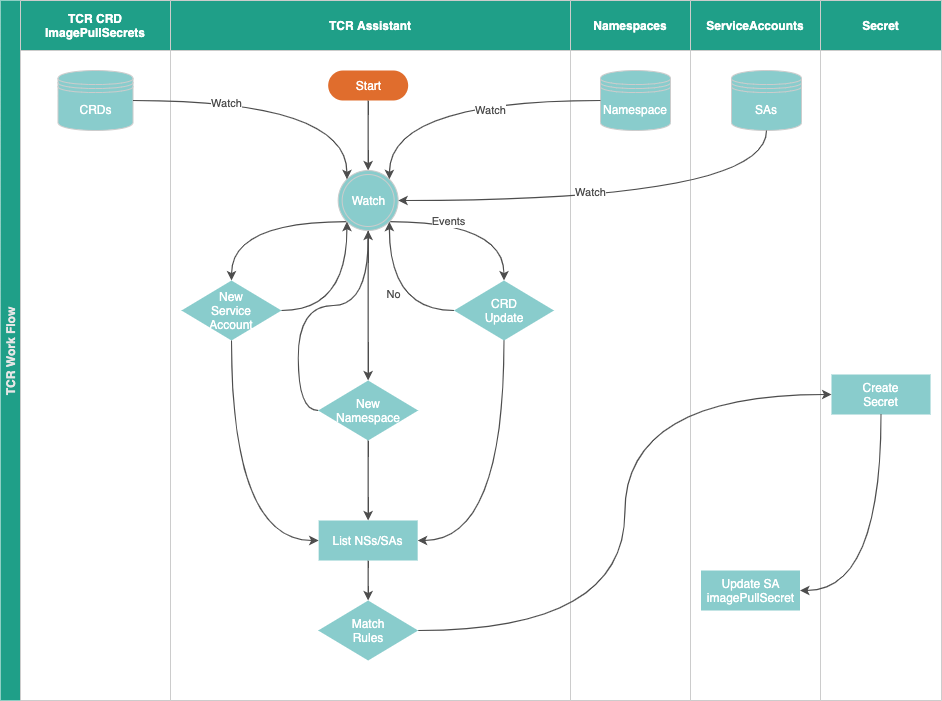
TCR Assistant 作为典型的 Kubernetes Operator,在部署 TCR Assistant 时,会在目标 Kubernetes 集群中创建 CRD 对象:
imagepullsecrets.tcr.tencentcloudcr.com。该 CRD 的 kind 为 ImagePullSecret,版本是 tcr.tencentcloudcr.com/v1,缩写为 ips 或者 ipss。TCR Assistant 通过持续观察(watch) Kubernetes 集群的
Namespace 和 ServiceAccount 资源,并在这些资源发生变更的时候,检查资源变化是否匹配 ImagePullSecret 中设定的规则来自动为用户部署拉取私有镜像仓库所需要的 Secret 资源。程序通常部署在 Kubernetes 集群内,使用 in cluster 模式访问 Kubernetes master API。创建 CRD 资源
说明:
密码(password):控制台获取的临时登录指令,有效期通常为1小时,这种方式主要用于人工测试。生产环境建议使用长期访问凭证。
用户名(username):为腾讯云账号 ID(如示例中的 100012345678),在控制台账号信息中获取。
域名(server):TCR 实例域名,如示例中的
fanjiankong-bj.tencentcloudcr.com。程序部署完成后,不会在目标 Kubernetes 集群部署任何的 TCR 镜像拉取密钥。此时可通过 kubectl 或 Client Go 新建
ImagePullSecret 资源。# 新建 ImagePullSecret 资源$ kubectl create -f allinone/imagepullsecret-sample.yamlimagepullsecret.tcr.tencentcloudcr.com/imagepullsecret-sample created
ImagePullSecret 资源示例文件(allinone/imagepullsecret-sample.yaml):apiVersion: tcr.tencentcloudcr.com/v1kind: ImagePullSecretmetadata:name: imagepullsecret-samplespec:namespaces: "*"serviceAccounts: "*"docker:username: "100012345678" #替换为您的腾讯云账号ID或长期凭证用户名password: "eyJhbGciOiJSUzI1NiIsImt..." #替换为您获取的有效令牌(Token)server: fanjiankong-bj.tencentcloudcr.com #替换为您的TCR实例域名
ImagePullSecret spec 字段解释如下表:字段 | 作用 | 注释 |
namespaces | NameSpace 匹配规则 | * 或者空字符表示匹配任意;要匹配任意多个 NameSpace 则使用 , 分隔多个资源名称。注意:不支持任何表达式,需要明确填写资源名称。 |
serviceAccounts | serviceAccounts 匹配规则 | * 或者空字符表示匹配任意;要匹配任意多个 ServiceAccount 则使用 , 分隔多个资源名称。注意:不支持任何表达式,需要明确填写资源名称。 |
docker.server | 镜像仓库域名 | 仅填写仓库域名。 |
docker.username | 镜像仓库用户名 | 请确保用户在镜像仓库拥有足够的访问权限。 |
docker.password | 镜像仓库用户名所对应的密码 |
创建完成后,可以通过以下命令观察 TCR Assistant 执行结果:
# 列出 ImagePullSecret 信息$ kubectl get ipssNAME NAMESPACES SERVICE-ACCOUNTS SECRETS-DESIRED SECRETS-SUCCESSimagepullsecret-sample * * 10 10# 查看详细信息$ kubectl describe ipssName: imagepullsecret-sampleNamespace:Labels: <none>Annotations: <none>API Version: tcr.tencentcloudcr.com/v1Kind: ImagePullSecretMetadata:Creation Timestamp: 2021-12-01T06:47:34ZGeneration: 1Manager: kubectl-client-side-applyOperation: UpdateTime: 2021-12-01T06:47:34ZAPI Version: tcr.tencentcloudcr.com/v1Manager: managerOperation: UpdateTime: 2021-12-01T06:47:38ZResource Version: 30389349UID: 2109f384-240b-405c-9ce8-73ce938a7c2fSpec:Docker:Password: tcr.jwt.tokenServer: fanjiankong-bj.tencentcloudcr.comUsername: 100012345678Namespaces: *Service Accounts: *Status:S As Desired: 47S As Success: 1Secret Update Successful:Namespaced Name: kube-public/tcr.ipsimagepullsecret-sampleUpdated At: 2021-12-01T06:47:36ZNamespaced Name: devtools/tcr.ipsimagepullsecret-sampleUpdated At: 2021-12-01T06:47:36ZNamespaced Name: demo/tcr.ipsimagepullsecret-sampleUpdated At: 2021-12-01T06:47:36ZNamespaced Name: kube-system/tcr.ipsimagepullsecret-sampleUpdated At: 2021-12-01T06:47:36ZNamespaced Name: tcr-assistant-system/tcr.ipsimagepullsecret-sampleUpdated At: 2021-12-01T06:47:36ZNamespaced Name: kube-node-lease/tcr.ipsimagepullsecret-sampleUpdated At: 2021-12-01T06:47:36ZNamespaced Name: cert-manager/tcr.ipsimagepullsecret-sampleUpdated At: 2021-12-01T06:47:36ZNamespaced Name: default/tcr.ipsimagepullsecret-sampleUpdated At: 2021-12-01T06:47:36ZNamespaced Name: afm/tcr.ipsimagepullsecret-sampleUpdated At: 2021-12-01T06:47:37ZNamespaced Name: lens-metrics/tcr.ipsimagepullsecret-sampleUpdated At: 2021-12-01T06:47:37ZSecrets Desired: 10Secrets Success: 10Service Accounts Modify Successful:Namespaced Name: default/defaultUpdated At: 2021-12-01T06:47:38ZEvents: <none>
注意:
如果需要更新 TCR Assistant 部署的
Secret 资源,无需删除重建 ImagePullSecret 资源,只需要编辑其中 docker.username 和 docker.password 字段即可生效。例如:$ kubectl edit ipss imagepullsecret-sample
Namespace 变更
TCR Assistant 在观察到有新的 Kubernetes
Namespace 资源创建后,会首先校验名称是否与 ImagePullSecret 资源中的 namespaces 字段匹配。如果资源名称不匹配,跳过后续流程;若资源名称匹配,则会调用 Kubernetes API 创建 Secret 资源,并添加 Secret 资源名称到 ServiceAccount 资源的 imagePullSecrets 字段中。示例如下:# 查看 newns 下自动部署的 Secret$ kubectl get secrets -n newnsNAME TYPE DATA AGEtcr.ipsimagepullsecret-sample kubernetes.io/dockerconfigjson 1 7m2sdefault-token-nb5vw kubernetes.io/service-account-token 3 7m2s# 查看 newns 下自动关联到 ServiceAccount 资源 default 中的 Secret$ kubectl get serviceaccounts default -o yaml -n newnsapiVersion: v1imagePullSecrets:- name: tcr.ipsimagepullsecret-samplekind: ServiceAccountmetadata:creationTimestamp: "2021-12-01T07:09:56Z"name: defaultnamespace: newnsresourceVersion: "30392461"uid: 7bc67144-3685-4666-ba41-b1447bbbaa38secrets:- name: default-token-nb5vw
ServiceAccount 变更
TCR Assistant 在观察到有新的 Kubernetes
ServiceAccount 资源创建后,会首先校验名称是否与 ImagePullSecret 资源中的 serviceAccounts 字段匹配。如果资源名称不匹配,跳过后续流程;若资源名称匹配,则会调用 Kubernetes API 创建或更新 Secret 资源,并添加 Secret 资源名称到 ServiceAccount 资源的 imagePullSecrets 字段当中。示例如下:# 在 newns 新建 ServiceAccount 资源$ kubectl create sa kung -n newnsserviceaccount/kung created# 查看 newns 下自动关联到新建 ServiceAccount 资源 kung 中的 Secret$ kubectl get serviceaccounts kung -o yaml -n newnsapiVersion: v1imagePullSecrets:- name: tcr.ipsimagepullsecret-samplekind: ServiceAccountmetadata:creationTimestamp: "2021-12-01T07:19:12Z"name: kungnamespace: newnsresourceVersion: "30393760"uid: e236829e-d88e-4feb-9e80-5e4a40f2aea2secrets:- name: kung-token-fljt8


