TensorFlow is an end-to-end open-source platform for machine learning. It possesses a comprehensive and flexible ecosystem, encompassing a variety of tools, libraries, and community resources. This ecosystem empowers researchers to propel the advancement of cutting-edge machine learning technologies, and enables developers to effortlessly construct and deploy applications bolstered by machine learning.
Effortlessly construct models using intuitive high-level APIs such as Keras in an eager execution environment, facilitating the swift iteration of machine learning models and the straightforward debugging of these models.
Conduct reliable machine learning production anytime, anywhere. Regardless of the language you utilize, you can effortlessly train and deploy models in the cloud, locally, within browsers, or on devices.
Powerful research experimentation
A simple yet flexible architecture that expedites the transformation of novel ideas from concept to code, subsequently facilitating the creation of advanced models, and ultimately enabling their release to the public.
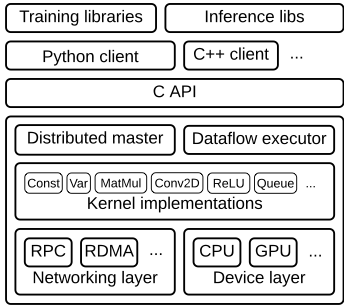
TensorFlow Architecture
Client
Defines the computational process as a data flow graph. Utilizes _Session_ to initialize the execution of the data flow graph.
Distributed Master
Prunes certain specific subgraphs within the graph, namely the parameters defined in Session.run(). Segments the subgraph into multiple parts that run across different processes and devices. Distributes the graph to various worker processes. Initiates the computation of the subgraph by the worker processes.
Worker Service (for each task)
Implements scheduling graph operations using kernels and executes on appropriate hardware (CPU, GPU, etc.). Sends or receives the results of operations to or from other worker processes.
Kernel Implementation
Executes an independent graph operation computation.
EMR Supports TensorFlow
TensorFlow Version: v1.14.0
Currently, TensorFlow only supports operation on CPU models and does not yet support GPU models.
Supports distributed training using TensorFlow on Spark.
TensorFlow Development Examples
This document uses TensorFlow v1.4.4 as an example. First, TensorFlow needs to be installed. Switch to the root user, the password is the one set when creating the EMR cluster. Install the python-pip tool first, then install the dependent packages: