【C++】B2113 输出亲朋字符串


💯前言
💯题目描述
如下图所示,题目要求生成一个“亲朋字符串”,具体规则如下: B2113 输出亲朋字符串
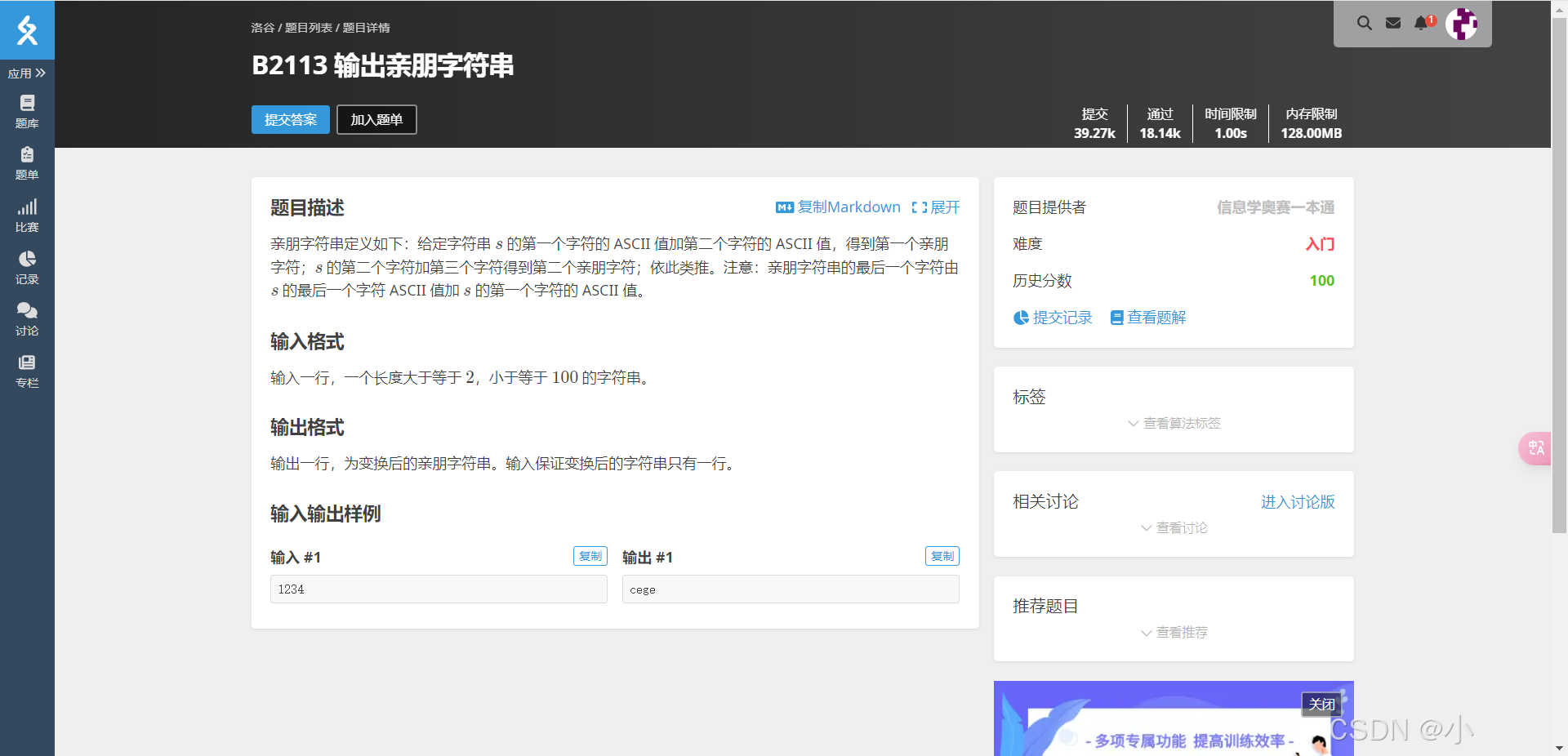
亲朋字符串定义如下: 给定字符串
s,它的“亲朋字符串”按以下规则生成:
- 第1个字符等于
s中第1个字符的ASCII值加第2个字符的ASCII值; - 第2个字符等于
s中第2个字符的ASCII值加第3个字符的ASCII值; - …以此类推;
- 如果是字符串的最后一个字符,则与字符串第1个字符相加。
输入格式:
- 一行字符串,长度大于2且小于等于100。
输出格式:
- 一行“亲朋字符串”。
示例输入输出
输入:
1234输出:
cege💯思路分析
在本题中,字符串的核心操作包括以下几点:
- 逐字符遍历: 我们需要逐一处理字符串的每个字符,将其与下一个字符相加。
- 循环处理边界: 特别是字符串的最后一个字符,需要将其与第一个字符相加。
- ASCII计算: 两个字符相加的结果实际上是ASCII值的和,需要将结果重新转换为字符。
- 内存安全: 避免字符串越界的问题是代码实现中需要注意的核心。
接下来,我们将通过三种代码实现来逐步解析。
💯我的做法及分析
代码实现
#include <iostream>
#include <cstdio>
#include <cstring>
using namespace std;

const int N = 105; // 定义最大长度
char s1[N]; // 输入字符串
char s2[N]; // 输出字符串

int main() {
    scanf("%s", s1); // 读取输入
    int len = strlen(s1); // 获取字符串长度

    for (int i = 0; i < len; i++) {
        if (i == len - 1)
            s2[i] = s1[i] + s1[0]; // 最后一个字符和第一个字符相加
        else
            s2[i] = s1[i] + s1[i + 1]; // 当前字符与下一个字符相加
    }

    s2[len] = '\0'; // 补充字符串结束符
    cout << s2 << endl; // 输出结果

    return 0;
}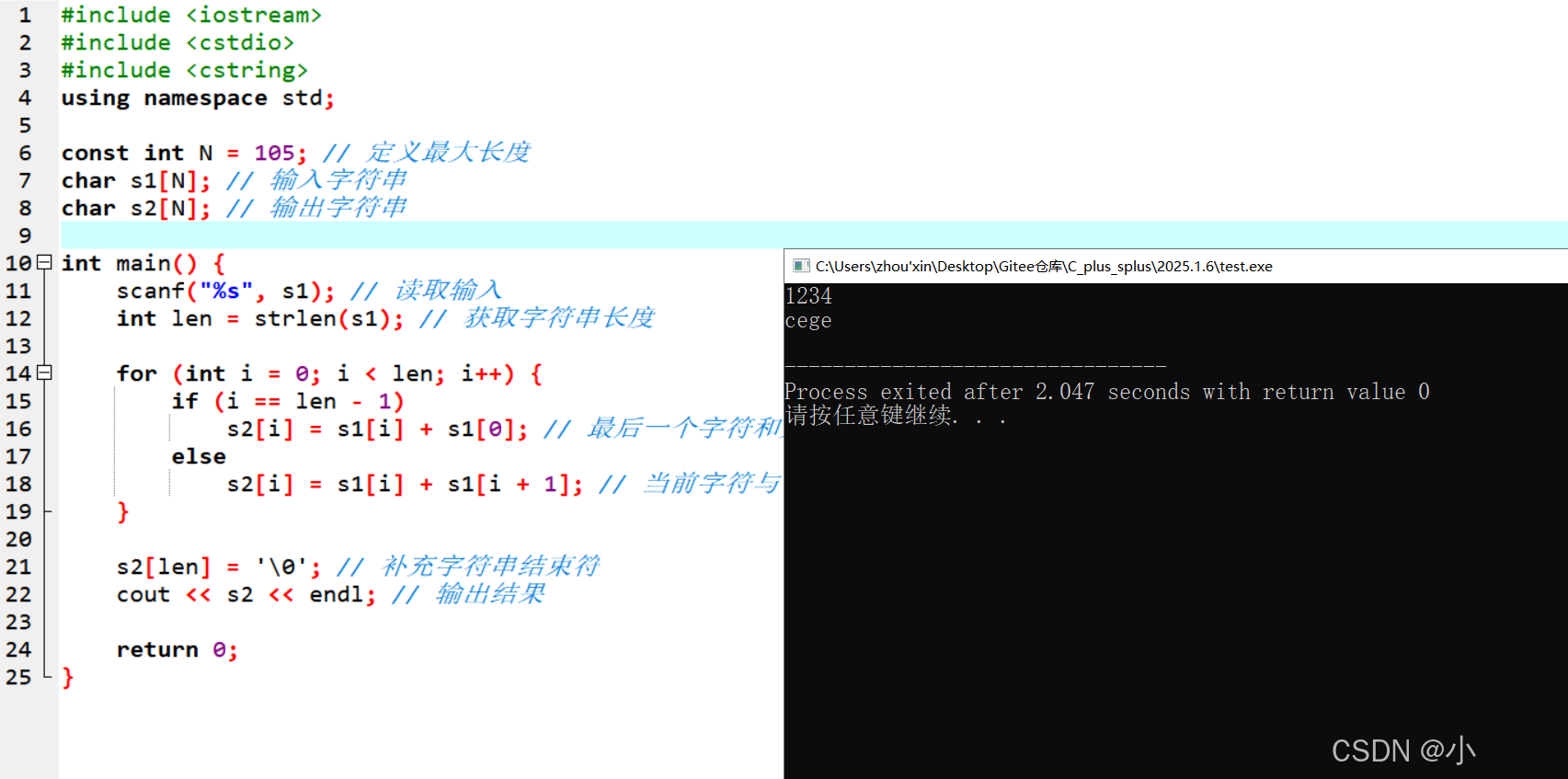
运行分析
- 输入
1234后,程序依次计算:- 第1个字符:
'1' + '2' = 49 + 50 = 99,ASCII值99对应字符'c'; - 第2个字符:
'2' + '3' = 50 + 51 = 101,ASCII值101对应字符'e'; - 第3个字符:
'3' + '4' = 51 + 52 = 103,ASCII值103对应字符'g'; - 第4个字符:
'4' + '1' = 52 + 49 = 101,ASCII值101对应字符'e'。
- 第1个字符:
- 输出结果为
cege。
优点与不足
- 优点:
- 使用数组存储结果,方便调试和后续操作。
- 逻辑清晰,易于理解。
- 不足:
- 对最后一个字符的处理需要特殊判断,显得不够简洁。
- 若忘记手动添加字符串结束符,可能会导致程序输出异常。
💯老师的第一种做法及分析
代码实现
#include <iostream>
using namespace std;

const int N = 110;
char str[N];

int main() {
    cin >> str; // 输入字符串
    int i = 0;

    while (str[i + 1]) { // 遍历到倒数第二个字符
        char tmp = str[i] + str[i + 1]; // 当前字符与下一个字符相加
        cout << tmp; // 输出结果
        i++;
    }

    // 单独处理最后一个字符与第一个字符
    cout << (char)(str[i] + str[0]) << endl;
    return 0;
}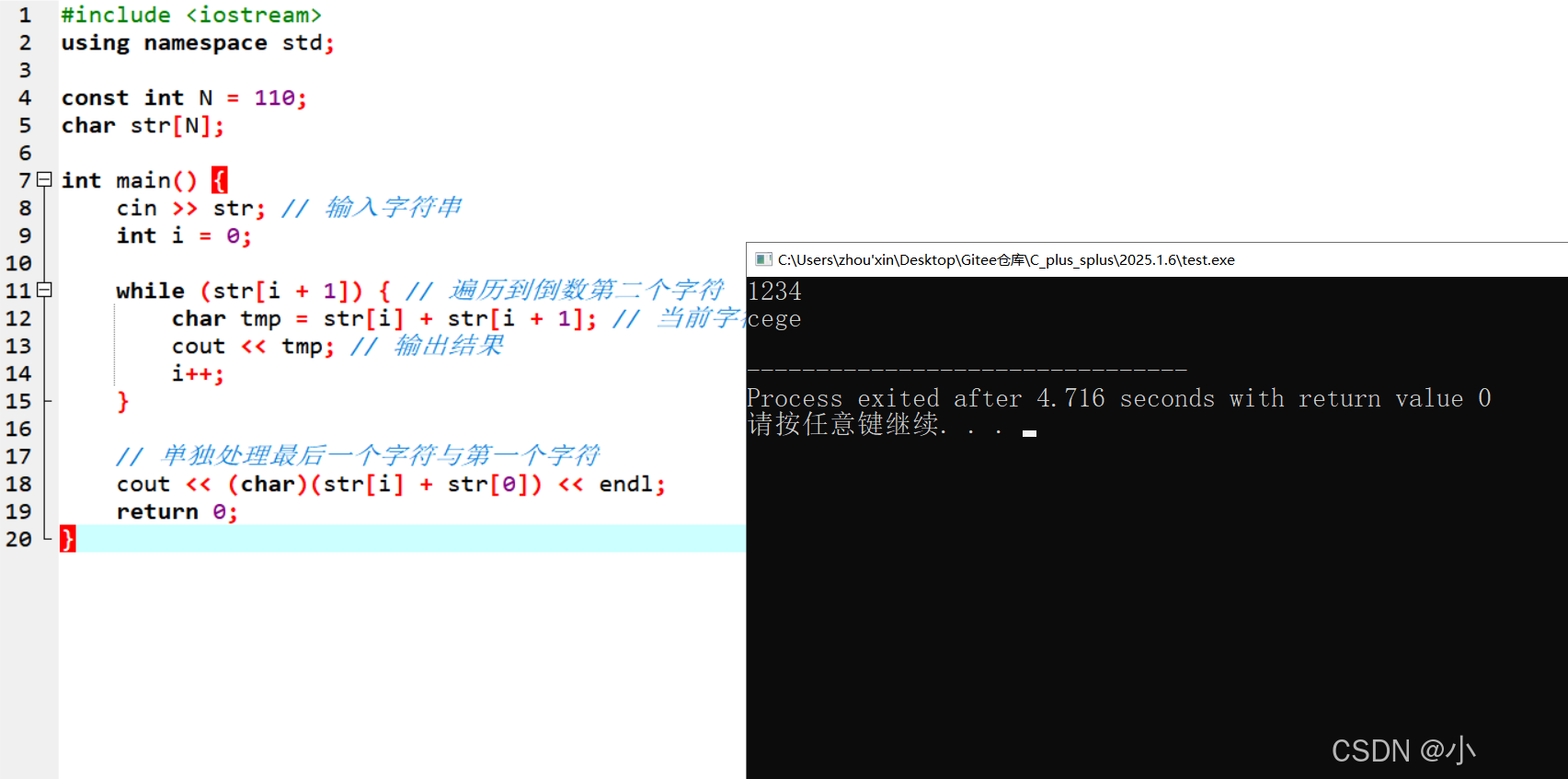
优点与不足
- 优点:
- 直接输出,无需额外数组存储结果。
- 逻辑简单,避免了对字符串结束符的显式处理。
- 不足:
- 需要特判最后一个字符,稍显复杂。
- 输出的结果直接依赖于循环条件
str[i + 1],对于初学者来说可能不够直观。
- 这类题⽬就是精确的控制下标,防⽌越界,算准下标。
- cout 在打印数据的时候是需要明确知道打印数据的类型的,⽅法1中 str[i] + str[0] 算的结果直接打印就被编译器当做整数打印了,所以我们做了 (char) 的强制类型转换。
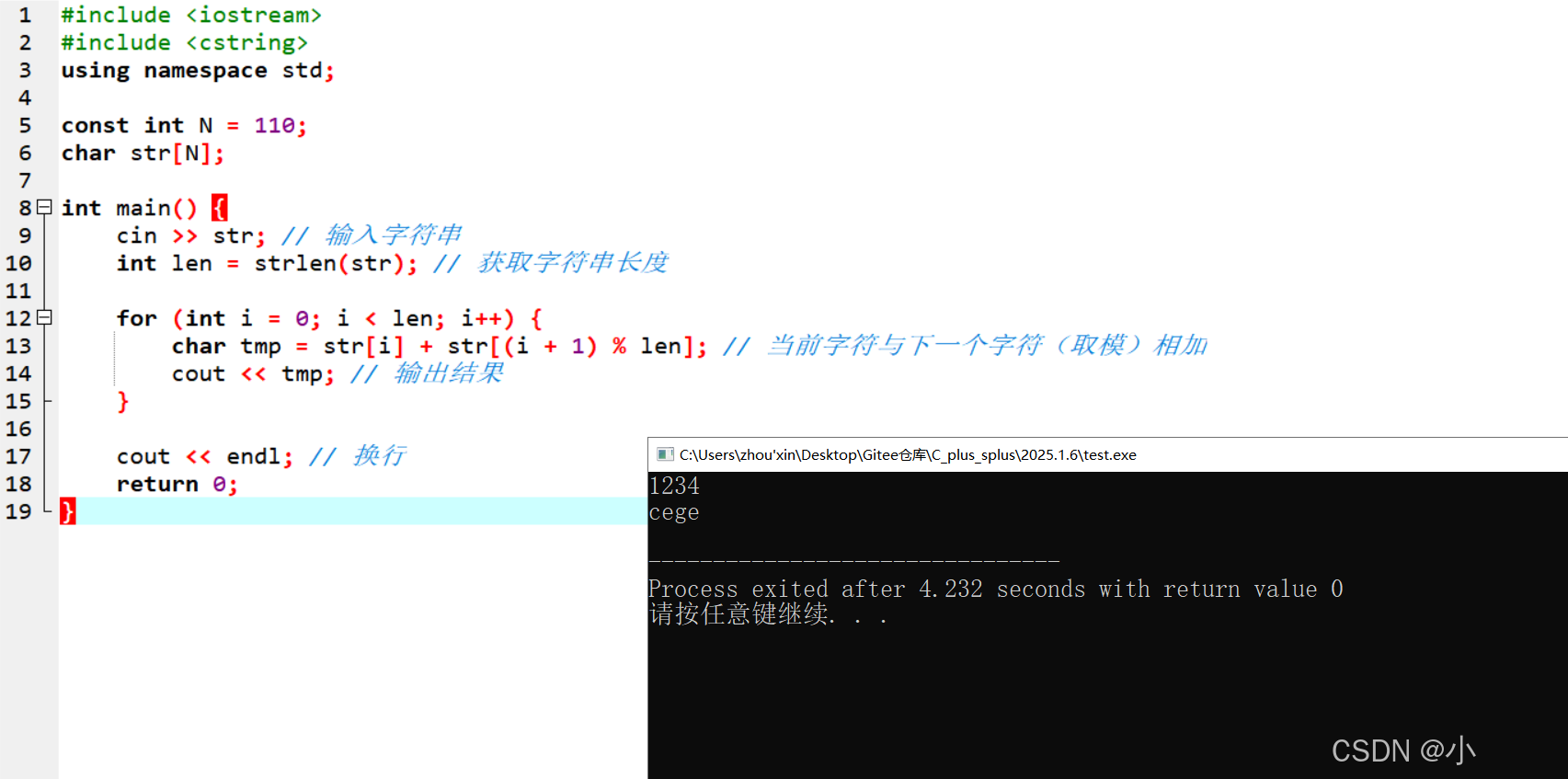
💯老师的第二种做法及分析
代码实现
#include <iostream>
#include <cstring>
using namespace std;

const int N = 110;
char str[N];

int main() {
    cin >> str; // 输入字符串
    int len = strlen(str); // 获取字符串长度

    for (int i = 0; i < len; i++) {
        char tmp = str[i] + str[(i + 1) % len]; // 当前字符与下一个字符(取模)相加
        cout << tmp; // 输出结果
    }

    cout << endl; // 换行
    return 0;
}
优点与不足
- 优点:
- 使用取模运算
% len统一处理了首尾字符的关系,无需特殊判断。 - 代码结构简洁,逻辑清晰。
- 使用取模运算
- 不足:
- 如果不熟悉取模运算的读者,可能需要额外理解其含义。
示例分析
对于输入1234:
- 第1个字符:
str[0] + str[1] = '1' + '2' = 99,输出c; - 第2个字符:
str[1] + str[2] = '2' + '3' = 101,输出e; - 第3个字符:
str[2] + str[3] = '3' + '4' = 103,输出g; - 第4个字符:
str[3] + str[0] = '4' + '1' = 101,输出e。
最终输出cege。
💯方法对比总结
比较维度 | 我的做法 | 老师的第一种做法 | 老师的第二种做法 |
|---|---|---|---|
逻辑复杂度 | 较高,需要特判最后一个字符 | 较低,需要单独处理最后一个字符 | 最低,通过取模简化逻辑 |
代码简洁性 | 较为繁琐 | 中等 | 最为简洁 |
内存使用 | 使用额外数组存储结果 | 无额外数组 | 无额外数组 |
新手友好性 | 初学者容易理解 | 容易理解 | 可能需额外解释取模的用法 |
💯拓展与优化
加强鲁棒性: 在所有实现中,都没有处理字符串为空的情况。如果输入为空,代码可能会出错。可以通过在读取输入后加上检查来解决:
if (strlen(str) == 0) {
    cout << endl;
    return 0;
}支持std::string: 如果将char数组替换为std::string,代码将更加现代化:
#include <iostream>
#include <string>
using namespace std;

int main() {
    string str;
    cin >> str;
    int len = str.length();

    for (int i = 0; i < len; i++) {
        char tmp = str[i] + str[(i + 1) % len];
        cout << tmp;
    }
    cout << endl;
    return 0;
}
适配Unicode字符: 如果需要支持更广泛的字符集,可以使用wchar_t或UTF-8编码。
💯小结
通过这道亲朋字符串题目,我们不仅复习了C++中的字符串操作,还深入理解了下标控制、ASCII计算、以及边界处理等细节。在学习代码的过程中,不同的实现方式展现了从“解决问题”到“简洁优雅”的进阶过程。希望这篇文章能够帮助读者加深对C++字符串处理的理解,同时激发更多的编程灵感!
本文参与 腾讯云自媒体同步曝光计划,分享自作者个人站点/博客。
原始发表:2025-01-07,如有侵权请联系 cloudcommunity@tencent.com 删除
评论
登录后参与评论
推荐阅读
目录
腾讯云开发者

Copyright © 2013 - 2026 Tencent Cloud. All Rights Reserved. 腾讯云 版权所有
深圳市腾讯计算机系统有限公司 ICP备案/许可证号:粤B2-20090059  粤公网安备44030502008569号
腾讯云计算(北京)有限责任公司 京ICP证150476号 | 京ICP备11018762号