《C++ 程序设计》第 4 章 - 类与对象

《C++ 程序设计》第 4 章 - 类与对象

啊阿狸不会拉杆
发布于 2026-01-21 12:33:23
发布于 2026-01-21 12:33:23
在 C++ 编程世界中,类与对象是面向对象程序设计(OOP)的核心基石。从简单的数据封装到复杂的继承多态,类与对象机制为我们提供了模块化、可复用、易维护的代码组织方式。本章将全面解析类与对象的核心概念、语法规则及实战应用,带你从面向过程思维平滑过渡到面向对象思维。
本章知识思维导图
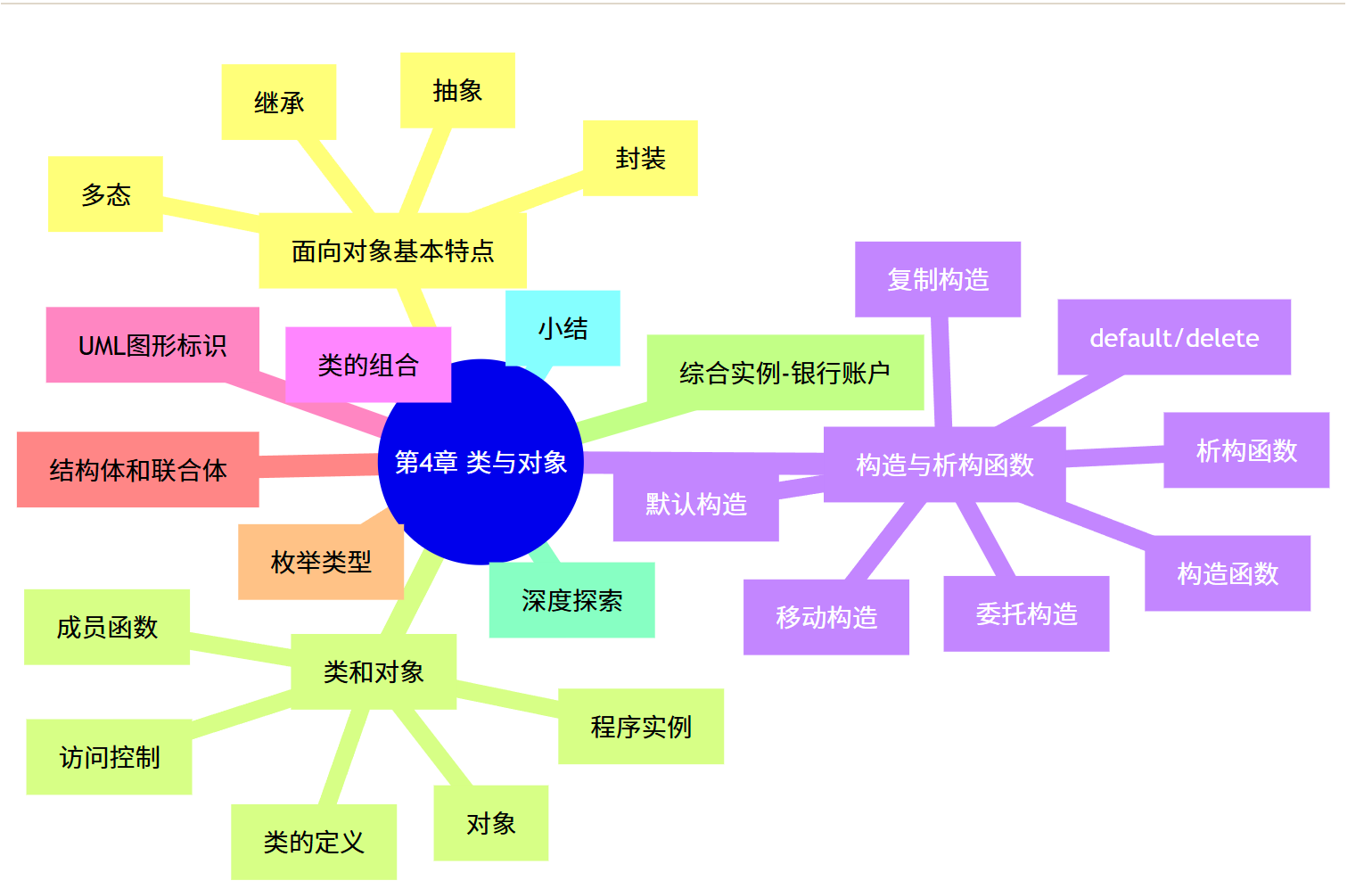
4.1 面向对象程序设计的基本特点
面向对象程序设计(OOP)是一种以 "对象" 为中心的编程思想,其核心特点可概括为抽象、封装、继承和多态四大支柱。
4.1.1 抽象
抽象是从具体事物中提取核心特征而忽略次要细节的过程。在编程中,我们通过类来实现抽象,聚焦于 "是什么" 而非 "怎么做"。
例如:描述 "汽车" 时,我们关注颜色、品牌、行驶功能,而非发动机内部结构。
4.1.2 封装
封装是将数据(属性)和操作数据的函数(方法)捆绑在一起,并隐藏内部实现细节,仅对外提供接口。这提高了安全性和模块化。
- 数据隐藏:内部数据仅能通过类提供的方法访问
- 接口公开:对外提供有限的交互方式
// 封装示例:时钟类
class Clock {
private:
    // 私有数据(隐藏)
    int hour, minute, second;
public:
    // 公开接口(访问控制)
    void setTime(int h, int m, int s) {
        hour = h;
        minute = m;
        second = s;
    }
    void showTime() {
        cout << hour << ":" << minute << ":" << second << endl;
    }
};
4.1.3 继承
继承允许新类(子类)继承现有类(父类)的属性和方法,实现代码复用和扩展。
例如:"学生" 类可以继承 "人" 类的姓名、年龄属性,再添加学号、专业等特有属性。
4.1.4 多态
多态指同一接口(函数名)在不同对象上有不同实现,程序运行时根据对象类型动态选择执行的代码。
例如:"动物" 类的 "发声" 方法,在 "猫" 类中实现为 "喵喵叫",在 "狗" 类中实现为 "汪汪叫"。
4.2 类和对象
类是对象的模板,定义了对象的属性和行为;对象是类的实例,是具体存在的实体。
4.2.1 类的定义
类通过class关键字定义,包含数据成员(属性)和成员函数(方法)。
// 类定义的基本格式
class 类名 {
    访问控制符:
        数据成员;  // 属性
        成员函数声明;  // 方法
};

// 成员函数实现(类外)
返回类型 类名::成员函数名(参数列表) {
    // 函数体
}
4.2.2 类成员的访问控制
C++ 通过访问控制符限制成员的访问权限,实现封装:
访问控制符 | 访问范围 |
|---|---|
public | 类内、类外、子类均可访问 |
private | 仅类内可访问(默认) |
protected | 类内和子类可访问,类外不可访问 |
class Person {
public:  // 公开成员
    string name;  // 姓名
    void setAge(int a);  // 设置年龄的方法

private:  // 私有成员
    int age;  // 年龄(直接访问被限制)

protected:  // 保护成员
    string idCard;  // 身份证号(子类可访问)
};
4.2.3 对象
对象是类的实例化,通过类名 对象名创建。可通过.运算符访问对象的成员。
// 创建对象并使用
int main() {
    Person p;  // 创建Person类对象p
    p.name = "张三";  // 访问public成员
    p.setAge(20);  // 调用public成员函数
    // p.age = 20;  // 错误:private成员不可直接访问
    return 0;
}
4.2.4 类的成员函数
成员函数分为内联函数和非内联函数:
- 内联函数:函数体在类内定义,编译时直接嵌入调用处,提高执行效率(适合短函数)
- 非内联函数:类内声明,类外实现
class Circle {
private:
    double radius;  // 半径
public:
    // 内联函数(类内实现)
    void setRadius(double r) {
        radius = r;
    }

    // 成员函数声明(类外实现)
    double getArea();  // 计算面积
    double getPerimeter();  // 计算周长
};

// 类外实现成员函数(需加类名限定)
double Circle::getArea() {
    return 3.14159 * radius * radius;
}

double Circle::getPerimeter() {
    return 2 * 3.14159 * radius;
}
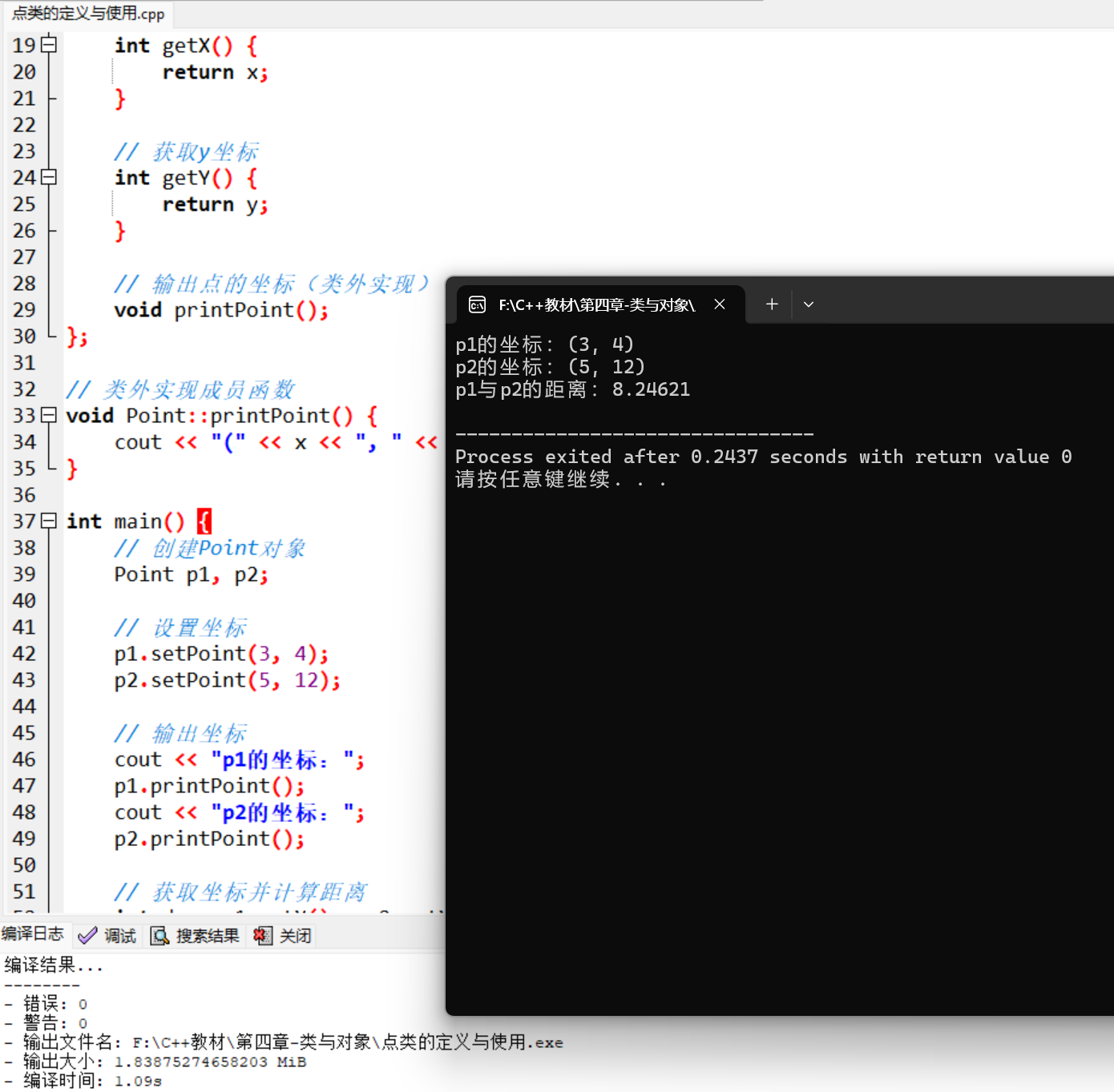
4.2.5 程序实例:点类的定义与使用
下面通过完整实例展示类的定义、对象创建和成员访问:
#include <iostream>
using namespace std;

// 点类:描述平面上的点
class Point {
private:
    int x;  // x坐标
    int y;  // y坐标

public:
    // 设置坐标(内联函数)
    void setPoint(int x_, int y_) {
        x = x_;
        y = y_;
    }

    // 获取x坐标
    int getX() {
        return x;
    }

    // 获取y坐标
    int getY() {
        return y;
    }

    // 输出点的坐标(类外实现)
    void printPoint();
};

// 类外实现成员函数
void Point::printPoint() {
    cout << "(" << x << ", " << y << ")" << endl;
}

int main() {
    // 创建Point对象
    Point p1, p2;

    // 设置坐标
    p1.setPoint(3, 4);
    p2.setPoint(5, 12);

    // 输出坐标
    cout << "p1的坐标:";
    p1.printPoint();
    cout << "p2的坐标:";
    p2.printPoint();

    // 获取坐标并计算距离
    int dx = p1.getX() - p2.getX();
    int dy = p1.getY() - p2.getY();
    double distance = sqrt(dx*dx + dy*dy);  // 需要#include <cmath>
    cout << "p1与p2的距离:" << distance << endl;

    return 0;
}运行结果:
4.3 构造函数和析构函数
构造函数和析构函数是特殊的成员函数,分别用于对象的初始化和资源清理。
4.3.1 构造函数
构造函数在对象创建时自动调用,用于初始化对象数据成员。
- 函数名与类名相同
- 无返回类型(包括 void)
- 可重载(定义多个参数不同的构造函数)
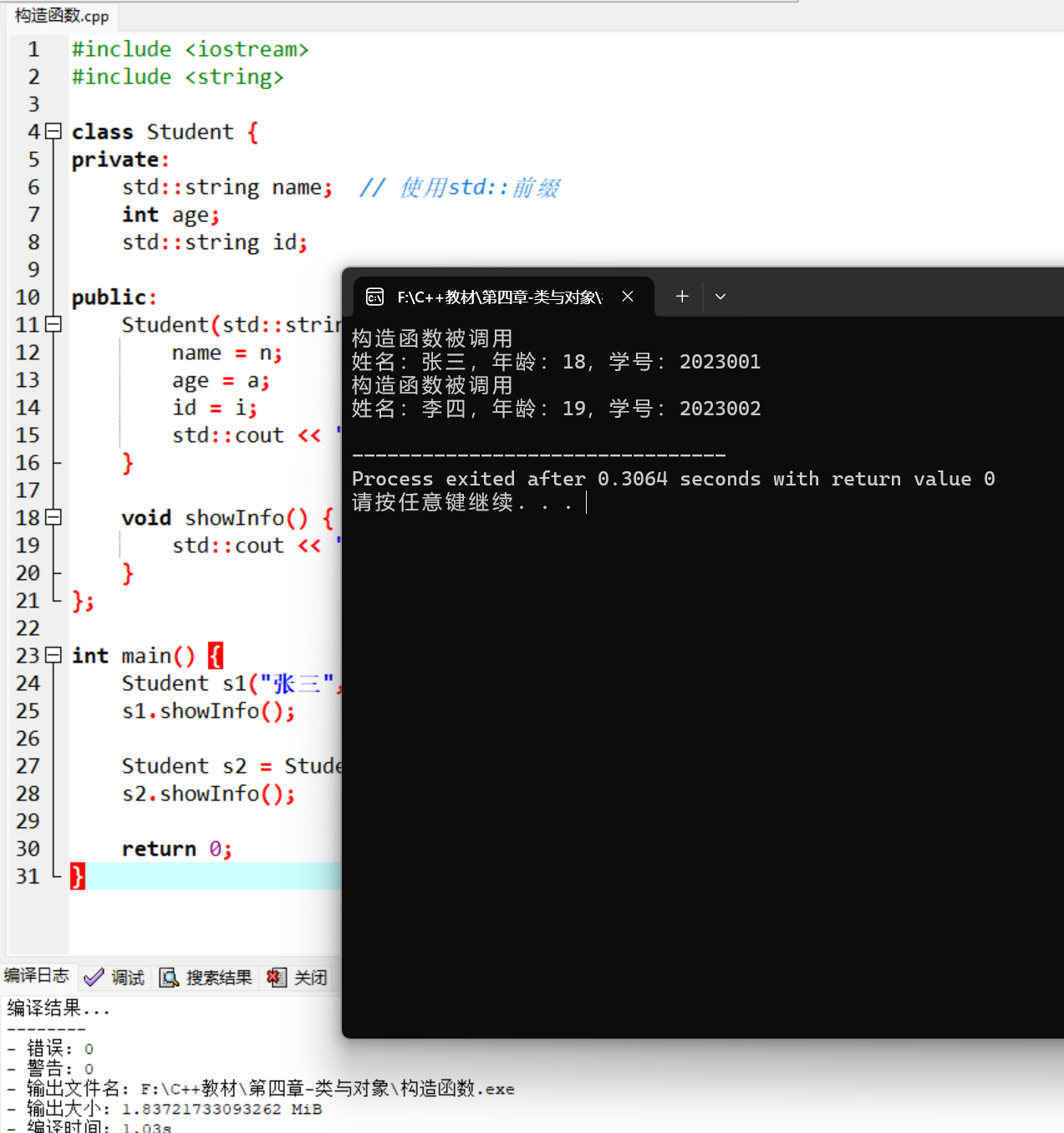
#include <iostream>
#include <string>

class Student {
private:
    std::string name;  // 使用std::前缀
    int age;
    std::string id;

public:
    Student(std::string n, int a, std::string i) {
        name = n;
        age = a;
        id = i;
        std::cout << "构造函数被调用" << std::endl;  // 使用std::前缀
    }

    void showInfo() {
        std::cout << "姓名:" << name << ",年龄:" << age << ",学号:" << id << std::endl;
    }
};

int main() {
    Student s1("张三", 18, "2023001");
    s1.showInfo();

    Student s2 = Student("李四", 19, "2023002");
    s2.showInfo();

    return 0;
}
4.3.2 默认构造函数
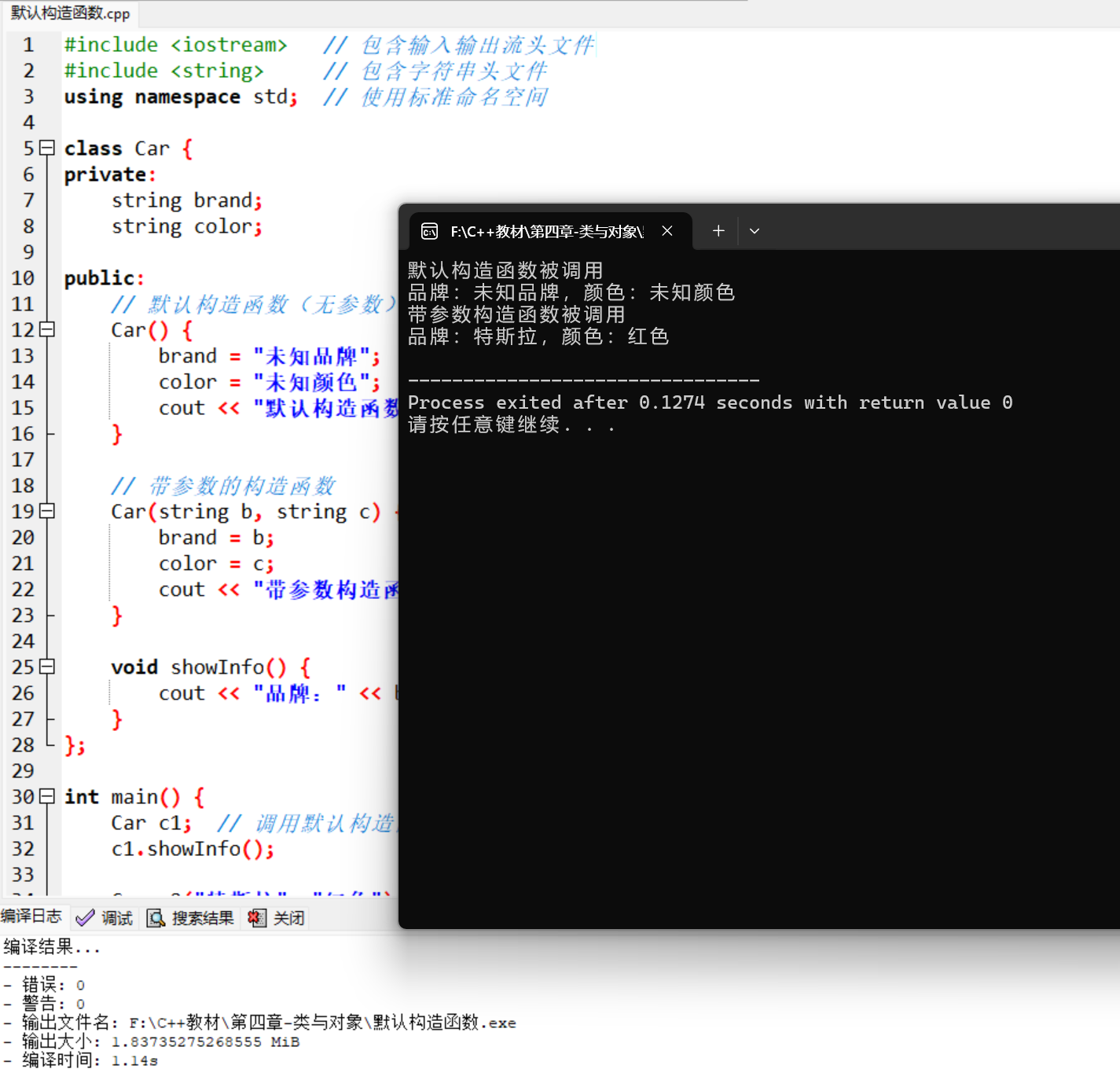
无参数的构造函数称为默认构造函数。如果未定义任何构造函数,编译器会自动生成默认构造函数(空实现)。
#include <iostream>   // 包含输入输出流头文件
#include <string>     // 包含字符串头文件
using namespace std;  // 使用标准命名空间

class Car {
private:
    string brand;
    string color;

public:
    // 默认构造函数(无参数)
    Car() {
        brand = "未知品牌";
        color = "未知颜色";
        cout << "默认构造函数被调用" << endl;
    }

    // 带参数的构造函数
    Car(string b, string c) {
        brand = b;
        color = c;
        cout << "带参数构造函数被调用" << endl;
    }

    void showInfo() {
        cout << "品牌:" << brand << ",颜色:" << color << endl;
    }
};

int main() {
    Car c1;  // 调用默认构造函数
    c1.showInfo();

    Car c2("特斯拉", "红色");  // 调用带参数构造函数
    c2.showInfo();

    return 0;
}
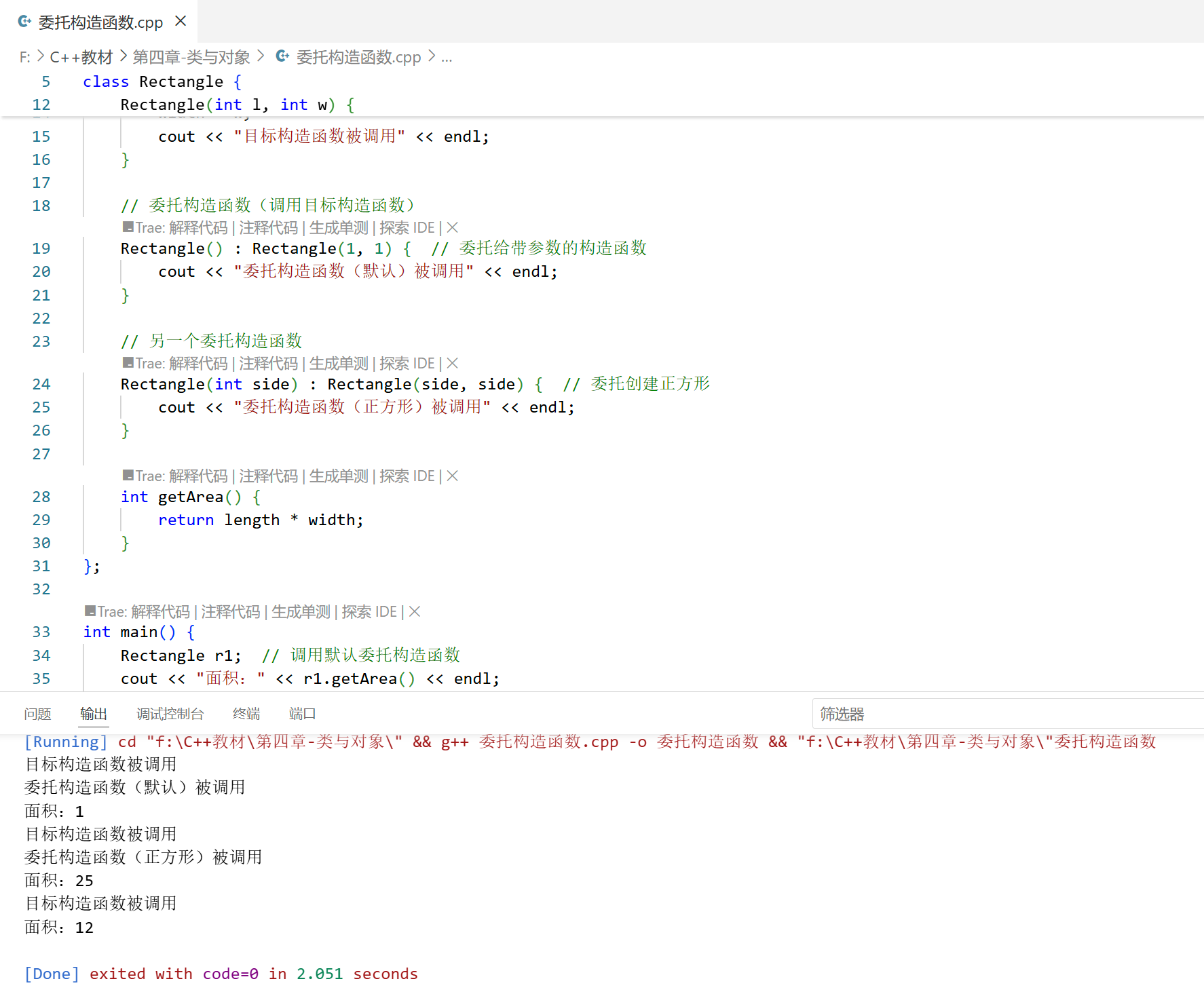
4.3.3 委托构造函数
委托构造函数允许一个构造函数调用同一类中的另一个构造函数,减少代码重复。
#include<iostream>
#include<string>
using namespace std;

class Rectangle {
private:
    int length;
    int width;

public:
    // 目标构造函数(被委托的构造函数)
    Rectangle(int l, int w) {
        length = l;
        width = w;
        cout << "目标构造函数被调用" << endl;
    }

    // 委托构造函数(调用目标构造函数)
    Rectangle() : Rectangle(1, 1) {  // 委托给带参数的构造函数
        cout << "委托构造函数(默认)被调用" << endl;
    }

    // 另一个委托构造函数
    Rectangle(int side) : Rectangle(side, side) {  // 委托创建正方形
        cout << "委托构造函数(正方形)被调用" << endl;
    }

    int getArea() {
        return length * width;
    }
};

int main() {
    Rectangle r1;  // 调用默认委托构造函数
    cout << "面积:" << r1.getArea() << endl;

    Rectangle r2(5);  // 调用正方形委托构造函数
    cout << "面积:" << r2.getArea() << endl;

    Rectangle r3(3, 4);  // 调用目标构造函数
    cout << "面积:" << r3.getArea() << endl;

    return 0;
}运行结果:
4.3.4 复制构造函数
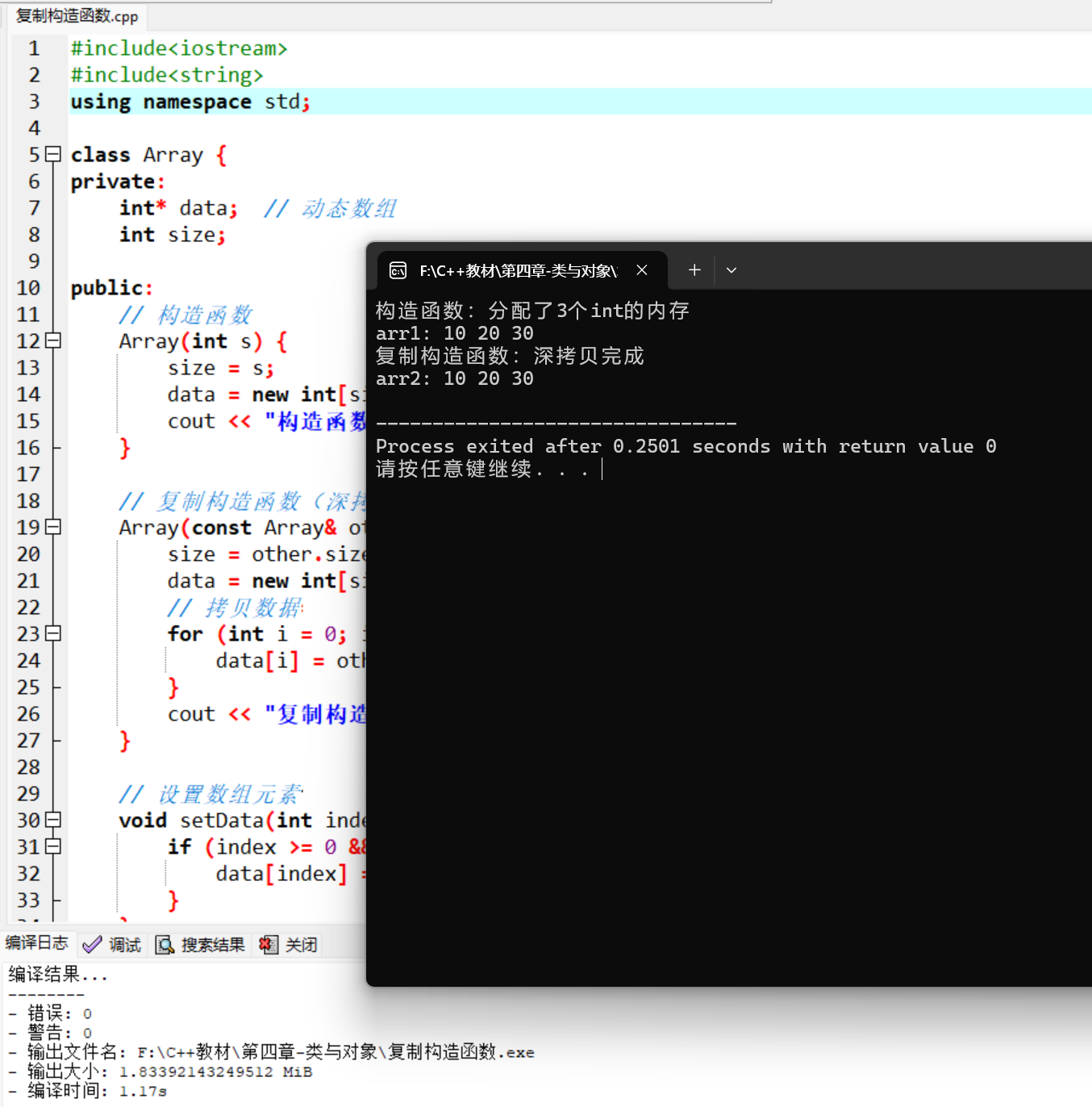
复制构造函数用于根据已有对象创建新对象(拷贝对象),参数为同类对象的引用。
- 格式:
类名(const 类名& 对象名) - 当未定义时,编译器生成默认复制构造函数(浅拷贝)
#include<iostream>
#include<string>
using namespace std;

class Array {
private:
    int* data;  // 动态数组
    int size;

public:
    // 构造函数
    Array(int s) {
        size = s;
        data = new int[size];  // 分配内存
        cout << "构造函数:分配了" << size << "个int的内存" << endl;
    }

    // 复制构造函数(深拷贝)
    Array(const Array& other) {
        size = other.size;
        data = new int[size];  // 重新分配内存
        // 拷贝数据
        for (int i = 0; i < size; i++) {
            data[i] = other.data[i];
        }
        cout << "复制构造函数:深拷贝完成" << endl;
    }

    // 设置数组元素
    void setData(int index, int value) {
        if (index >= 0 && index < size) {
            data[index] = value;
        }
    }

    // 打印数组
    void print() {
        for (int i = 0; i < size; i++) {
            cout << data[i] << " ";
        }
        cout << endl;
    }
};

int main() {
    Array arr1(3);  // 创建对象
    arr1.setData(0, 10);
    arr1.setData(1, 20);
    arr1.setData(2, 30);
    cout << "arr1: ";
    arr1.print();

    // 使用复制构造函数创建新对象
    Array arr2 = arr1;  // 等价于 Array arr2(arr1);
    cout << "arr2: ";
    arr2.print();

    return 0;
}
4.3.5 析构函数
析构函数在对象销毁时自动调用,用于释放对象占用的资源(如动态内存、文件句柄等)。
- 函数名:
~类名 - 无返回类型,无参数
- 一个类只能有一个析构函数(不能重载)
class MyString {
private:
    char* str;  // 动态分配的字符串

public:
    // 构造函数(分配内存)
    MyString(const char* s) {
        int len = strlen(s);
        str = new char[len + 1];  // +1 用于存储结束符'\0'
        strcpy(str, s);
        cout << "构造函数:创建字符串 \"" << str << "\"" << endl;
    }

    // 析构函数(释放内存)
    ~MyString() {
        cout << "析构函数:释放字符串 \"" << str << "\"" << endl;
        delete[] str;  // 释放动态分配的内存
    }

    void show() {
        cout << str << endl;
    }
};

int main() {
    {  // 代码块,用于演示对象销毁时机
        MyString s1("Hello");
        s1.show();
    }  // s1超出作用域,析构函数被调用

    MyString s2("World");
    s2.show();

    return 0;
} // s2超出作用域,析构函数被调用运行结果:
构造函数:创建字符串 "Hello"
Hello
析构函数:释放字符串 "Hello"
构造函数:创建字符串 "World"
World
析构函数:释放字符串 "World"
4.3.6 移动构造函数
移动构造函数用于将临时对象(右值)的资源 "移动" 到新对象,避免不必要的拷贝,提高效率。
- 参数为右值引用:
类名(类名&& 对象名) - 使用
std::move()将左值转换为右值
#include <utility>  // 包含std::move

class Buffer {
private:
    int* data;
    int size;

public:
    // 构造函数
    Buffer(int s) : size(s) {
        data = new int[size];
        cout << "构造函数:分配" << size << "个int的内存" << endl;
    }

    // 移动构造函数
    Buffer(Buffer&& other) noexcept {  // noexcept表示不会抛出异常
        // 移动资源
        data = other.data;
        size = other.size;

        // 置空原对象指针(避免原对象析构时释放资源)
        other.data = nullptr;
        other.size = 0;

        cout << "移动构造函数:资源移动完成" << endl;
    }

    // 析构函数
    ~Buffer() {
        if (data != nullptr) {
            cout << "析构函数:释放" << size << "个int的内存" << endl;
            delete[] data;
        } else {
            cout << "析构函数:无资源可释放" << endl;
        }
    }
};

int main() {
    // 创建临时对象(右值)
    Buffer buf1(10000);

    // 使用移动构造函数创建新对象(转移资源)
    Buffer buf2 = std::move(buf1);  // 将左值转换为右值

    return 0;
}运行结果:
构造函数:分配10000个int的内存
移动构造函数:资源移动完成
析构函数:无资源可释放
析构函数:释放10000个int的内存
4.3.7 default、delete 函数
default:显式要求编译器生成默认版本的函数delete:显式禁用某个函数(如禁止拷贝)
class Example {
private:
    int value;

public:
    // 使用default生成默认构造函数
    Example() = default;

    // 带参数的构造函数
    Example(int v) : value(v) {}

    // 禁用复制构造函数
    Example(const Example&) = delete;

    // 禁用赋值运算符
    Example& operator=(const Example&) = delete;

    int getValue() const { return value; }
};

int main() {
    Example e1;  // 调用默认构造函数
    Example e2(10);  // 调用带参数构造函数

    // Example e3 = e2;  // 错误:复制构造函数已禁用
    // e1 = e2;  // 错误:赋值运算符已禁用

    return 0;
}
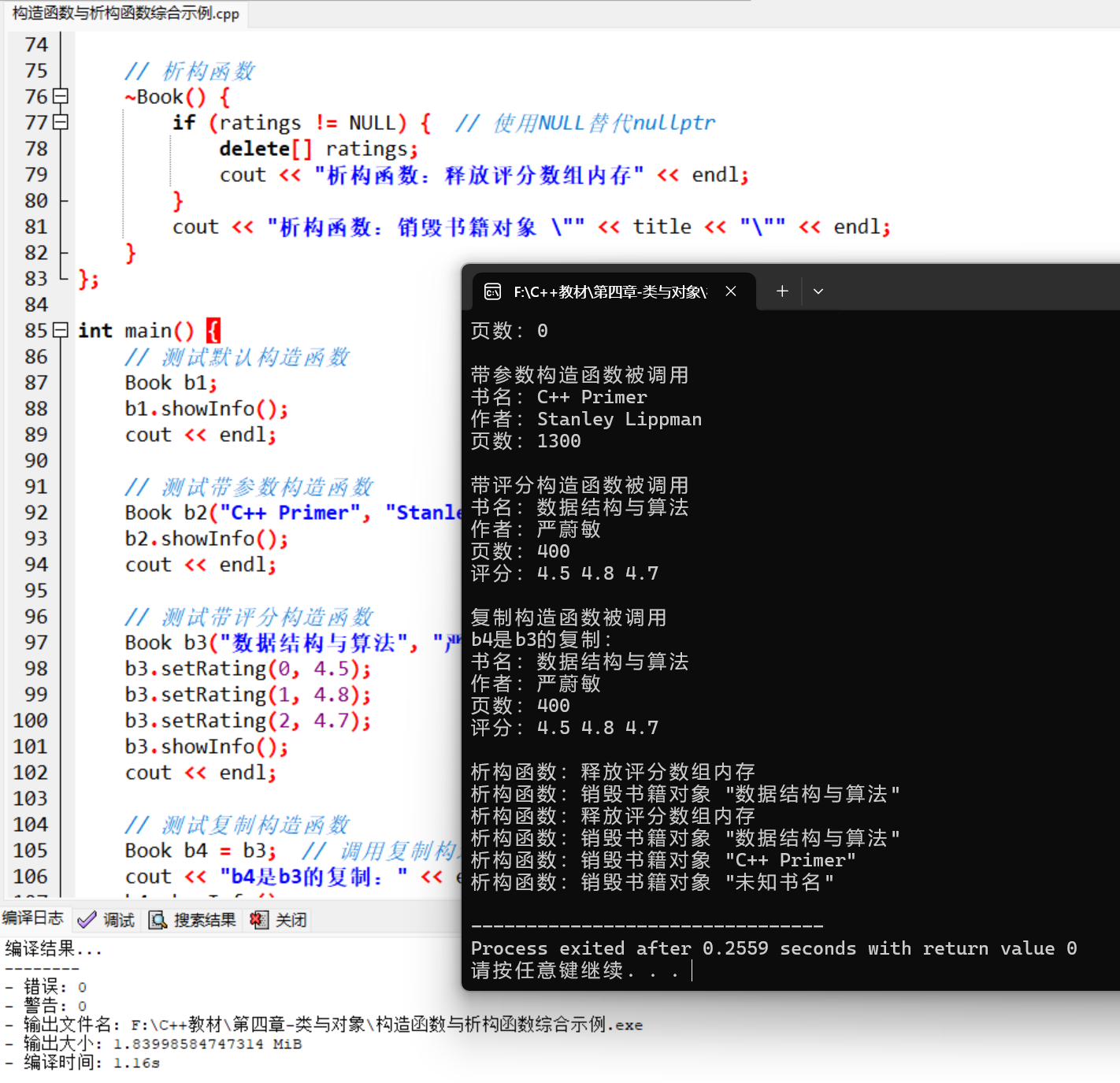
4.3.8 程序实例:构造函数与析构函数综合示例
#include <iostream>
#include <string>
using namespace std;

class Book {
private:
    string title;  // 书名
    string author;  // 作者
    int pages;  // 页数
    double* ratings;  // 评分数组(动态分配)
    int ratingCount;  // 评分数量

public:
    // 默认构造函数
    Book() : title("未知书名"), author("未知作者"), pages(0),
             ratings(NULL), ratingCount(0) {  // 使用NULL替代nullptr
        cout << "默认构造函数被调用" << endl;
    }

    // 带参数的构造函数
    Book(string t, string a, int p) : title(t), author(a), pages(p),
                                      ratings(NULL), ratingCount(0) {  // 使用NULL替代nullptr
        cout << "带参数构造函数被调用" << endl;
    }

    // 不使用委托构造函数(改为普通构造函数)
    Book(string t, string a, int p, int rCount) : title(t), author(a), pages(p) {
        ratingCount = rCount;
        if (ratingCount > 0) {
            ratings = new double[ratingCount]();  // 初始化为0
        } else {
            ratings = NULL;  // 使用NULL替代nullptr
        }
        cout << "带评分构造函数被调用" << endl;
    }

    // 复制构造函数(深拷贝)
    Book(const Book& other) : title(other.title), author(other.author),
                             pages(other.pages), ratingCount(other.ratingCount) {
        if (ratingCount > 0) {
            ratings = new double[ratingCount];
            // 拷贝评分数据
            for (int i = 0; i < ratingCount; i++) {
                ratings[i] = other.ratings[i];
            }
        } else {
            ratings = NULL;  // 使用NULL替代nullptr
        }
        cout << "复制构造函数被调用" << endl;
    }

    // 移除移动构造函数(C++11特性)

    // 设置评分
    void setRating(int index, double score) {
        if (index >= 0 && index < ratingCount) {
            ratings[index] = score;
        }
    }

    // 显示书籍信息
    void showInfo() {
        cout << "书名:" << title << endl;
        cout << "作者:" << author << endl;
        cout << "页数:" << pages << endl;
        if (ratingCount > 0) {
            cout << "评分:";
            for (int i = 0; i < ratingCount; i++) {
                cout << ratings[i] << " ";
            }
            cout << endl;
        }
    }

    // 析构函数
    ~Book() {
        if (ratings != NULL) {  // 使用NULL替代nullptr
            delete[] ratings;
            cout << "析构函数:释放评分数组内存" << endl;
        }
        cout << "析构函数:销毁书籍对象 \"" << title << "\"" << endl;
    }
};

int main() {
    // 测试默认构造函数
    Book b1;
    b1.showInfo();
    cout << endl;

    // 测试带参数构造函数
    Book b2("C++ Primer", "Stanley Lippman", 1300);
    b2.showInfo();
    cout << endl;

    // 测试带评分构造函数
    Book b3("数据结构与算法", "严蔚敏", 400, 3);  // 3个评分
    b3.setRating(0, 4.5);
    b3.setRating(1, 4.8);
    b3.setRating(2, 4.7);
    b3.showInfo();
    cout << endl;

    // 测试复制构造函数
    Book b4 = b3;  // 调用复制构造函数
    cout << "b4是b3的复制:" << endl;
    b4.showInfo();
    cout << endl;

    // 移除移动构造函数测试代码

    return 0;
}
4.4 类的组合
类的组合指一个类包含其他类的对象作为成员,体现 "has-a"(有一个)的关系。
4.4.1 组合
当类 A 包含类 B 的对象作为成员时,称类 A 组合了类 B。创建 A 的对象时,会先调用 B 的构造函数,再调用 A 的构造函数;销毁时则相反。
// 日期类
class Date {
private:
    int year, month, day;

public:
    // 构造函数
    Date(int y, int m, int d) : year(y), month(m), day(d) {
        cout << "Date构造函数被调用:" << year << "-" << month << "-" << day << endl;
    }

    // 显示日期
    void showDate() {
        cout << year << "-" << month << "-" << day << endl;
    }

    // 析构函数
    ~Date() {
        cout << "Date析构函数被调用:" << year << "-" << month << "-" << day << endl;
    }
};

// 学生类(组合了Date类对象)
class Student {
private:
    string name;  // 姓名
    Date birthday;  // 生日(Date类对象,组合关系)
    int score;  // 成绩

public:
    // 构造函数:先初始化成员对象birthday
    Student(string n, int y, int m, int d, int s)
        : name(n), birthday(y, m, d), score(s) {  // 成员初始化列表
        cout << "Student构造函数被调用:" << name << endl;
    }

    // 显示学生信息
    void showInfo() {
        cout << "姓名:" << name << endl;
        cout << "生日:";
        birthday.showDate();
        cout << "成绩:" << score << endl;
    }

    // 析构函数
    ~Student() {
        cout << "Student析构函数被调用:" << name << endl;
    }
};

// 组合类的构造/析构顺序演示
int main() {
    cout << "创建学生对象:" << endl;
    Student s("张三", 2005, 3, 15, 90);
    s.showInfo();

    return 0;
}运行结果:
创建学生对象:
Date构造函数被调用:2005-3-15
Student构造函数被调用:张三
姓名:张三
生日:2005-3-15
成绩:90
Student析构函数被调用:张三
Date析构函数被调用:2005-3-15
4.4.2 前向引用声明
当两个类相互引用时,需使用前向引用声明(forward declaration)告知编译器类的存在。
// 前向引用声明:告知编译器Teacher类存在
class Teacher;

// 学生类:引用Teacher类
class Student {
private:
    string name;
    Teacher* advisor;  // 只能声明为指针或引用

public:
    Student(string n) : name(n) {}

    // 设置导师
    void setAdvisor(Teacher* t);

    void showAdvisor();
};

// 教师类:引用Student类
class Teacher {
private:
    string name;
    Student* student;  // 学生

public:
    Teacher(string n) : name(n) {}

    void setStudent(Student* s) {
        student = s;
    }

    string getName() const {
        return name;
    }
};

// 实现Student类的成员函数(此时Teacher类已完整定义)
void Student::setAdvisor(Teacher* t) {
    advisor = t;
    t->setStudent(this);  // 相互关联
}

void Student::showAdvisor() {
    cout << name << "的导师是:" << advisor->getName() << endl;
}

int main() {
    Student s("李四");
    Teacher t("王教授");

    s.setAdvisor(&t);  // 建立关联
    s.showAdvisor();

    return 0;
}
4.5 UML 图形标识
UML(统一建模语言)是用于软件设计的标准化图形语言,类图是最常用的 UML 图之一。
4.5.1 UML 简介
UML 提供了一套图形符号用于可视化软件系统的结构和行为,包括类图、用例图、时序图等。类图用于描述类的结构及类之间的关系。
4.5.2 UML 类图
UML 类图用矩形表示类,分为三部分:类名、属性、方法。
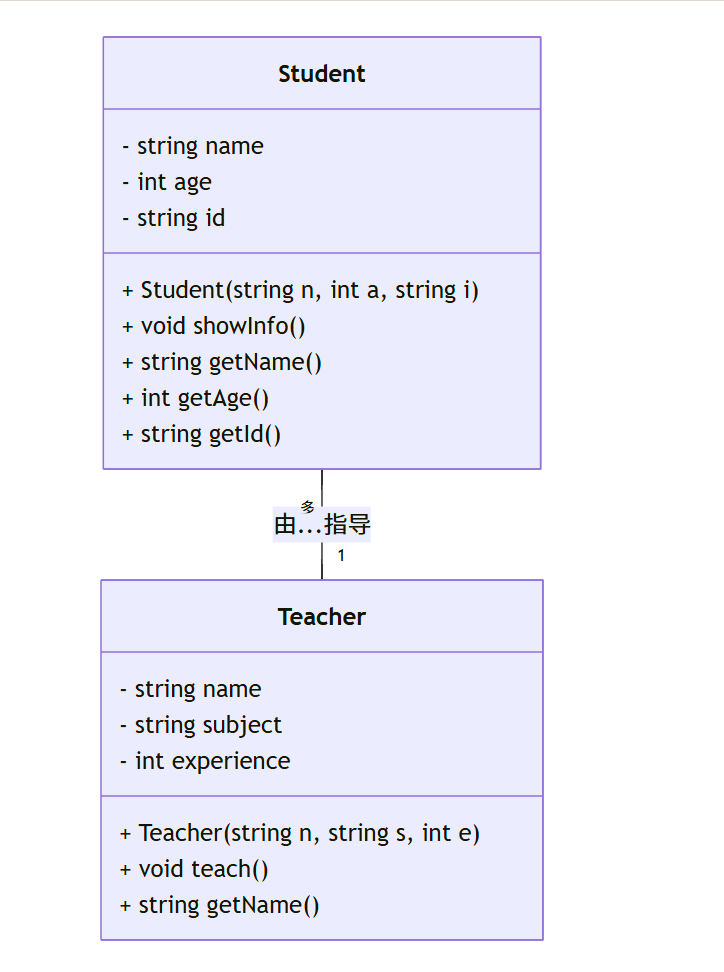
符号说明:
+:public 成员-:private 成员#:protected 成员- 类之间的连线表示关系:
--表示关联,<-表示继承
4.6 结构体和联合体
4.6.1 结构体
结构体(struct)与类类似,但默认访问权限为public(类默认是private)。通常用于存储数据集合,类用于封装数据和行为。
// 结构体示例:点坐标
struct Point {
    int x;  // 默认public
    int y;  // 默认public

    // 结构体也可以有成员函数
    Point(int x_, int y_) : x(x_), y(y_) {}

    void print() {
        cout << "(" << x << ", " << y << ")" << endl;
    }
};

// 结构体与类的区别演示
class PointClass {
    int x;  // 默认private
    int y;  // 默认private

public:  // 需要显式声明public
    PointClass(int x_, int y_) : x(x_), y(y_) {}

    void print() {
        cout << "(" << x << ", " << y << ")" << endl;
    }
};

int main() {
    // 结构体使用
    Point p1(3, 4);
    p1.x = 5;  // 直接访问public成员
    p1.print();  // (5, 4)

    // 类使用
    PointClass p2(6, 7);
    // p2.x = 8;  // 错误:x是private成员
    p2.print();  // (6, 7)

    return 0;
}
4.6.2 联合体
联合体(union)所有成员共享同一块内存空间,同一时间只能存储一个成员的值,节省内存。
#include <cstring>  // 用于strcpy

// 联合体示例:存储不同类型的数据,但只能同时使用一种
union Data {
    int i;  // 整数
    float f;  // 浮点数
    char str[20];  // 字符串
};

int main() {
    Data d;

    d.i = 100;  // 存储整数
    cout << "整数值:" << d.i << endl;

    d.f = 3.14f;  // 存储浮点数(覆盖之前的整数)
    cout << "浮点数值:" << d.f << endl;

    strcpy(d.str, "Hello Union");  // 存储字符串(覆盖之前的浮点数)
    cout << "字符串值:" << d.str << endl;

    // 注意:此时访问i或f会得到无意义的值
    cout << "此时访问整数i:" << d.i << "(无意义)" << endl;

    // 联合体大小为最大成员的大小
    cout << "Data联合体大小:" << sizeof(Data) << "字节" << endl;

    return 0;
}
4.7 枚举类型 ——enum
枚举类型用于定义命名的整数常量集合,提高代码可读性。
// 传统枚举
enum Weekday {
    Monday,    // 0
    Tuesday,   // 1
    Wednesday, // 2
    Thursday,  // 3
    Friday,    // 4
    Saturday,  // 5
    Sunday     // 6
};

// 带作用域的枚举(C++11):避免命名冲突
enum class Color {
    Red,    // 0
    Green,  // 1
    Blue,   // 2
    Yellow  // 3
};

// 指定枚举值
enum Month {
    January = 1,
    February,  // 2
    March,     // 3
    // ... 其他月份
    December = 12
};

int main() {
    // 使用传统枚举
    Weekday today = Wednesday;
    cout << "今天是星期" << today + 1 << endl;  // Wednesday是2,输出3

    // 使用带作用域的枚举(必须加作用域)
    Color favorite = Color::Blue;
    if (favorite == Color::Blue) {
        cout << "我最喜欢的颜色是蓝色" << endl;
    }

    // 使用指定值的枚举
    Month currentMonth = January;
    cout << "当前月份是:" << currentMonth << endl;  // 输出1

    return 0;
}
4.8 综合实例 —— 个人银行账户管理程序
4.8.1 类的设计
设计BankAccount类实现个人银行账户管理,包含以下功能:
- 账户信息:账号、姓名、余额
- 操作:存款、取款、查询余额、显示账户信息
- 记录交易历史
4.8.2 源程序及说明
#include <iostream>
#include <string>
#include <vector>
#include <iomanip>  // 用于格式化输出
#include <ctime>    // 用于记录交易时间
#include <sstream>  // 用于数值转字符串(C++98方式)
using namespace std;

// 辅助函数:将double转换为string(C++98兼容)
string doubleToString(double value) {
    stringstream ss;
    ss << value;
    return ss.str();
}

// 银行账户类
class BankAccount {
private:
    string accountId;  // 账号
    string name;       // 账户姓名
    double balance;    // 账户余额
    vector<string> transactionHistory;  // 交易历史记录

    // 获取当前时间字符串(辅助函数)
    string getCurrentTime() {
        time_t now = time(0);
        char* dt = ctime(&now);
        return string(dt);  // 转换为string并返回
    }

public:
    // 构造函数:初始化账户
    BankAccount(string id, string n, double initial = 0.0)
        : accountId(id), name(n), balance(initial) {
        // 记录开户信息(使用自定义的doubleToString替代to_string)
        if (initial > 0) {
            transactionHistory.push_back(getCurrentTime() + "  开户存款:" + doubleToString(initial) + "元");
        } else {
            transactionHistory.push_back(getCurrentTime() + "  账户开户,初始余额:0元");
        }
    }

    // 存款
    void deposit(double amount) {
        if (amount > 0) {
            balance += amount;
            // 使用自定义的doubleToString替代to_string
            transactionHistory.push_back(getCurrentTime() + "  存款:" + doubleToString(amount) + "元,余额:" + doubleToString(balance) + "元");
            cout << "存款成功!当前余额:" << balance << "元" << endl;
        } else {
            cout << "存款金额必须大于0!" << endl;
        }
    }

    // 取款
    bool withdraw(double amount) {
        if (amount <= 0) {
            cout << "取款金额必须大于0!" << endl;
            return false;
        }
        if (amount > balance) {
            cout << "余额不足!当前余额:" << balance << "元" << endl;
            return false;
        }

        balance -= amount;
        // 使用自定义的doubleToString替代to_string
        transactionHistory.push_back(getCurrentTime() + "  取款:" + doubleToString(amount) + "元,余额:" + doubleToString(balance) + "元");
        cout << "取款成功!当前余额:" << balance << "元" << endl;
        return true;
    }

    // 查询余额
    double getBalance() const {
        return balance;
    }

    // 显示账户基本信息
    void showInfo() const {
        cout << "\n===== 账户信息 =====" << endl;
        cout << "账号:" << accountId << endl;
        cout << "姓名:" << name << endl;
        cout << "当前余额:" << fixed << setprecision(2) << balance << "元" << endl;
        cout << "====================" << endl << endl;
    }

    // 显示交易历史(使用C++98的迭代器循环替代范围for循环)
    void showHistory() const {
        cout << "\n===== 交易历史 =====" << endl;
        // 用迭代器循环替代范围for循环
        for (vector<string>::const_iterator it = transactionHistory.begin();
             it != transactionHistory.end(); ++it) {
            cout << *it;
        }
        cout << "====================" << endl << endl;
    }
};

// 主函数:实现用户交互
int main() {
    // 创建银行账户
    string id, name;
    double initial;

    cout << "===== 欢迎使用个人银行账户管理系统 =====" << endl;
    cout << "请输入账号:";
    cin >> id;
    cin.ignore();  // 忽略输入缓冲区的换行符

    cout << "请输入账户姓名:";
    getline(cin, name);

    cout << "请输入初始存款金额(0表示不存款):";
    cin >> initial;

    // 创建账户对象
    BankAccount account(id, name, initial);
    cout << "账户创建成功!" << endl;

    // 菜单循环
    int choice;
    double amount;
    do {
        cout << "\n===== 操作菜单 =====" << endl;
        cout << "1. 存款" << endl;
        cout << "2. 取款" << endl;
        cout << "3. 查询余额" << endl;
        cout << "4. 显示账户信息" << endl;
        cout << "5. 查看交易历史" << endl;
        cout << "0. 退出系统" << endl;
        cout << "请选择操作:";
        cin >> choice;

        switch (choice) {
            case 1:  // 存款
                cout << "请输入存款金额:";
                cin >> amount;
                account.deposit(amount);
                break;

            case 2:  // 取款
                cout << "请输入取款金额:";
                cin >> amount;
                account.withdraw(amount);
                break;

            case 3:  // 查询余额
                cout << "当前账户余额:" << fixed << setprecision(2)
                     << account.getBalance() << "元" << endl;
                break;

            case 4:  // 显示账户信息
                account.showInfo();
                break;

            case 5:  // 查看交易历史
                account.showHistory();
                break;

            case 0:  // 退出
                cout << "感谢使用,再见!" << endl;
                break;

            default:
                cout << "无效的选择,请重新输入!" << endl;
        }
    } while (choice != 0);

    return 0;
}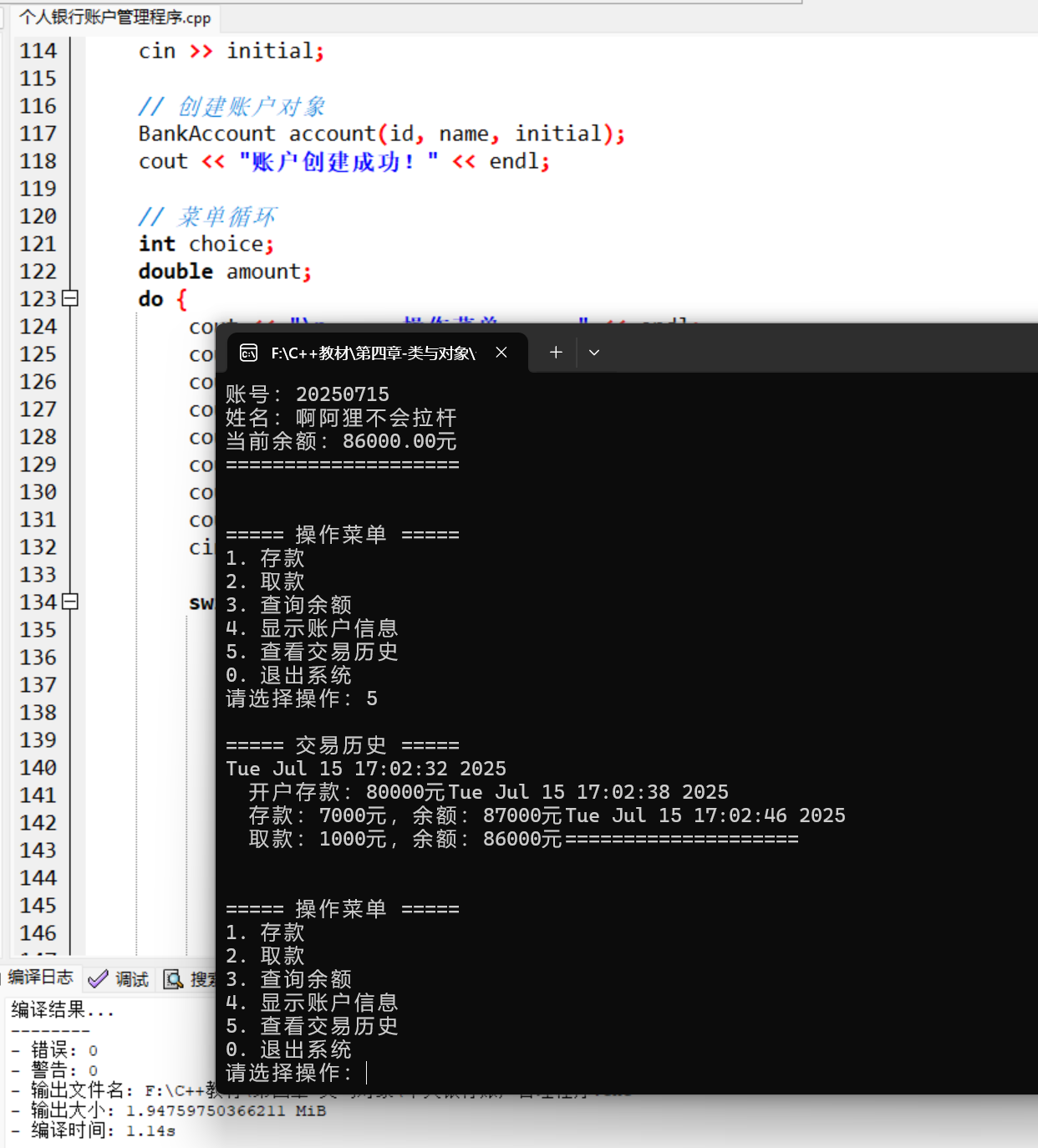
程序说明:
BankAccount类封装了账户的核心功能,通过私有成员保护账户数据- 使用
vector存储交易历史,每次操作都记录时间和金额 - 主函数实现交互式菜单,用户可通过选择数字执行不同操作
- 使用
fixed和setprecision确保金额显示两位小数 - 记录交易时间,提高交易历史的实用性
4.9 深度探索
4.9.1 位域
位域(bit field)允许将数据成员存储在指定的二进制位数中,节省内存空间。
#include <iostream>
using namespace std;

// 使用位域存储状态信息
struct Flags {
    // 每个成员后面的数字表示占用的位数
    unsigned int isActive : 1;    // 1位:0或1
    unsigned int mode : 2;        // 2位:0~3
    unsigned int priority : 3;    // 3位:0~7
    unsigned int reserved : 26;   // 26位:预留(总32位)
};

int main() {
    Flags f;

    // 设置位域值
    f.isActive = 1;    // 激活状态
    f.mode = 2;        // 模式2
    f.priority = 5;    // 优先级5

    cout << "isActive: " << f.isActive << endl;
    cout << "mode: " << f.mode << endl;
    cout << "priority: " << f.priority << endl;

    // 位域结构体大小
    cout << "Flags结构体大小:" << sizeof(f) << "字节" << endl;  // 输出4字节(32位)

    return 0;
}
4.9.2 用构造函数定义类型转换
构造函数可以定义从其他类型到当前类类型的隐式转换,使用explicit关键字可禁止隐式转换。
class Distance {
private:
    double meters;  // 以米为单位存储距离

public:
    // 普通构造函数
    Distance(double m) : meters(m) {}

    // explicit构造函数:禁止隐式转换
    explicit Distance(int cm) {
        meters = cm / 100.0;  // 厘米转米
    }

    double getMeters() const { return meters; }
    double getCentimeters() const { return meters * 100; }
};

// 接受Distance类型参数的函数
void printDistance(Distance d) {
    cout << "距离:" << d.getMeters() << "米 ("
         << d.getCentimeters() << "厘米)" << endl;
}

int main() {
    // 隐式转换:double -> Distance(允许,因为构造函数未加explicit)
    Distance d1 = 10.5;  // 等价于 Distance d1(10.5)
    printDistance(20.3);  // 隐式转换:20.3 -> Distance

    // 下面代码会报错,因为Distance(int)是explicit的
    // Distance d2 = 1500;  // 错误:禁止int到Distance的隐式转换
    // printDistance(2000);  // 错误:禁止隐式转换

    // 显式转换是允许的
    Distance d3 = Distance(1500);  // 显式构造
    printDistance(Distance(2000));  // 显式转换

    return 0;
}
4.9.3 对象作为函数参数和返回值的传递方式
对象作为参数或返回值时有三种传递方式:值传递、引用传递、指针传递。
#include <iostream>
using namespace std;

class MyClass {
private:
    int value;

public:
    // 构造函数
    MyClass(int v) : value(v) {
        cout << "构造函数:value = " << value << endl;
    }

    // 复制构造函数
    MyClass(const MyClass& other) : value(other.value) {
        cout << "复制构造函数:value = " << value << endl;
    }

    // 析构函数
    ~MyClass() {
        cout << "析构函数:value = " << value << endl;
    }

    void setValue(int v) { value = v; }
    int getValue() const { return value; }
};

// 1. 值传递:会调用复制构造函数
void passByValue(MyClass obj) {
    obj.setValue(20);
    cout << "值传递函数内:" << obj.getValue() << endl;
}

// 2. 引用传递:不会调用复制构造函数
void passByReference(MyClass& obj) {
    obj.setValue(30);
    cout << "引用传递函数内:" << obj.getValue() << endl;
}

// 3. 指针传递:不会调用复制构造函数
void passByPointer(MyClass* obj) {
    obj->setValue(40);
    cout << "指针传递函数内:" << obj->getValue() << endl;
}

// 返回值传递:会调用复制构造函数(编译器可能优化)
MyClass returnByValue() {
    MyClass temp(50);
    return temp;  // 返回临时对象
}

int main() {
    MyClass obj(10);
    cout << "调用函数前:" << obj.getValue() << endl;

    // 测试值传递
    passByValue(obj);
    cout << "值传递后:" << obj.getValue() << endl;  // 仍为10(修改的是副本)

    // 测试引用传递
    passByReference(obj);
    cout << "引用传递后:" << obj.getValue() << endl;  // 变为30(修改的是原对象)

    // 测试指针传递
    passByPointer(&obj);
    cout << "指针传递后:" << obj.getValue() << endl;  // 变为40(修改的是原对象)

    // 测试返回值传递
    MyClass obj2 = returnByValue();
    cout << "返回值传递后:" << obj2.getValue() << endl;  // 50

    return 0;
}
4.10 小结
本章深入讲解了 C++ 面向对象程序设计的核心概念 —— 类与对象,主要内容包括:
- 面向对象四大特性:抽象、封装、继承、多态是 OOP 的核心思想,为模块化和复用提供支持。
- 类与对象基础:类是对象的模板,定义了属性和方法;对象是类的实例,通过成员访问运算符
.使用。 - 构造与析构函数:负责对象的初始化和资源清理,包括默认构造、复制构造、移动构造等特殊形式。
- 类的组合:体现 "has-a" 关系,一个类包含其他类的对象作为成员,需注意构造和析构顺序。
- UML 类图:用于可视化类的结构和关系,是设计阶段的重要工具。
- 结构体与联合体:结构体默认 public 访问,适合数据集合;联合体共享内存,适合存储互斥数据。
- 枚举类型:定义命名常量集合,提高代码可读性,C++11 引入带作用域的枚举。
- 综合应用:通过银行账户管理程序实践了类的设计和使用。
- 深度主题:位域、类型转换、对象传递方式等高级特性,帮助理解底层机制。
掌握类与对象是学好 C++ 的关键,它们为后续学习继承、多态、模板等高级特性奠定了基础。建议多编写代码实践,深入理解面向对象的思维方式。
本文参与 腾讯云自媒体同步曝光计划,分享自作者个人站点/博客。
原始发表:2025-07-15,如有侵权请联系 cloudcommunity@tencent.com 删除
评论
登录后参与评论
推荐阅读
目录
腾讯云开发者

Copyright © 2013 - 2026 Tencent Cloud. All Rights Reserved. 腾讯云 版权所有
深圳市腾讯计算机系统有限公司 ICP备案/许可证号:粤B2-20090059  粤公网安备44030502008569号
腾讯云计算(北京)有限责任公司 京ICP证150476号 | 京ICP备11018762号