30-Rust 教程 - 消息传递

30-Rust 教程 - 消息传递

LarryLan
发布于 2026-06-03 18:20:26
发布于 2026-06-03 18:20:26
消息传递
"别共享内存了,互相打电话吧!" —— Rust 并发哲学的核心
🎬 引入
还记得上篇我们说的厨房类比吗?多个厨师(线程)同时做菜,如果都去同一个冰箱(共享内存)拿食材,很容易撞车。
那怎么办呢?有两种方案:
方案 1:共享状态
- 冰箱上挂个牌子:"我正在用,别人别动"
- 每次拿东西前先挂牌子,用完再摘下来
- 问题:万一有人忘了摘牌子呢?或者两个人同时挂牌子呢?
方案 2:消息传递
- 每个厨师有自己的食材箱
- 需要食材时,给仓库管理员发消息:"我要两个鸡蛋"
- 管理员把鸡蛋送过来
- 完美!没有争抢,只有通信
Rust 推崇方案 2——消息传递。这是 Go 语言的名言 "Don't communicate by sharing memory, share memory by communicating" 的 Rust 版本。
今天我们就来学习 Rust 的消息传递机制:channel(通道)、mpsc(多生产者单消费者)、以及如何实现 Actor 模式。
📌 核心概念
什么是消息传递?
消息传递的核心思想是:线程之间不直接共享数据,而是通过发送和接收消息来通信。
生活化类比:
想象一个公司:
- 生产者 = 员工(可以多个)
- channel = 公司内部邮箱系统
- 消费者 = 老板(通常一个,处理所有邮件)
员工把报告放进邮箱,老板从邮箱取报告。员工和老板不需要直接见面,也不需要共享同一个办公桌。
channel 是什么?
channel 是 Rust 标准库提供的消息传递机制。它就像一根管道:
[生产者] ---> [channel] ---> [消费者]
- 生产者调用
send()把数据放进管道 - 消费者调用
recv()从管道取出数据 - 数据的所有权被转移,不是复制
mpsc 是什么?
mpsc 是 multiple producer, single consumer(多生产者单消费者)的缩写。
- 多生产者:可以有多个线程发送消息
- 单消费者:只有一个线程接收消息
为什么是单消费者?因为如果多个消费者同时从同一个 channel 收消息,可能会导致消息被重复处理或者丢失。
Rust 编译器: "多个消费者?那消息到底归谁?我不允许这种 ambiguity!"
💻 代码示例
基础示例:单生产者单消费者
use std::sync::mpsc;
use std::thread;

fn main() {
    // 1. 创建 channel
    // tx = transmitter (发送端)
    // rx = receiver (接收端)
    let (tx, rx) = mpsc::channel();

    // 2. 创建生产者线程
    thread::spawn(move || {
        let msg = String::from("你好,消费者!");
        tx.send(msg).unwrap();
        // msg 的所有权已经转移给 channel 了
    });

    // 3. 消费者接收消息
    // recv 会阻塞,直到有消息到达
    let received = rx.recv().unwrap();
    println!("收到:{}", received);
}
输出:
收到:你好,消费者!
关键点:
mpsc::channel()返回一对端点:发送端tx和接收端rxsend()发送消息,返回Result<(), SendError<T>>recv()接收消息,会阻塞直到有消息,返回Result<T, RecvError>- 消息的所有权被转移,不是复制
多个消息
use std::sync::mpsc;
use std::thread;
use std::time::Duration;

fn main() {
    let (tx, rx) = mpsc::channel();

    thread::spawn(move || {
        let messages = vec![
            String::from("消息 1"),
            String::from("消息 2"),
            String::from("消息 3"),
        ];

        for msg in messages {
            tx.send(msg).unwrap();
            thread::sleep(Duration::from_millis());
        }
    });

    // 方式 1:阻塞接收
    // for received in rx {
    //     println!("收到:{}", received);
    // }

    // 方式 2:非阻塞接收
    loop {
        match rx.recv_timeout(Duration::from_millis()) {
            Ok(msg) => println!("收到:{}", msg),
            Err(_) => {
                println!("超时,没有新消息");
                break;
            }
        }
    }
}
多生产者
use std::sync::mpsc;
use std::thread;
use std::time::Duration;

fn main() {
    let (tx, rx) = mpsc::channel();

    // 生产者 1
    let tx1 = tx.clone();  // 克隆发送端
    thread::spawn(move || {
        for i in ..= {
            tx1.send(format!("生产者 1: 消息 {}", i)).unwrap();
            thread::sleep(Duration::from_millis());
        }
    });

    // 生产者 2
    let tx2 = tx.clone();
    thread::spawn(move || {
        for i in ..= {
            tx2.send(format!("生产者 2: 消息 {}", i)).unwrap();
            thread::sleep(Duration::from_millis());
        }
    });

    // 原始的 tx 在这里会 drop,不影响其他克隆

    // 消费者接收所有消息
    for received in rx {
        println!("收到:{}", received);
    }
}
输出(顺序可能不同):
收到:生产者 1: 消息 1
收到:生产者 2: 消息 1
收到:生产者 1: 消息 2
收到:生产者 2: 消息 2
收到:生产者 1: 消息 3
收到:生产者 2: 消息 3
关键点:
- 用
tx.clone()创建多个发送端 - 所有发送端共享同一个 channel
- 当所有发送端都 drop 后,
recv()会返回错误
不同类型的消息
channel 可以发送任何类型的数据,包括枚举:
use std::sync::mpsc;
use std::thread;

// 定义消息类型
enum Message {
    Text(String),
    Number(i32),
    Quit,
}

fn main() {
    let (tx, rx) = mpsc::channel();

    thread::spawn(move || {
        tx.send(Message::Text(String::from("你好"))).unwrap();
        tx.send(Message::Number()).unwrap();
        tx.send(Message::Quit).unwrap();
    });

    for msg in rx {
        match msg {
            Message::Text(text) => println!("文本:{}", text),
            Message::Number(num) => println!("数字:{}", num),
            Message::Quit => {
                println!("收到退出信号");
                break;
            }
        }
    }
}
🐛 常见坑点
坑点 1:发送端 drop 后继续发送
use std::sync::mpsc;
use std::thread;

fn main() {
    let (tx, rx) = mpsc::channel();

    thread::spawn(move || {
        tx.send(String::from("你好")).unwrap();
        // tx 在这里被 drop 了
    });

    // 等待线程完成
    thread::sleep(std::time::Duration::from_millis());

    // ❌ 错误!tx 已经不存在了
    // tx.send(String::from("第二条")).unwrap();

    // 接收端会收到 Err,因为所有发送端都 drop 了
    match rx.recv() {
        Ok(msg) => println!("收到:{}", msg),
        Err(_) => println!("发送端已关闭"),
    }
}
坑点 2:忘记克隆发送端
use std::sync::mpsc;
use std::thread;

fn main() {
    let (tx, rx) = mpsc::channel();

    let tx1 = tx.clone();
    thread::spawn(move || {
        tx1.send("来自线程 1").unwrap();
    });

    // ❌ 错误!tx 被移动到上面的线程了
    // thread::spawn(move || {
    //     tx.send("来自线程 2").unwrap();
    // });

    // ✅ 正确:再克隆一次
    let tx2 = tx.clone();
    thread::spawn(move || {
        tx2.send("来自线程 2").unwrap();
    });

    for _ in .. {
        println!("收到:{}", rx.recv().unwrap());
    }
}
坑点 3:recv 阻塞导致死锁
use std::sync::mpsc;
use std::thread;

fn main() {
    let (tx, rx) = mpsc::channel();

    // 消费者先开始等待
    thread::spawn(move || {
        println!("等待消息...");
        let msg = rx.recv().unwrap();  // 阻塞
        println!("收到:{}", msg);
    });

    // 生产者...等等,生产者在另一个线程
    // 而主线程在这里卡住了,因为没有生产者!

    // ❌ 死锁!需要创建生产者线程
    thread::spawn(move || {
        tx.send("你好").unwrap();
    });

    thread::sleep(std::time::Duration::from_secs());
}
🎯 实战案例
案例 1:日志收集器
多个工作线程产生日志,一个专门的线程负责写入文件:
use std::sync::mpsc;
use std::thread;
use std::time::Duration;
use std::fs::OpenOptions;
use std::io::Write;

enum LogMessage {
    Info(String),
    Warning(String),
    Error(String),
}

fn main() {
    let (tx, rx) = mpsc::channel();

    // 日志写入线程(消费者)
    let log_handle = thread::spawn(move || {
        let mut file = OpenOptions::new()
            .create(true)
            .append(true)
            .open("app.log")
            .unwrap();

        for msg in rx {
            let log_line = match msg {
                LogMessage::Info(s) => format!("[INFO] {}\n", s),
                LogMessage::Warning(s) => format!("[WARN] {}\n", s),
                LogMessage::Error(s) => format!("[ERROR] {}\n", s),
            };

            writeln!(file, "{}", log_line).unwrap();
            print!("{}", log_line);  // 同时也输出到控制台
        }
    });

    // 模拟多个工作线程
    for i in ..= {
        let tx_clone = tx.clone();
        thread::spawn(move || {
            for j in ..= {
                tx_clone.send(LogMessage::Info(
                    format!("工作线程 {} - 任务 {}", i, j)
                )).unwrap();
                thread::sleep(Duration::from_millis());
            }
        });
    }

    // 等待所有工作完成
    thread::sleep(Duration::from_secs());

    // drop 所有发送端,日志线程会退出
    drop(tx);
    log_handle.join().unwrap();
}
案例 2:Actor 模式
Actor 模式是一种并发设计模式:每个 Actor 是一个独立的实体,有自己的状态,通过消息与其他 Actor 通信。
use std::sync::mpsc;
use std::thread;
use std::collections::HashMap;

// Actor 消息
enum ActorMessage {
    Get(String),
    Set(String, String),
    Delete(String),
    Stop,
}

// Actor 响应
enum ActorResponse {
    Value(Option<String>),
    Done,
}

// 简单的键值存储 Actor
fn kv_store_actor(rx: mpsc::Receiver<ActorMessage>) {
    let mut store = HashMap::new();

    loop {
        match rx.recv() {
            Ok(ActorMessage::Get(key)) => {
                let response = store.get(&key).cloned();
                println!("Get {:?} -> {:?}", key, response);
            }
            Ok(ActorMessage::Set(key, value)) => {
                store.insert(key, value);
                println!("Set 完成");
            }
            Ok(ActorMessage::Delete(key)) => {
                store.remove(&key);
                println!("Delete {:?} 完成", key);
            }
            Ok(ActorMessage::Stop) => {
                println!("Actor 停止");
                break;
            }
            Err(_) => break,
        }
    }
}

fn main() {
    let (tx, rx) = mpsc::channel();

    // 启动 Actor
    let actor_handle = thread::spawn(move || {
        kv_store_actor(rx);
    });

    // 与 Actor 交互
    tx.send(ActorMessage::Set("name".to_string(), "Larry".to_string())).unwrap();
    tx.send(ActorMessage::Set("age".to_string(), "25".to_string())).unwrap();
    tx.send(ActorMessage::Get("name".to_string())).unwrap();
    tx.send(ActorMessage::Delete("age".to_string())).unwrap();
    tx.send(ActorMessage::Stop).unwrap();

    actor_handle.join().unwrap();
}
输出:
Set 完成
Set 完成
Get "name" -> Some("Larry")
Delete "age" 完成
Actor 停止
案例 3:工作池模式
use std::sync::mpsc;
use std::thread;
use std::time::Duration;

enum Job {
    Process(i32),
    Shutdown,
}

fn worker(id: usize, rx: std::sync::Arc<std::sync::Mutex<mpsc::Receiver<Job>>>) {
    loop {
        // 需要 Mutex 因为多个线程共享同一个 receiver
        let job = {
            let rx = rx.lock().unwrap();
            rx.recv().unwrap()
        };

        match job {
            Job::Process(n) => {
                println!("工人 {} 处理任务 {}", id, n);
                thread::sleep(Duration::from_millis());
                println!("工人 {} 完成任务 {}", id, n);
            }
            Job::Shutdown => {
                println!("工人 {} 收到 shutdown", id);
                break;
            }
        }
    }
}

fn main() {
    let (tx, rx) = mpsc::channel();
    let rx = std::sync::Arc::new(std::sync::Mutex::new(rx));

    // 创建 3 个工作线程
    let mut workers = vec![];
    for i in .. {
        let rx_clone = std::sync::Arc::clone(&rx);
        let handle = thread::spawn(move || {
            worker(i, rx_clone);
        });
        workers.push(handle);
    }

    // 发送任务
    for i in .. {
        tx.send(Job::Process(i)).unwrap();
    }

    // 发送 shutdown 信号
    for _ in .. {
        tx.send(Job::Shutdown).unwrap();
    }

    // 等待所有工人完成
    for handle in workers {
        handle.join().unwrap();
    }
}
🧠 思维导图
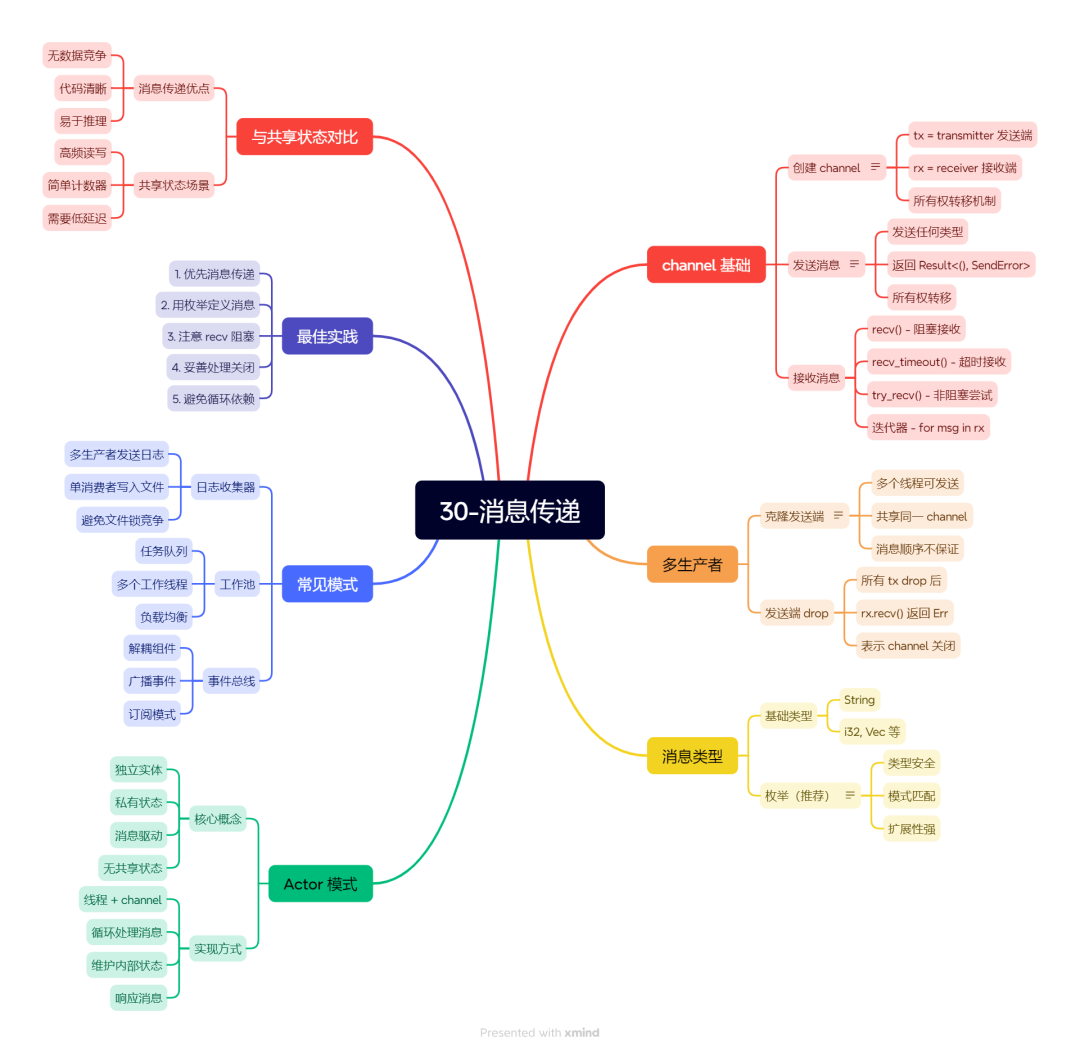
30-消息传递
📝 小结
- 消息传递优于共享状态——避免数据竞争,代码更清晰。
- mpsc channel 支持多生产者单消费者,用
clone()创建多个发送端。 recv()会阻塞,可以用recv_timeout()或try_recv()避免死锁。- 消息所有权被转移,不是复制,高效且安全。
- Actor 模式 是消息传递的经典应用,每个 Actor 维护自己的状态。
下篇预告: 如果就是需要共享状态怎么办?比如多个线程需要读写同一个计数器?别急,下篇我们学习 Mutex、RwLock、Arc,以及 Rust 如何通过类型系统保证共享状态的安全!
🔗 参考资料
- Rust Book - mpsc
- std::sync::mpsc 文档
- Actor 模式
本文参与 腾讯云自媒体同步曝光计划,分享自微信公众号。
原始发表:2026-05-25,如有侵权请联系 cloudcommunity@tencent.com 删除
评论
登录后参与评论
推荐阅读
目录
腾讯云开发者

Copyright © 2013 - 2026 Tencent Cloud. All Rights Reserved. 腾讯云 版权所有
深圳市腾讯计算机系统有限公司 ICP备案/许可证号:粤B2-20090059  粤公网安备44030502008569号
腾讯云计算(北京)有限责任公司 京ICP证150476号 | 京ICP备11018762号