The content of this page has been automatically translated by AI. If you encounter any problems while reading, you can view the corresponding content in Chinese.

Recording Plan

Last updated: 2024-08-05 17:45:50

Overview

The recording plan is to address the issue of which devices to pull streams from at what times and how long to store them. Currently, it is divided into two types: real-time cloud upload plan and video recording cloud upload plan, both of which rely on a recording template.

Prerequisites

You need to create a corresponding recording template first. For details, you can refer to the Recording Template Usage Guide.

Scenario Solution

\
Real-time Cloud Upload Plan
Recording Cloud Upload Plan
Applicable Scenario
Data stored in the cloud and sufficient device uplink network
Data stored in the cloud but insufficient device uplink network.
Note:
Essentially, using the device's idle times in the night or early morning (customer-defined) to upload the previous day's local recordings to the cloud.
Differences
Real-time data cloud storage of the device
Local recording to cloud of the device (i.e., recordings stored in IPC Camera storage card or NVR hard drive), for long-term backup storage.
Best Practice
Background:<0> To store data from the store's IPC cameras from 8 AM to 8 PM in the cloud for 7 days, ensuring it can be accessed and viewed at any time.
Operation:<1>
1. First, create a real-time cloud upload template with the time set as Monday to Sunday, 8 AM to 8 PM.
2. Then create a recording plan: select the device and apply the above template, and choose hot storage for 7 days.
Background: The goal is to upload 24 hours of video recordings from the hotel's NVR device hard drive every Sunday to cloud storage, ensuring accessibility within 7 days for immediate review, while also achieving lower-cost backup storage for 180 days.
Operation:
1. First, create a cloud upload template. Here are two recommended settings for the template:
Assuming the off-peak hours for cloud upload are from 00:00 to 6:00 on Mondays; Cloud upload speed: 4x.
Assuming the off-peak hours for cloud upload are from 00:00 to 8:00 and 20:00 to 24:00 on Mondays; Cloud upload speed: 2x
Note:
The platform will upload the previous day's recording data to the cloud at the specified speed during the cloud upload timeframe. Thus, to ensure data completeness, the template settings must at least meet the condition(cloud upload timeframe = previous day's recording timeframe / upload speed)
2. Then create a recording plan: select the device and apply the above template. Choose hot storage for 7 days and cold storage for 180 days.

Operation step

Real-time Cloud Upload Plan

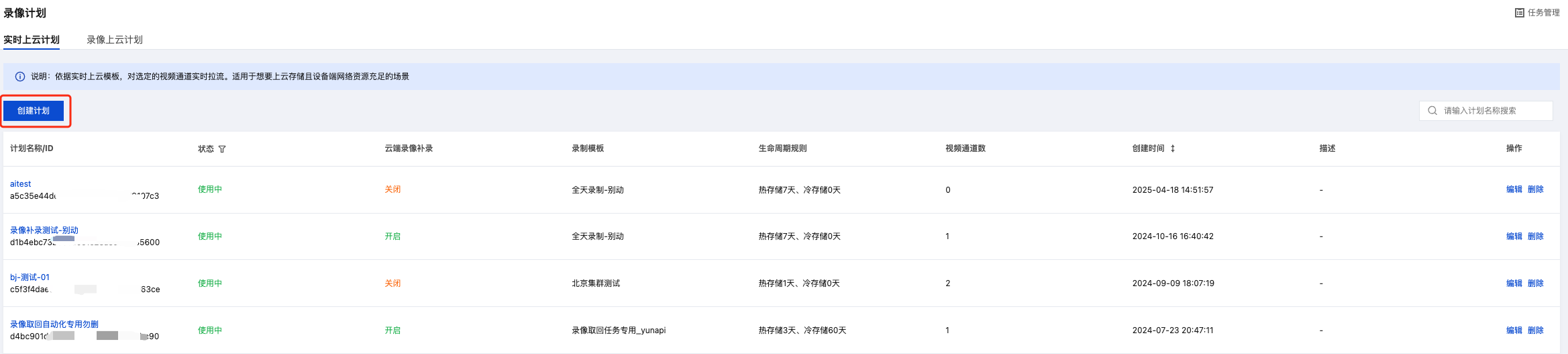
1. Click the top leftCreate Plan.

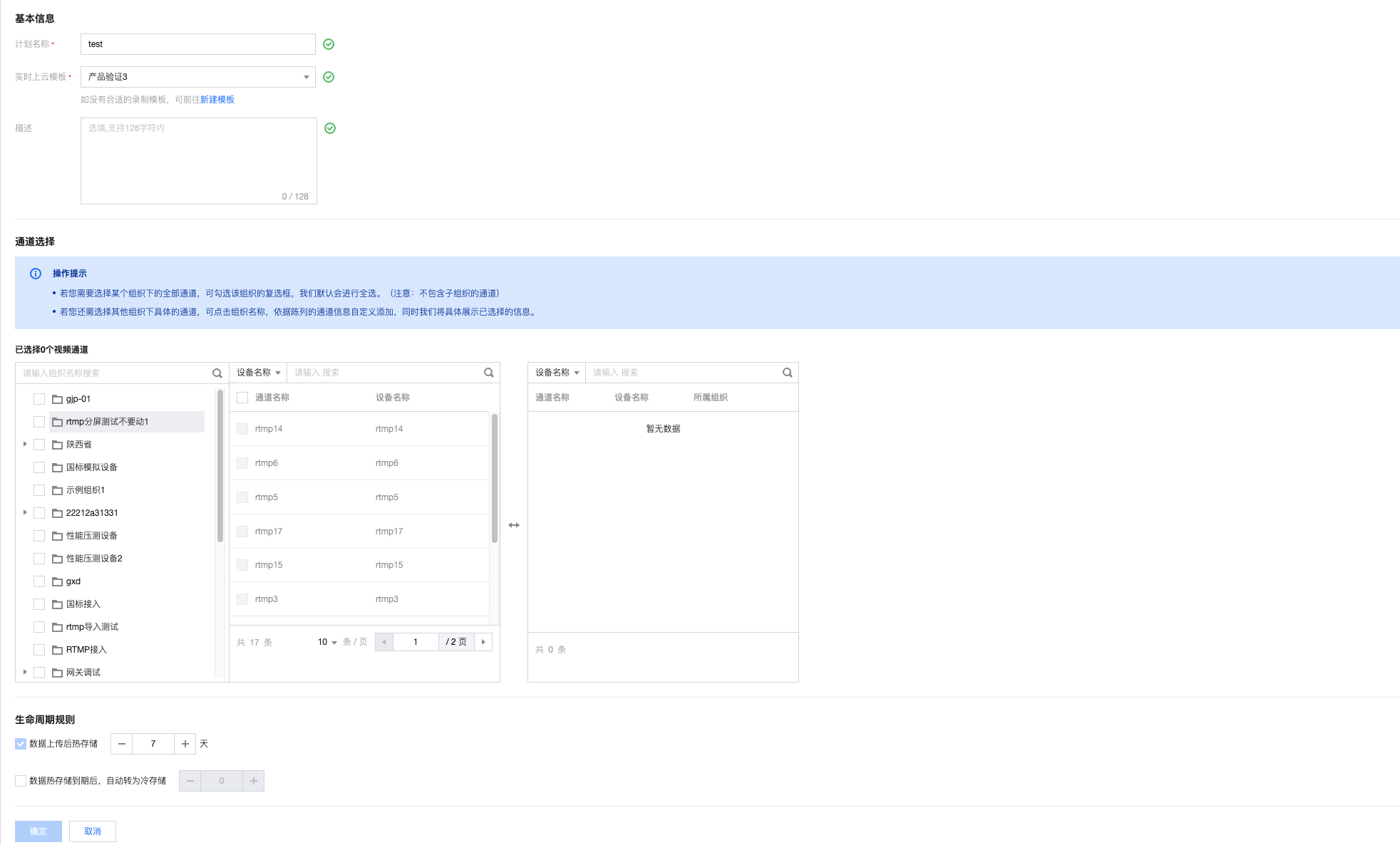
2. Fill in the basic information, select the created real-time cloud recording template, and add the video channel.
Note:
Regardless of whether the device and channels are online, they can be added to the plan. Each video channel can only be applied to one plan.
In terms of operation, we support selecting all channels under an organization, and we also support custom selection of channels under an organization.

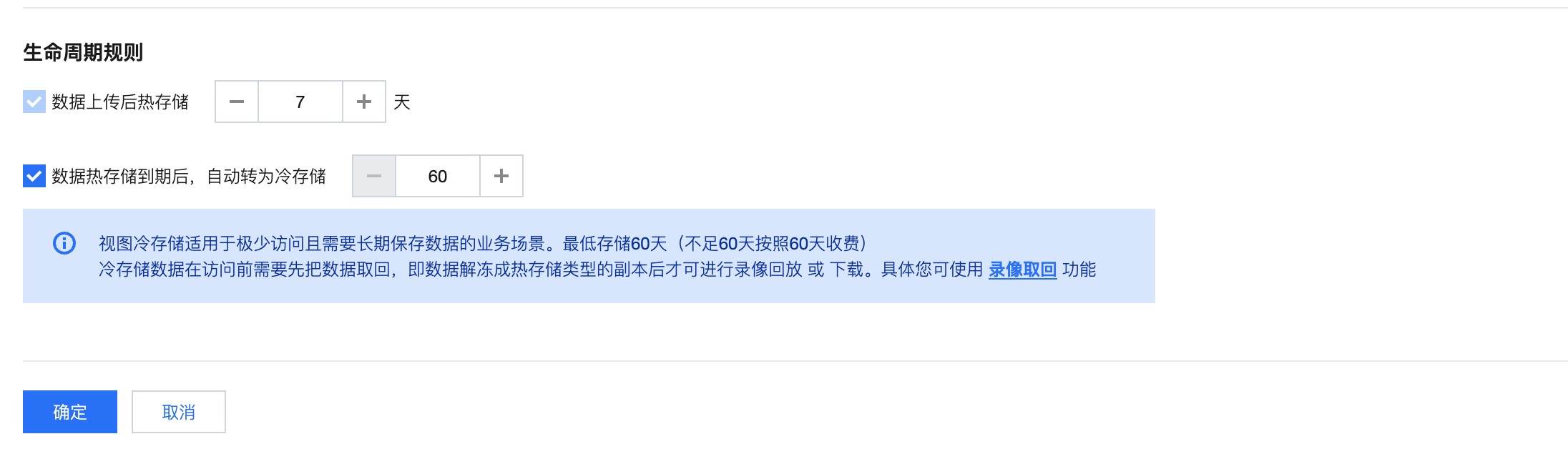
3. Set theLifecycle Rules, which define how long the data will be stored in the cloud.
Note:
Hot data storage type is suitable for scenarios requiring immediate access, with a duration of 1-3650 days.
Cold data storage type is suitable for long-term backup with infrequent access, with a minimum storage duration of60 daysand a maximum of 3650 days.

4. After completing the plan creation, the platform will execute the data upload and storage according to the settings.

Recording Cloud Upload Plan

Note:
You need to first ensure the integrity of the device's local recording. It is recommended that you log in to the Device Configuration End to check.
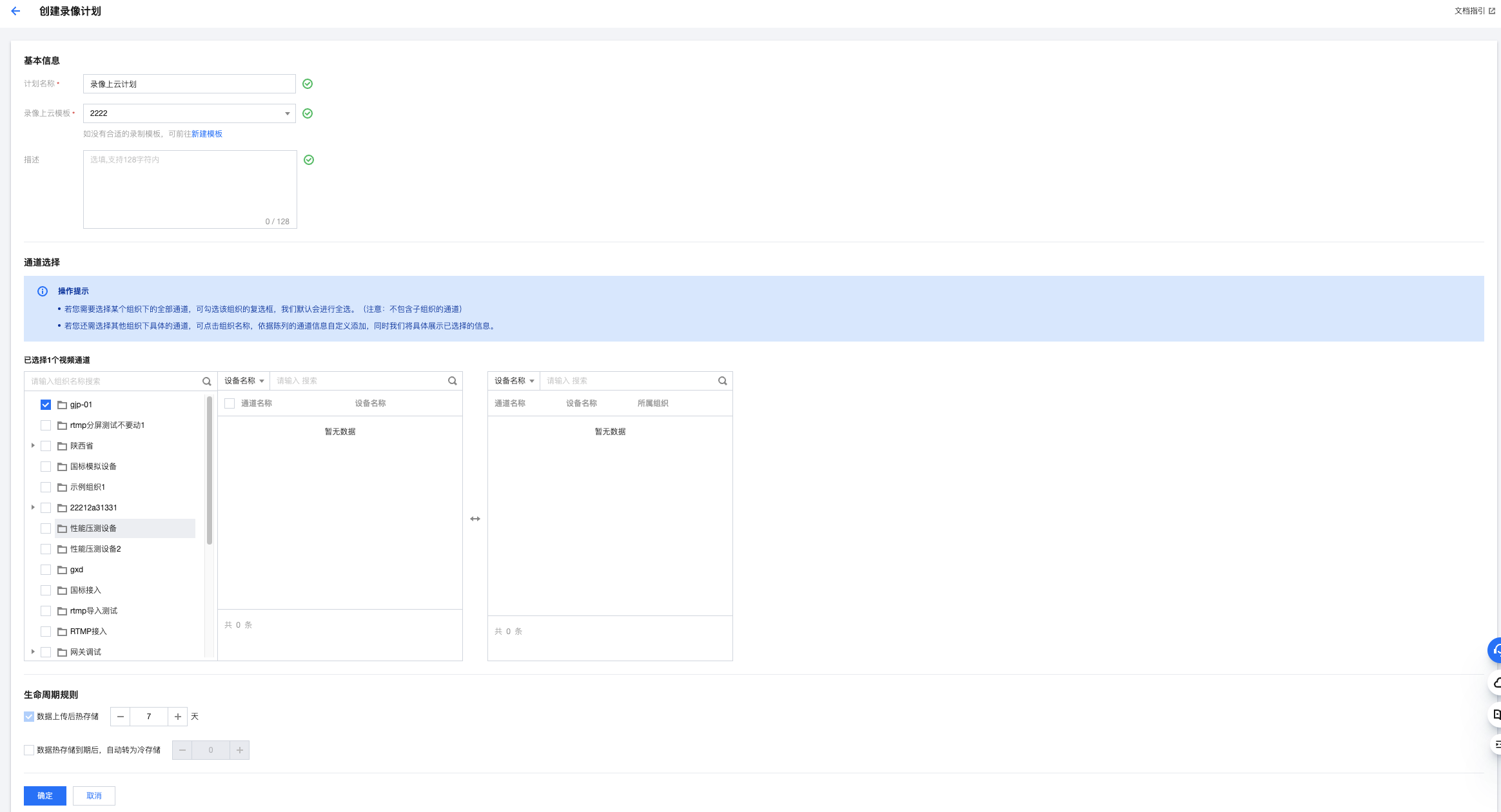
1. Click Create Plan in the top left corner.

2. Select the created Recording to Cloud Template, and add video channel and storage period. After completing the plan creation, the platform will execute the data upload and storage according to the settings.