Creating a Scaling Group

Last updated: 2026-05-12 20:45:21

Scenario

This document provides guidance on how to create a scaling group through the Tencent Cloud Auto Scaling console.

Instructions

Select a region

1. Log into the Auto Scaling console and select Scaling Groups from the left navigation bar.
2. Select the desired region at the top of the "Scaling Groups" page.
The choice of region restricts the cloud servers that can be manually added and the load balancers that can be bound. For instance, if the launch configuration's region is set to Guangzhou, then the cloud servers automatically added to the scaling group will be from Guangzhou. In a scaling group with the region set to Guangzhou, you cannot manually add cloud servers from other regions such as Shanghai, Beijing, Hong Kong, Toronto, etc., nor can you bind load balancers from these regions.

Configure the Scaling Group

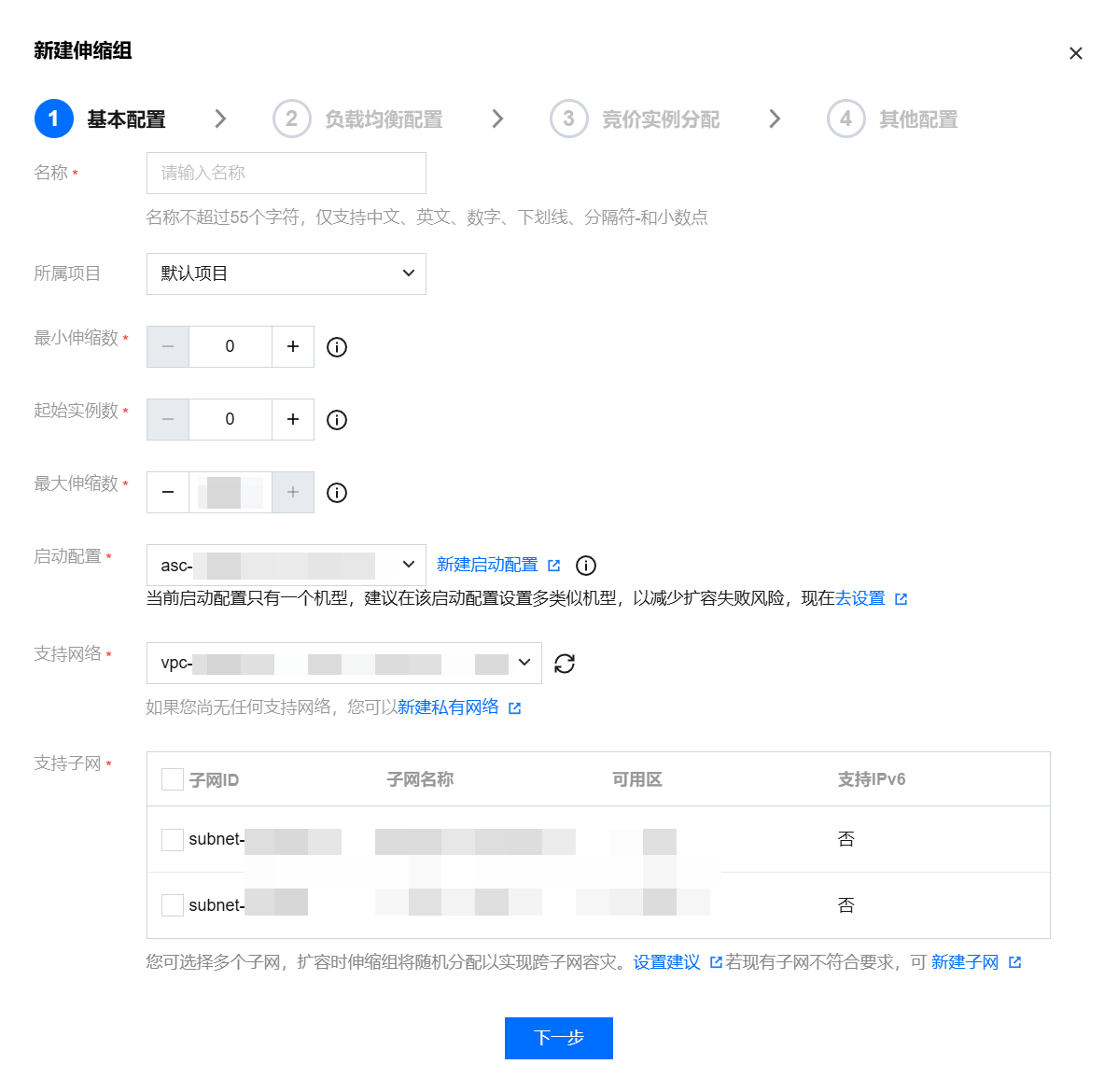
1. On the Scaling Groups page, click New.

Scaling Group Name: A custom name used to identify this scaling group.
Minimum Scaling Number: Specifies the minimum number of instances in the scaling group.
Initial Instance Count: Specifies the number of instances that the scaling group will automatically generate at the start. The corresponding number of instances will be produced after the scaling group is created.
Maximum Scaling Number: Specifies the maximum number of instances in the scaling group.
Launch Configuration: Specifies the created launch configuration. Expansion machines will be created according to this configuration during scaling.
Network Support: Specifies the network attributes of the expanded machines, i.e., whether the expanded machines are in the basic network or in a certain private network (VPC).
Subnet Support: Specifies the subnet where the expanded machines are located. You can choose multiple subnets, and the automatically expanded machines will be randomly created from the subnets you have selected, achieving a cross-subnet disaster recovery effect.
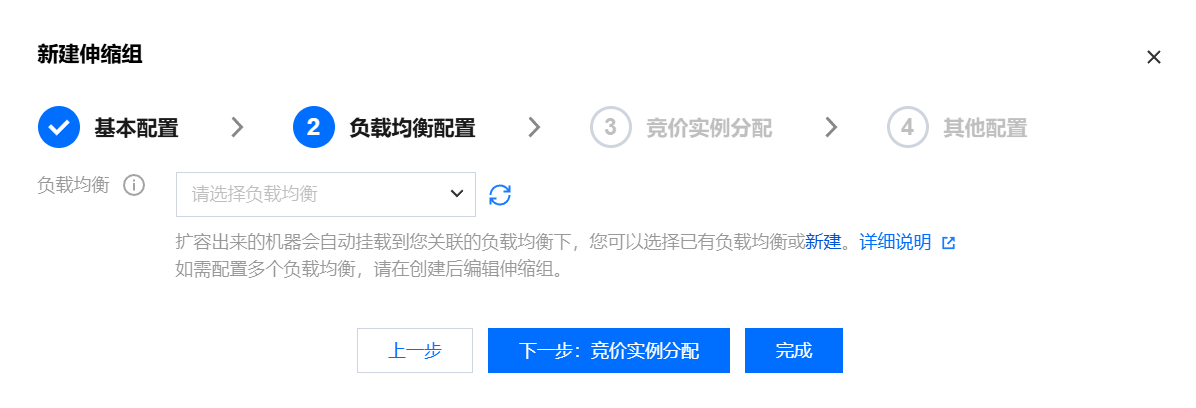
2. Click Next to proceed with the load balancing configuration for the scaling group.


You can choose an existing load balancer or create a new one. The expanded machines will automatically mount under the load balancer you have associated. If you need to configure multiple load balancers, please edit the scaling group after creation.
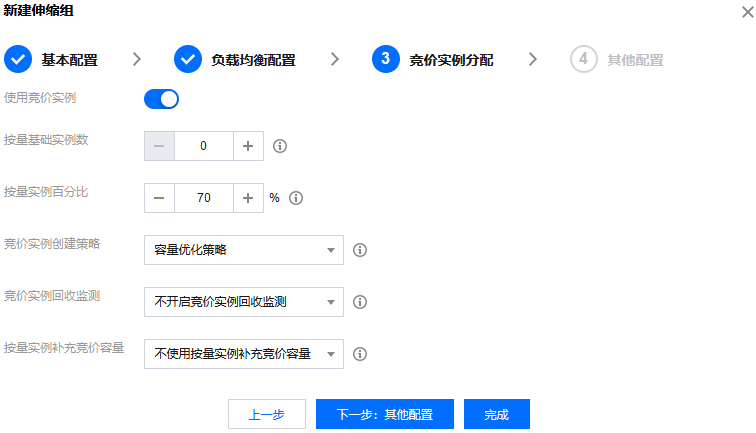
3. (Optional) Click Next: Spot Instance Allocation to configure the spot instance allocation strategy. You can also click Finish to skip this step. Turn on the "Use Spot Instance" switch. Once activated, it appears as shown below:


Number of On-Demand Base Instances: The minimum number of on-demand billed instances that must be met within the scaling group. When the scaling group expands, this portion of the instances is expanded first.
On-Demand Instance Percentage: The proportion of on-demand instances, excluding the number of on-demand billed base instances. You can specify any ratio between 0 and 100.
Spot Instance Creation Strategy: The strategy for creating spot instances when the launch configuration configures multiple machine types.
Capacity Optimization Strategy: Prioritize the selection of the most available spot instance types. Expanding in this manner can help you make the best use of spot instance resources.
Cost Optimization Strategy: Prioritize the selection of spot instance types with the lowest per-core price. Your instances will be allocated from the availability zones you specify. Expanding in this manner can help you save costs to the greatest extent.
Spot Instance Reclamation Monitoring: When enabled, Auto Scaling will attempt to proactively replace the spot instances in the scaling group that are about to be reclaimed with new instances, thereby helping you maintain the number of instances within the scaling group and the ratio of on-demand instances.
On-Demand Instances Supplementing Spot Capacity: When enabled, it will attempt to create on-demand billed instances for you when the spot instance inventory of your configured machine type is insufficient.
Note:
For detailed information about scaling groups mixed with on-demand billing and spot instances, please refer to Overview.
A scaling group mixed with on-demand billing and spot instances can only be created when the specified launch configuration billing mode is on-demand billing.
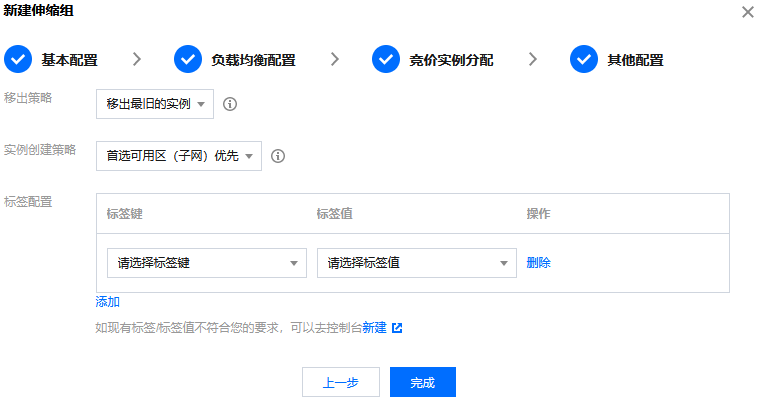
4. (Optional) Click Next: Other Configurations to proceed with other related configurations for the scaling group, or you can skip this step by clicking Finish. As shown in the figure below:

Removal Policy: When the scaling group needs to reduce instances and there are multiple options, the instance to be removed will be selected based on the removal policy. You can choose:
Remove the Oldest Instance: This option removes the oldest automatically added machine. Once all automatically added machines are removed, the earliest manually added machines will be removed. This option is typically selected.
Remove the Newest Instance: This option removes the most recently added automatic machine. Once all automatically added machines are removed, the most recently manually added machines will be removed.
Instance Creation Policy: When the scaling group needs to add instances and multiple subnets are specified in different availability zones, instances will be added according to this policy. You can choose:
Priority to Preferred Availability Zone (Subnet): Based on the order of your configured availability zones (subnets), the system will prioritize the earlier configurations. If it fails, it will automatically retry in order (suitable for architectures that primarily rely on a specific availability zone, with other zones as secondary).
Disperse Across Multiple Availability Zones (Subnets): The system will create new instances in the relatively less populated availability zones (subnets) based on the distribution of instances within the scaling group during expansion (suitable for architectures that require evenly distributed instances).
Tag Configuration: You can manage resources categorically through tags. For more details, please refer to Tags.
5. Click Complete.

See Also

Upon completion of the scaling group creation, the group can accommodate machines, but it does not yet possess the capability for intelligent scaling. We strongly recommend that you proceed with the following three operations: