小目标分割的"框"靠得住吗?YOLO26x 11% 的匹配分割落在检测框外
原创
小目标分割的"框"靠得住吗?YOLO26x 11% 的匹配分割落在检测框外
原创
AI小怪兽
发布于 2026-11-02 10:49:08
发布于 2026-11-02 10:49:08
论文解读 | 小目标分割的"框"靠得住吗?YOLO26x 11% 的匹配分割落在检测框外
论文:On Detection Reliability for Small Object Segmentation
题目译名:《面向小目标分割的检测可靠性研究》
作者:Olivier Rukundo(利默里克大学 电子与计算机工程系,爱尔兰)
arXiv:2610.34432(2026-10-25,cs.CV)|数据集公开于 Zenodo
一句话导读:用腺病毒 TEM 显微图像做了一组"体检式"实验,量化"检测框能不能可靠地指示分割应该在哪里做"——结论是:不能。YOLO26x 有 11.27% 已匹配的分割预测质心落在所有预测框之外。
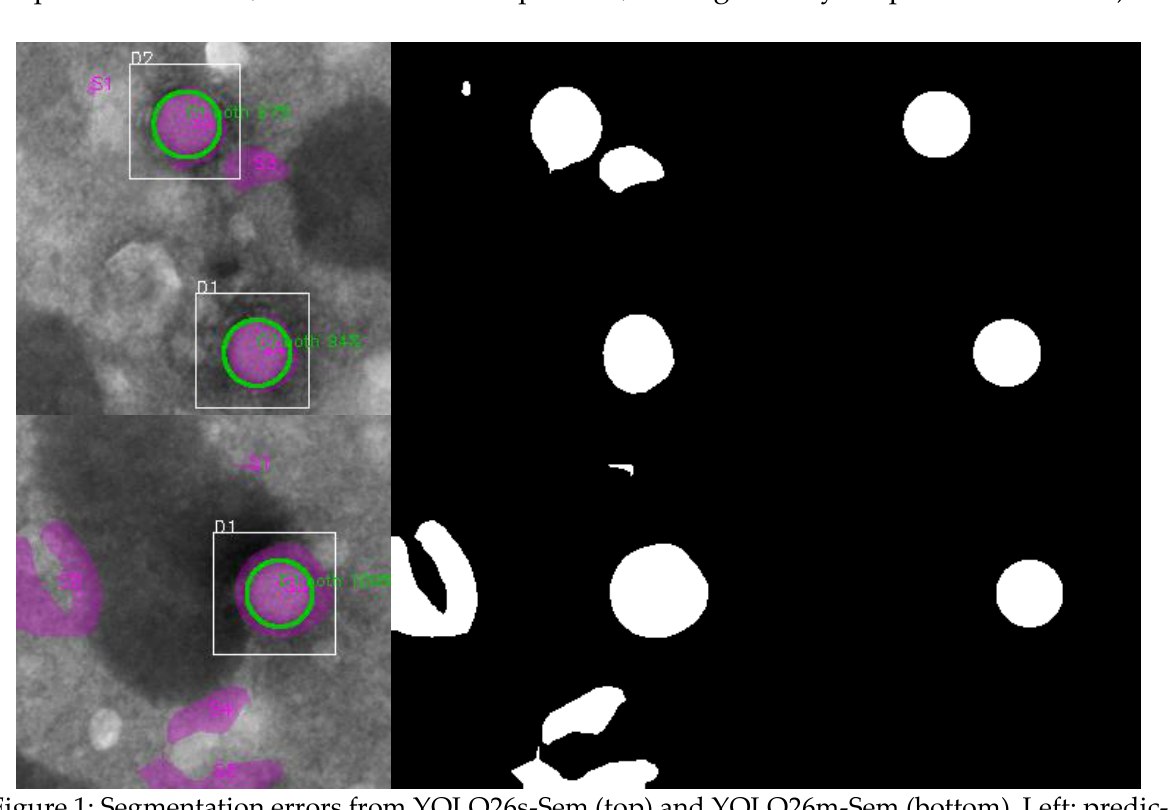
图 1:YOLO26s-Sem(上)与 YOLO26m-Sem(下)的分割错误示例。左:预测叠加图;中:预测 mask;右:真值 mask。可见预测前景外溢到标注边界之外。
博主简介

AI小怪兽 | 计算机视觉布道者 | 视觉检测领域创新者

深耕计算机视觉与深度学习领域,专注于目标检测前沿技术的探索与突破。长期致力于YOLO系列算法的结构性创新、性能极限优化与工业级落地实践,旨在打通从学术研究到产业应用的最后一公里。
🚀 核心专长与技术创新
- YOLO算法结构性创新:于CSDN平台原创发布《YOLOv13魔术师》、《YOLOv12魔术师》等全系列深度专栏。系统性提出并开源了多项原创自研模块,在模型轻量化设计、多维度注意力机制融合、特征金字塔重构等关键方向完成了一系列突破性实践,为行业提供了具备高参考价值的技术路径与完整解决方案。
- 技术生态建设与知识传播:独立运营 “计算机视觉大作战” 公众号(粉丝1.6万),成功构建高质量的技术交流社群。致力于将复杂算法转化为通俗易懂的解读与可复现的工程代码,显著降低了计算机视觉的技术入门门槛。
🏆 行业影响力与商业实践
- 荣获腾讯云年度影响力作者与创作之星奖项,内容质量与专业性获行业权威平台认证。
- 全网累计拥有 7万+ 垂直领域技术受众,专栏文章总阅读量突破百万,在目标检测领域形成了广泛的学术与工业影响力。
- 具备丰富的企业级项目交付经验,曾为工业视觉检测、智慧城市安防等多个关键领域提供定制化的算法模型与解决方案,驱动业务智能化升级。
💡 未来方向与使命
秉持 “让每一行代码都有温度” 的技术理念,未来将持续聚焦于实时检测、语义分割及工业缺陷检测的商业化闭环等核心方向。愿与业界同仁协同创新,共同推动技术边界,以坚实的技术能力赋能实体经济与行业变革。
一、摘要
小目标分割常依赖"检测框定区域、分割器在框内跑"的两段式范式,但这篇论文追问了一个被普遍忽略的前提:预测框本身可靠吗?作者以腺病毒颗粒(透射电镜 TEM 图像)为小目标载体,用 YOLO26x 做检测、YOLO26x-Sem 做分割、Mask R-CNN 兼做两者,通过质心匹配把分割预测与真值对齐,再统计匹配成功的分割质心落在检测框内、外的比例。结果显示:YOLO26x/YOLO26x-Sem 组合中,34 个参考目标(47.89%)的匹配分割质心在至少一个预测框内、8 个(11.27%)在所有框之外、29 个(40.85%)无匹配分割;而 Mask R-CNN 对应数字是 69(97.18%)、0、2(2.82%)。把分割限制在检测框内,可能把框外有效的分割预测直接扔掉,制造假阴性。
伪代码如下:
"""
Pseudocode for:
"On Detection Reliability for Small Object Segmentation"
arXiv:2610.34432

This file implements the core centroid-containment analysis pipeline
described in Sections 2.1 and 2.3 of the paper. It covers:
  - Reference annotation consistency check (Eq. 1–4)
  - Matching of predicted mask centroids to ground-truth mask centroids
  - Classification of matched centroids as INSIDE, OUTSIDE, or NO_MATCH
"""

from dataclasses import dataclass
from enum import Enum
from typing import List, Tuple, Optional

import numpy as np
from scipy.optimize import linear_sum_assignment


# ---------------------------------------------------------------------------
# Data structures
# ---------------------------------------------------------------------------

@dataclass
class BBox:
    """Axis-aligned bounding box in pixel coordinates (x1, y1, x2, y2)."""
    x1: float
    y1: float
    x2: float
    y2: float

    @property
    def center(self) -> Tuple[float, float]:
        return (self.x1 + self.x2) / 2.0, (self.y1 + self.y2) / 2.0

    def contains(self, point: Tuple[float, float]) -> bool:
        """Check whether a point lies inside the box (boundary inclusive)."""
        px, py = point
        return self.x1 <= px <= self.x2 and self.y1 <= py <= self.y2


@dataclass
class MaskObject:
    """A single connected foreground component with its mask centroid."""
    centroid: Tuple[float, float]
    bbox: BBox  # expanded reference box (5 px margin applied for GT)


class ContainmentOutcome(Enum):
    INSIDE = "inside"
    OUTSIDE = "outside"
    NO_MATCH = "no_match"


# ---------------------------------------------------------------------------
# Eq. (1): centroids and reference box construction
# ---------------------------------------------------------------------------

def compute_mask_centroid(mask: np.ndarray) -> Tuple[float, float]:
    """
    Compute the centroid of a binary mask using standard image moments.

    Args:
        mask: 2-D binary array (foreground = 255 or True).

    Returns:
        (cx, cy) centroid coordinates.
    """
    ys, xs = np.nonzero(mask)
    if len(xs) == 0:
        raise ValueError("Empty mask has no centroid.")
    return float(xs.mean()), float(ys.mean())


def expand_bbox(bbox: BBox, margin: int = 5,
                img_shape: Optional[Tuple[int, int]] = None) -> BBox:
    """Expand a bounding box by `margin` pixels on each side (clipped)."""
    x1 = bbox.x1 - margin
    y1 = bbox.y1 - margin
    x2 = bbox.x2 + margin
    y2 = bbox.y2 + margin

    if img_shape is not None:
        h, w = img_shape[:2]
        x1 = max(0.0, x1)
        y1 = max(0.0, y1)
        x2 = min(float(w - 1), x2)
        y2 = min(float(h - 1), y2)

    return BBox(x1, y1, x2, y2)


# ---------------------------------------------------------------------------
# Eq. (2): optimal one-to-one assignment
# ---------------------------------------------------------------------------

def match_centroids(
    source_points: List[Tuple[float, float]],
    target_points: List[Tuple[float, float]],
) -> List[Tuple[int, int]]:
    """
    Solve the one-to-one assignment problem (Eq. 2) using the
    Jonker–Volgenant algorithm via SciPy's linear_sum_assignment.

    Returns:
        List of (source_index, target_index) matched pairs.
    """
    n = len(source_points)
    m = len(target_points)
    if n == 0 or m == 0:
        return []

    cost = np.zeros((n, m), dtype=float)
    for i, (sx, sy) in enumerate(source_points):
        for j, (tx, ty) in enumerate(target_points):
            cost[i, j] = np.hypot(sx - tx, sy - ty)

    row_ind, col_ind = linear_sum_assignment(cost)
    return list(zip(row_ind.tolist(), col_ind.tolist()))


# ---------------------------------------------------------------------------
# Eq. (3) & (4): reference annotation consistency metrics
# ---------------------------------------------------------------------------

def reference_consistency_metrics(
    gt_mask_objects: List[MaskObject],
    gt_bboxes: List[BBox],
    tolerance: float = 5.0,
) -> Tuple[float, float]:
    """
    Compute centre-coordinate agreement (Eq. 3) and mask-centroid
    containment (Eq. 4) for reference annotations.

    Returns:
        (agreement_pct, containment_pct)
    """
    bbox_centers = [b.center for b in gt_bboxes]
    mask_centroids = [obj.centroid for obj in gt_mask_objects]

    matches = match_centroids(mask_centroids, bbox_centers)
    total = len(matches)
    if total == 0:
        return 0.0, 0.0

    agree = 0
    contained = 0
    for mi, bi in matches:
        mx, my = mask_centroids[mi]
        bx, by = bbox_centers[bi]
        if np.hypot(mx - bx, my - by) <= tolerance:
            agree += 1
        if gt_bboxes[bi].contains((mx, my)):
            contained += 1

    return 100.0 * agree / total, 100.0 * contained / total


# ---------------------------------------------------------------------------
# Section 2.3: predicted-mask centroid containment analysis
# ---------------------------------------------------------------------------

def classify_predicted_centroids(
    pred_mask_centroids: List[Tuple[float, float]],
    gt_mask_centroids: List[Tuple[float, float]],
    pred_bboxes: List[BBox],
) -> Tuple[List[ContainmentOutcome], dict]:
    """
    Core analysis: match predicted mask centroids to GT mask centroids,
    then classify each matched centroid as INSIDE at least one predicted
    bounding box, OUTSIDE all predicted boxes, or NO_MATCH.

    Returns:
        outcomes: per matched prediction, the containment outcome.
        stats:    summary counts and percentages.
    """
    matches = match_centroids(pred_mask_centroids, gt_mask_centroids)

    outcomes: List[ContainmentOutcome] = []
    inside_count = 0
    outside_count = 0

    matched_gt_indices = set()
    for pi, gi in matches:
        matched_gt_indices.add(gi)
        cx, cy = pred_mask_centroids[pi]

        if any(bbox.contains((cx, cy)) for bbox in pred_bboxes):
            outcomes.append(ContainmentOutcome.INSIDE)
            inside_count += 1
        else:
            outcomes.append(ContainmentOutcome.OUTSIDE)
            outside_count += 1

    no_match_count = len(gt_mask_centroids) - len(matched_gt_indices)
    total_gt = len(gt_mask_centroids)

    stats = {
        "total_gt_objects": total_gt,
        "matched_predictions": len(matches),
        "inside": inside_count,
        "outside": outside_count,
        "no_match": no_match_count,
        "inside_pct": 100.0 * inside_count / total_gt if total_gt else 0.0,
        "outside_pct": 100.0 * outside_count / total_gt if total_gt else 0.0,
        "no_match_pct": 100.0 * no_match_count / total_gt if total_gt else 0.0,
    }
    return outcomes, stats


# ---------------------------------------------------------------------------
# End-to-end demonstration (matches the paper's reporting style)
# ---------------------------------------------------------------------------

def run_centroid_containment_analysis(
    gt_mask_objects: List[MaskObject],
    gt_bboxes: List[BBox],
    pred_mask_centroids: List[Tuple[float, float]],
    pred_bboxes: List[BBox],
    tolerance: float = 5.0,
) -> None:
    """
    Full pipeline:
      1. Reference consistency check (Eq. 3–4)
      2. Predicted centroid containment classification (Section 2.3)
      3. Print the same style of summary reported in the paper.
    """
    print("=" * 60)
    print("1. REFERENCE ANNOTATION CONSISTENCY")
    print("=" * 60)

    agree_pct, contain_pct = reference_consistency_metrics(
        gt_mask_objects, gt_bboxes, tolerance
    )
    print(f"Centre-coordinate agreement (≤{tolerance:.0f} px): {agree_pct:.2f}%")
    print(f"Mask-centroid containment in reference boxes: {contain_pct:.2f}%")

    print("\n" + "=" * 60)
    print("2. PREDICTED-MASK CENTROID CONTAINMENT")
    print("=" * 60)

    gt_mask_centroids = [obj.centroid for obj in gt_mask_objects]
    outcomes, stats = classify_predicted_centroids(
        pred_mask_centroids, gt_mask_centroids, pred_bboxes
    )

    print(f"Total GT objects          : {stats['total_gt_objects']}")
    print(f"Matched predictions       : {stats['matched_predictions']}")
    print(f"  INSIDE  at least one box: {stats['inside']:3d}  "
          f"({stats['inside_pct']:.2f}%)")
    print(f"  OUTSIDE all boxes       : {stats['outside']:3d}  "
          f"({stats['outside_pct']:.2f}%)")
    print(f"  NO_MATCH                : {stats['no_match']:3d}  "
          f"({stats['no_match_pct']:.2f}%)")

    print("\nPer-matched-prediction outcomes:")
    for i, outcome in enumerate(outcomes):
        print(f"  Pred {i:03d}: {outcome.value}")


# ---------------------------------------------------------------------------
# Minimal toy example (for quick sanity check)
# ---------------------------------------------------------------------------

if __name__ == "__main__":
    # Toy GT: two small objects
    gt_masks = [
        MaskObject(centroid=(10.0, 10.0), bbox=BBox(5, 5, 15, 15)),
        MaskObject(centroid=(40.0, 40.0), bbox=BBox(35, 35, 45, 45)),
    ]
    gt_boxes = [obj.bbox for obj in gt_masks]

    # Simulated predictions:
    # - pred 0: centroid inside its predicted box (INSIDE)
    # - pred 1: centroid outside its predicted box (OUTSIDE)
    # - GT object 1 receives no matched prediction (NO_MATCH)
    pred_centroids = [(10.5, 10.5), (39.0, 39.0)]
    pred_bboxes = [
        BBox(8, 8, 13, 13),      # contains (10.5, 10.5) → INSIDE
        BBox(50, 50, 60, 60),     # does NOT contain (39, 39) → OUTSIDE
    ]

    run_centroid_containment_analysis(
        gt_mask_objects=gt_masks,
        gt_bboxes=gt_boxes,
        pred_mask_centroids=pred_centroids,
        pred_bboxes=pred_bboxes,
        tolerance=5.0,
    )
二、研究背景
小目标分割在邻近目标密集、背景噪声复杂的场景下本就困难(细胞、病毒颗粒是典型代表)。当检测与分割被组合在同一 pipeline 里——例如 YOLO 检测后裁框送 SAM 分割——用预测框决定"在哪里分割"就意味着结果受制于检测器的输出:检测器漏了,分割器永远看不到;框是误检,分割器就输出假 mask。
此前工作各有侧重:BREPS(AAAI 2026)用对抗性框提示评估可提示分割的鲁棒性;BoxCell 等利用 SAM 把框当作 prompt;Tiny-YOLOSAM 用 YOLO 框提示 SAM、并在 YOLO mask 无覆盖处补充。但它们都没直接回答:"独立预测的 mask"与"检测框"之间,空间对应关系到底有多牢靠?这篇论文补的就是这个量化空白,也顺带把作者此前的腺病毒检测(YOLO26)与 SSP 切片工具两条线接了起来。
三、创新点
- 新的评测问题定义:不比 mAP、不比 IoU,而是把"匹配分割质心是否落在检测框内"作为独立指标,定义三种结果——框内匹配、框外匹配、无匹配分割(图 2 示意)。
- 参考标注一致性前置审计:先用 8 连通域从真值 mask 反推目标、扩 5px 成参考框,再用 Jonker–Volgenant 指派算法做框中心与 mask 质心的一对一匹配,确认检测/分割两套标注确实描述同一批目标(97.18% 中心距 ≤5px、100% 质心在参考框内),评估才成立。
- 跨范式对照:YOLO26(纯检测)+ YOLO26-Sem(语义分割)的"解耦两段式",对比 Mask R-CNN 的"框-mask 耦合式",同一数据、同一套匹配准则下量化差异。
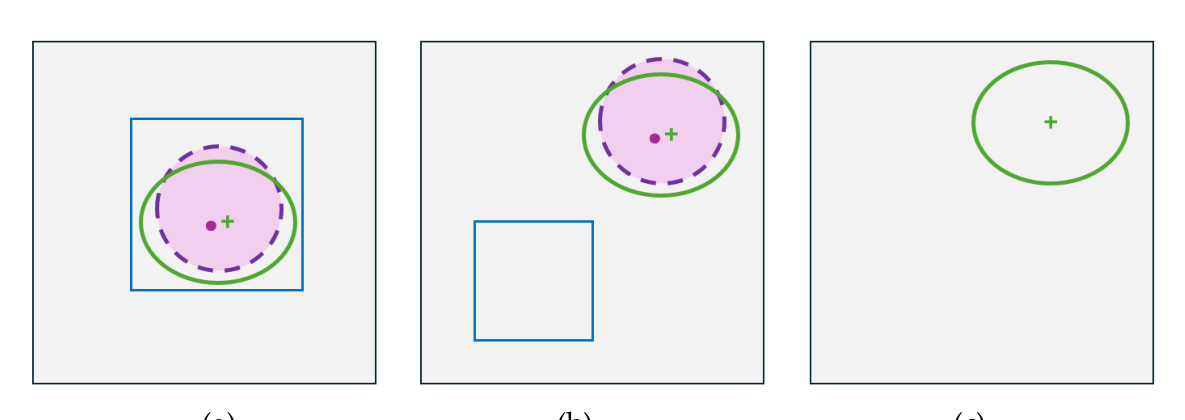
图 2:三种匹配结果示意。(a) 质心在至少一个预测框内;(b) 质心在所有预测框之外;(c) 无匹配分割。绿色实线为真值 mask,紫色虚线为匹配的预测 mask,蓝框为预测框。
四、创新点解读
这套质心审计方法好在哪?(非论文原文,个人观点)
- 它测的是 pipeline 的"结构性风险",不是模型强弱。 mAP 高不代表每个相关目标都拿到了分割区域——论文特意点破这一点。检测精度描述"接受的检测对不对",但不保证"该分的都分到了"。47.89% vs 11.27% vs 40.85% 这个三分分布,把"检测框作为分割先验"的失效率拆成了可直接归因的三块。
- Mask R-CNN 的 97.18% 要冷读。 它的 mask 本来就是从预测框内生成的,质心几乎必然在框内——这是结构性耦合的产物,不能反推"检测完整"。作者在讨论里明确说了这一点,这份清醒值得点赞。真正可对比的只有"无匹配分割"的 2.82% vs 40.85%。
- 对 YOLO 生态的工程警示。 YOLO26x 是五档中 mAP@0.50:0.95 最高的(0.5480),即便如此仍有 11.27% 匹配分割在框外。对时下流行的"YOLO26 检测 + SAM 分割"方案(如 Tiny-YOLOSAM),这个数字意味着直接裁框会漏掉约 1/9 已经能被分割器找到的目标——False Negative 不是分割器的锅,是框的锅。
- 40.85% 无匹配分割的读法。 匹配阈值是 0.25 置信度 / 0.50 前景概率,"无匹配分割"不等于"没分割"——预测可能存在但不满足与真值质心的匹配准则(图 6 右列黄叉)。这与前一篇 ScopeMamba 里"漏检"概念要区分开。
五、实验结果
实验设置:SSP 数据集(源自 TEM 病毒数据集的腺病毒类,SSP 工具切片),145 对检测/分割图像,87/26/32 划分训练/验证/测试,测试集含 71 个参考目标。所有模型在 RTX 3070 + i7-11700F 上训练(单卡 8GB 档位就能复现的体量),最多 300 epoch、早停耐心 100,YOLO26 用 MuSGD(batch 2),Mask R-CNN 用 SGD(lr 0.005)。增广:±180° 旋转、10% 平移、0.8–1.2 缩放、概率 0.5 翻转。
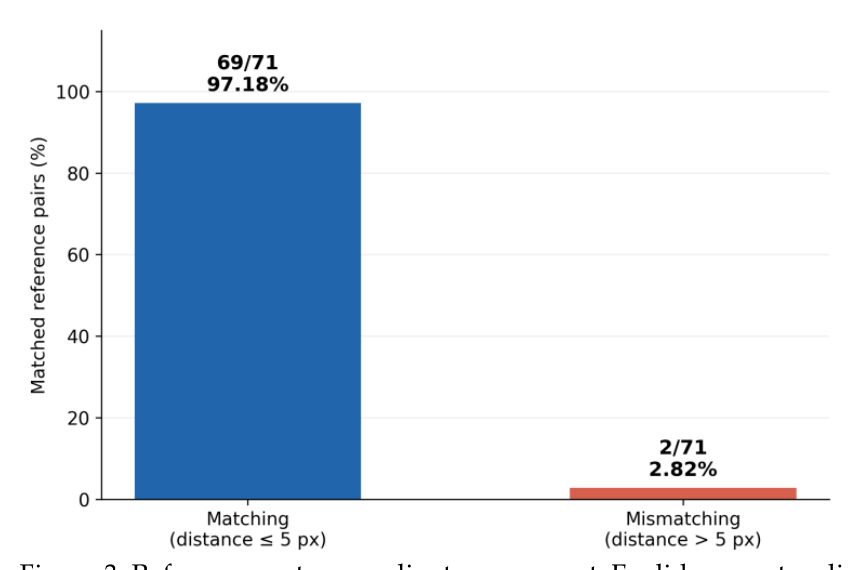
图 3:参考标注一致性——69/71(97.18%)的框中心与 mask 质心欧氏距离不超过 5 像素。
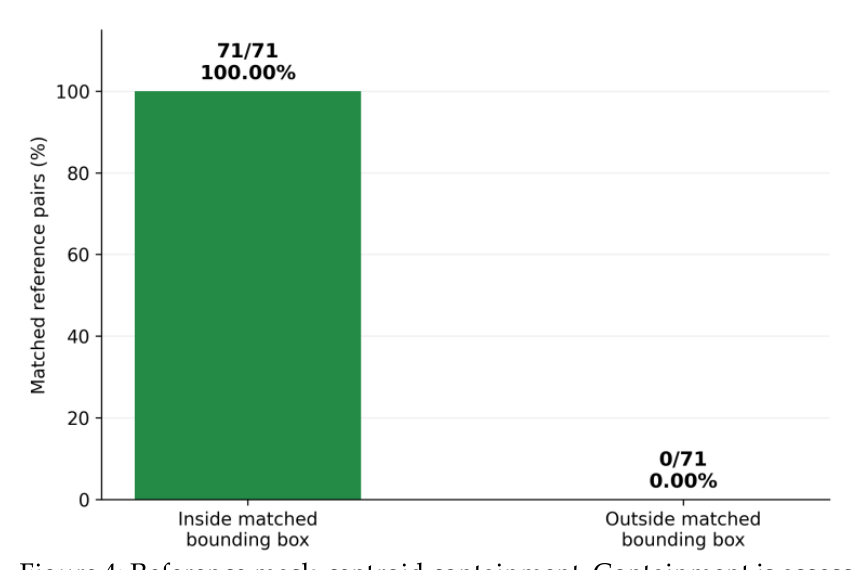
图 4:参考质心包含率——全部 71 个 mask 质心(100%)都落在对应参考框内,标注一致性成立。
检测性能(Table 1,测试集):
模型 | Precision | Recall | mAP@0.50 | mAP@0.50:0.95 |
|---|---|---|---|---|
YOLO26n | 0.9210 | 0.8169 | 0.8978 | 0.5320 |
YOLO26s | 0.8479 | 0.7069 | 0.7738 | 0.4149 |
YOLO26m | 0.8411 | 0.8201 | 0.8892 | 0.4753 |
YOLO26l | 0.8219 | 0.7324 | 0.8490 | 0.5110 |
YOLO26x | 0.9456 | 0.8028 | 0.9075 | 0.5480 |
Mask R-CNN | 0.8519 | 0.9718 | — | — |
分割性能(Table 2,测试集):
模型 | IoU | mIoU | Dice | 像素Precision | 像素Recall |
|---|---|---|---|---|---|
YOLO26n-Sem | 0.6196 | 0.7680 | 0.7651 | 0.6391 | 0.9529 |
YOLO26s-Sem | 0.6137 | 0.7639 | 0.7606 | 0.6321 | 0.9548 |
YOLO26m-Sem | 0.6035 | 0.7564 | 0.7527 | 0.6173 | 0.9642 |
YOLO26l-Sem | 0.6145 | 0.7784 | 0.7612 | 0.8817 | 0.6697 |
YOLO26x-Sem | 0.7144 | 0.8325 | 0.8334 | 0.7959 | 0.8747 |
Mask R-CNN | 0.7254 | 0.8367 | 0.8409 | 0.7468 | 0.9620 |
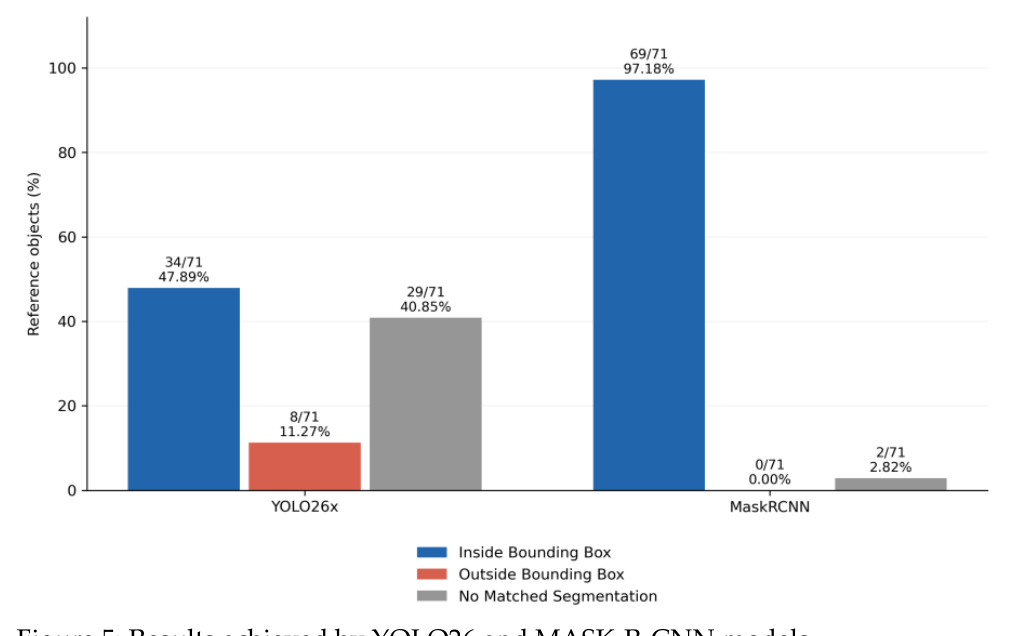
图 5:核心结果。YOLO26x/YOLO26x-Sem:47.89% 框内、11.27% 框外、40.85% 无匹配分割;Mask R-CNN:97.18% 框内、0% 框外、2.82% 无匹配分割。
核心发现(图 5):即便选用各组里最强的 YOLO26x/YOLO26x-Sem,仍有 8/71(11.27%)的匹配分割质心落在所有预测框之外——这部分目标分割器明明找到了,却会被"只在框内分割"的策略丢掉。定性示例(图 6)展示了三种结果的真实样例,注意右列黄叉目标是"有预测但不满足匹配",而非完全无分割。
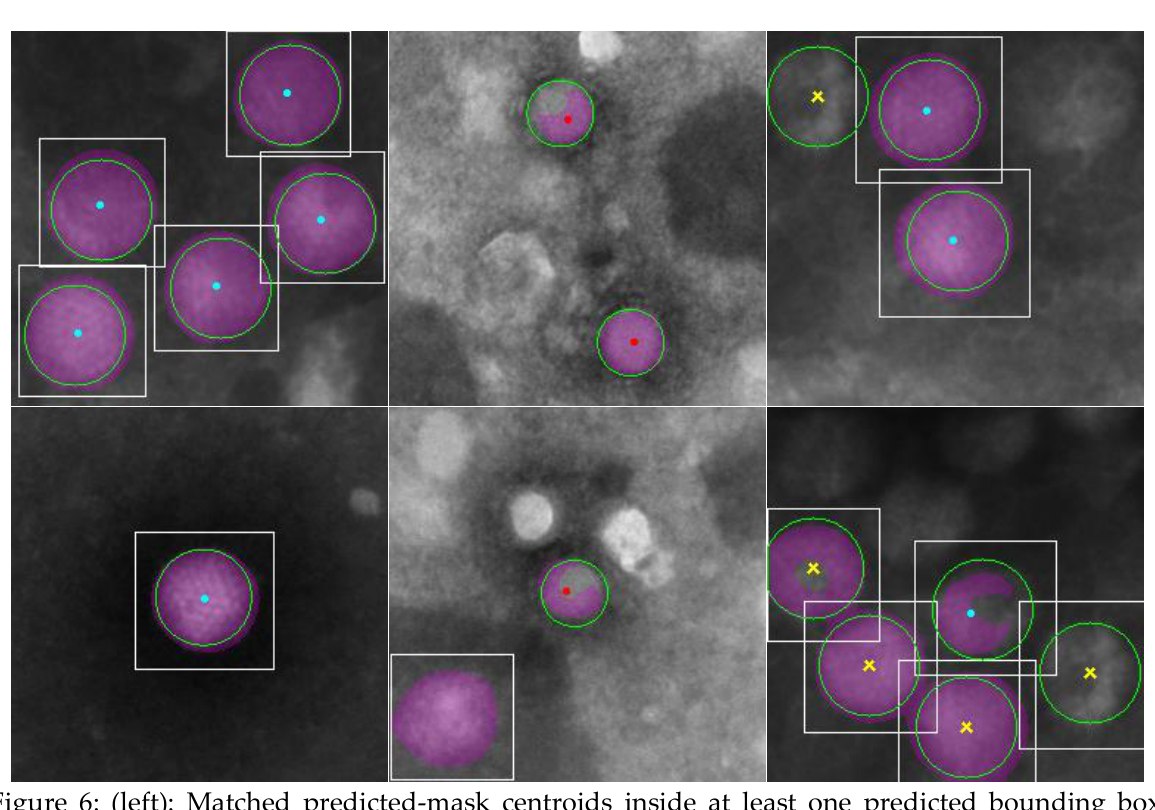
图 6:三种结果的定性示例。左:质心在至少一个预测框内;中:质心在所有预测框之外;右:无匹配分割的真值目标(黄叉标记)。
六、展望
论文自己把边界画得很清楚:这是初步实验——单一数据集(71 个目标)、单组阈值(0.25/0.50)、未做匹配敏感性分析,结论外推前需要在更广的数据上验证(非论文原文,以下为个人观点):
- 对两段式方案的直接启示:检测框不适合作为分割的唯一空间先验,要么像 Tiny-YOLOSAM 那样补充框外覆盖,要么直接上耦合式(Mask R-CNN 类)或语义分割全图方案。
- 指标空白:mAP/IoU 之外,"质心包含率"值得进 pipeline 的验收清单——尤其医疗、显微这类漏检代价高的场景。
- 留给社区的问题:框外匹配的 11.27% 在不同 IoU/置信度阈值下如何变化?SSP 数据集已在 Zenodo 公开,这个实验 anyone 都能跑。
原创声明:本文系作者授权腾讯云开发者社区发表,未经许可,不得转载。
如有侵权,请联系 cloudcommunity@tencent.com 删除。
目录
腾讯云开发者

Copyright © 2013 - 2026 Tencent Cloud. All Rights Reserved. 腾讯云 版权所有
深圳市腾讯计算机系统有限公司 ICP备案/许可证号:粤B2-20090059  粤公网安备44030502008569号
腾讯云计算(北京)有限责任公司 京ICP证150476号 | 京ICP备11018762号