If your cloud services deployed in a VPC need to be shared with VPCs in other regions, you can use Private Connection and Cloud Connect Network services.
Background Information
A Virtual Private Cloud (VPC) is your exclusive cloud-based network, and different VPCs are completely isolated by default. You can use Private Link service to establish secure and stable connections between Tencent Cloud VPCs and other VPCs in the same region, simplifying network architecture and avoiding potential security risks associated with public network access. If you need to share VPC services across regions, you can use Cloud Connect Network to enable cross-regional VPC communication, and then use the Private Link service with the endpoint in the consumer VPC to access services in the provider VPC.
To use Private Link, you need to create an Endpoint Service and an Endpoint. Before creating the Endpoint Service, you need to create an internal Layer 4 Cloud Load Balancer instance and a listener associated with the Cloud Virtual Machine instance where your service is deployed. Then, when creating the Endpoint Service, associate it with the Cloud Load Balancer instance. At this point, the Endpoint Service will serve as the access point for the service provider's business, allowing the consumer to create an Endpoint to request a connection. Once the connection is established, the service consumer can access the business services deployed by the service provider.
Scenario Example
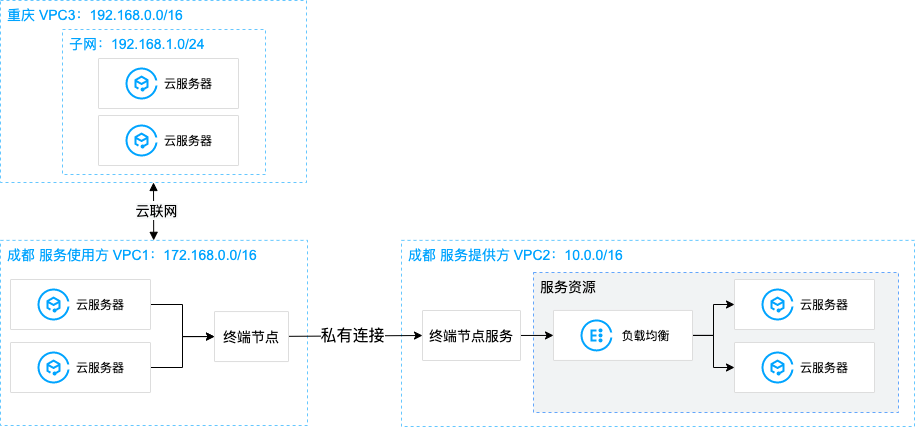
In this document, we will use the following business scenario as an example. A company has its services deployed in the Chengdu region's VPC2 and needs to share these services with clients in the same region's VPC1 network and the Chongqing region's VPC3 network. To avoid potential security risks associated with public network access, Tencent Cloud Private Link and Cloud Connect Network are used to implement this communication solution.
Note
This article assumes that the three VPCs are under the same account.
Preparations
Service provider VPC2 and service consumer VPC1 have been created, as well as cross-regional service consumer VPC3.
In the service provider's VPC2, an internal Layer 4 CLB instance has been created, and related service resources are deployed in the backend Cloud Virtual Machine instances. Please ensure that the backend Cloud Virtual Machine instances can properly handle requests forwarded by the Cloud Load Balancer. For more information, refer to the Cloud Load Balancer Quick Start Guide.
Please ensure that the security group associated with the Cloud Virtual Machine in the service provider's VPC2 has allowed the 11.163.0.0/16 address range, as shown in the following diagram.
Instructions
Step 1: Service provider creates an Endpoint Service
Note
In this example, the service provider's VPC2 has created a Layer 4 private network CLB, with the backend Cloud Virtual Machine instances already deployed with the relevant business services. The security group of the Cloud Virtual Machine instances has allowed the 11.163.0.0/16 IP address range.
2. Click Private Link > Endpoint Services in the left sidebar.
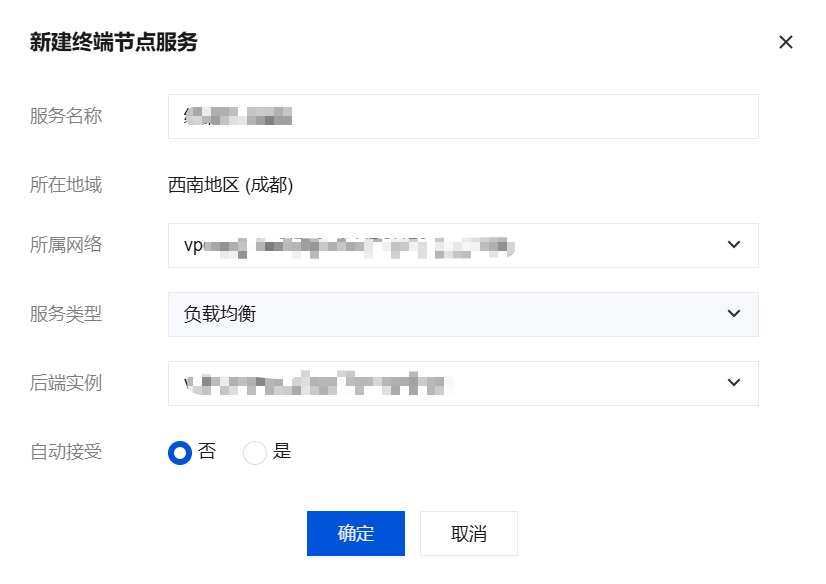
3. Click Create, and in the pop-up window for creating a new Endpoint Service, configure the relevant parameters.
Parameter name
Description
Service name
Customize the Endpoint Service name.
Region
Endpoint service region.
Network
Select the associated VPC; in this example, choose VPC2.
Cloud Load Balancer
Select the Cloud Load Balancer instance that has been created in the VPC. In this example, choose the CLB instance already created in VPC2.
Accept endpoint connection request
Specify whether the Endpoint Service will or will not automatically accept connection requests initiated by the Endpoint. In this example, we choose yes:
When Yes is selected for automatic acceptance, the Endpoint Service will accept all connection requests from Endpoints by default. After the Endpoint is created successfully, its status will be Available.
When selecting No for not accepting automatic connections, the Endpoint connection status will be Pending Acceptance. The Endpoint Service needs to manually perform Accept Connection to change the status from Pending Acceptance to Available.
4. After completing the parameter settings, click OK to finish creating the Endpoint Service.
Step 2: Service consumer creates a VPC endpoint
Note
In this example, the access is between VPCs under the same account, so there is no need to add the service consumer's whitelist account in the Endpoint Service. If it is a cross-account VPC access, the service consumer needs to inform the service provider of their UIN account in advance. The service provider's Endpoint Service should add the whitelist first, and then proceed with this step. For more information, see Service Sharing between Cross-Account VPCs.
1. In the left sidebar, click Endpoint.
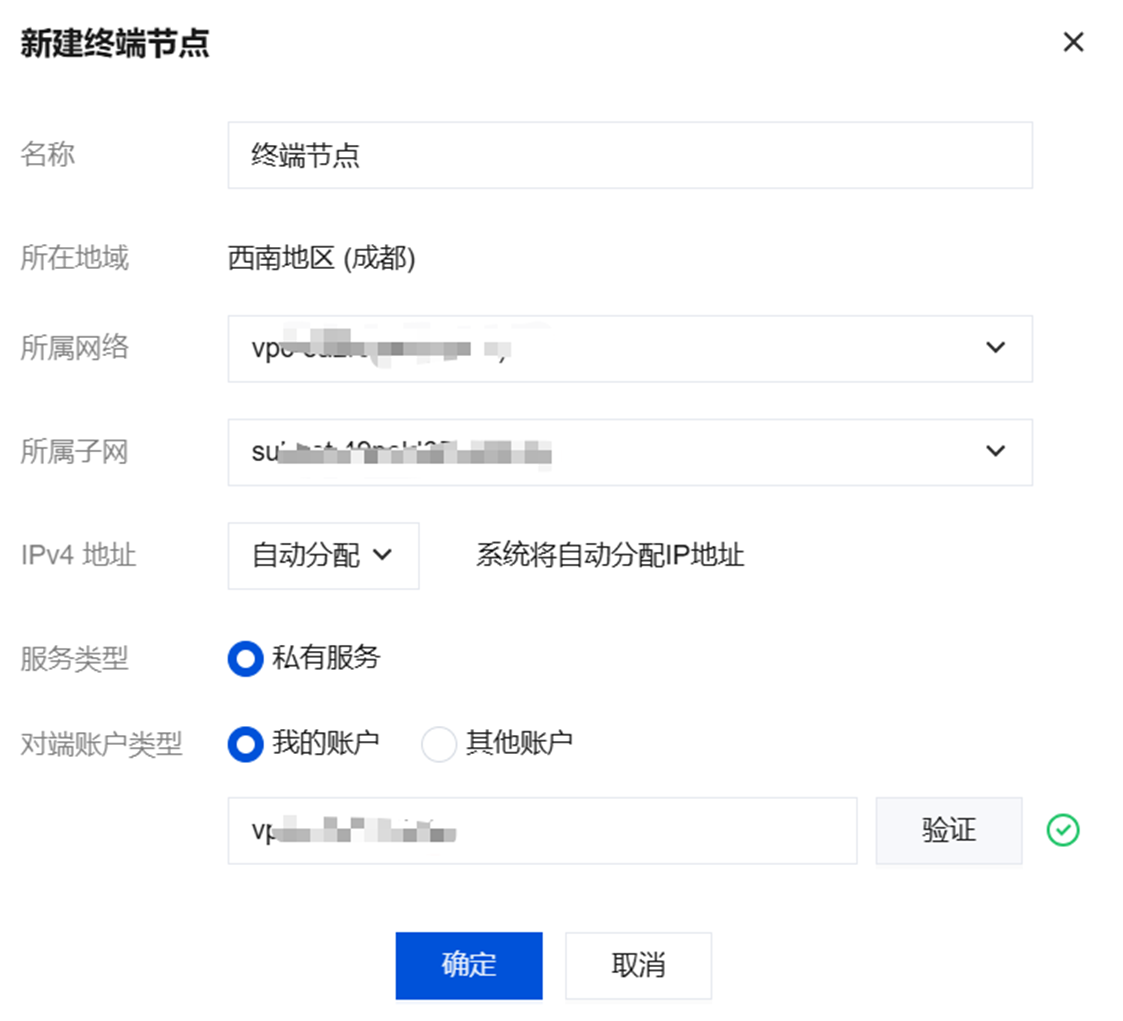
2. Click Create and, in the pop-up window for creating a new Endpoint, configure the relevant parameters.
Parameter name
Description
Name
Specify a custom name for the endpoint.
Region
Endpoint node region.
Network
Select the VPC where the Endpoint is located; in this example, choose VPC1.
Subnet
Select the subnet where the Endpoint is located.
IP Addresses
Endpoint IP address: You can specify an IP address, which should be a private IP within VPC1, or you can choose to have the IP address automatically assigned.
Destination account type
Select the account to which the Endpoint Service to be connected belongs. In this example, choose My Account:
For access between VPCs under the same account, select My Account.
For cross-account VPC access, select Other Account.
Select a service
Enter the endpoint node service ID and click Verify; only verified services can establish a connection.
3. After completing the parameter configuration, click Confirm. In this example, since the Endpoint Service in Step 1 is set to automatically accept connections, it will accept connection requests from all Endpoints by default. Therefore, once the Endpoint is created successfully, its status will be Available.
Step 3: Create a Cloud Connect Network to connect VPC3 and VPC1 networks
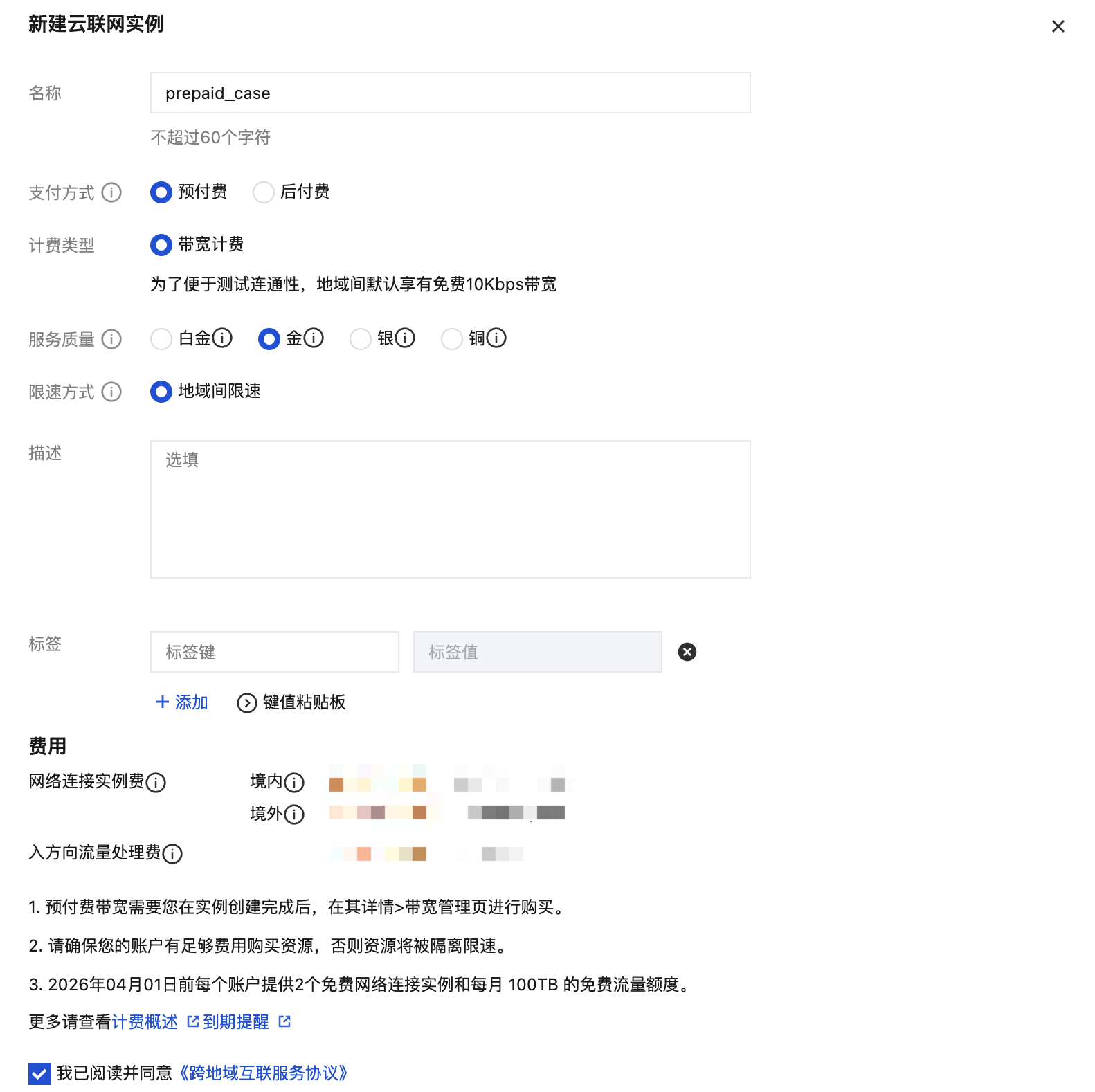
2. Click Create to create a Cloud Connect Network instance, associate cross-regional VPC1 and VPC3, and click Confirm to enable interconnectivity between VPC1 and VPC3.
Step 4: Service consumer initiates access request to verify the connection
Verify that the service consumer VPC1 in Chengdu region can access VPC2:
a. Log in to a CVM in the service consumer's VPC1 and access the service provider's backend services using VIP + VPORT.
b. In this example, use telnet to verify connectivity by running telnet VIP VPORT.
Note
If the server does not have telnet installed, please run yum install telnet to install telnet first.
Obtain the Endpoint VIP:
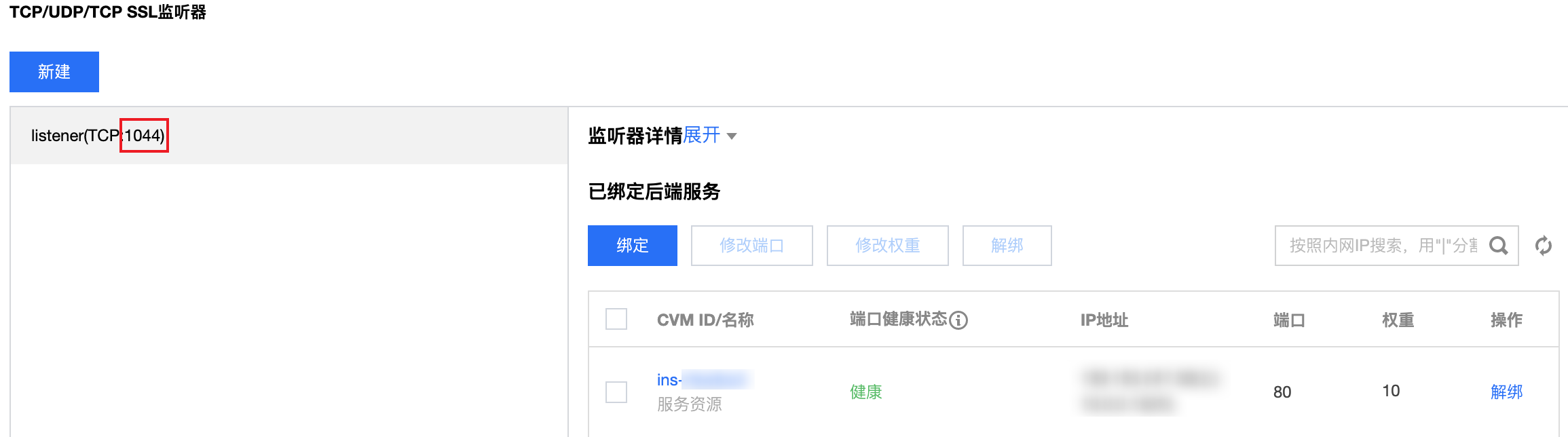
Obtain the CLB VPort:
If the following message is returned, it indicates a successful access:
Verify that VPC3 in Chongqing region accesses the service provider VPC2 through the endpoint in the service consumer VPC1 in Chengdu region:
a. Log in to a CVM under VPC3 and access the service provider's backend service via VIP + VPORT. The VIP is the one obtained from the Endpoint in VPC1, in this case, 172.16.2.16, and the VPORT is the listener port of the CLB in VPC2, which is 1044 in this example.
b. Continue using telnet to verify connectivity by executing telnet VIP VPORT.
Note
If the server does not have telnet installed, please run yum install telnet to install telnet first.
The following message indicates a successful access: