The content of this page has been automatically translated by AI. If you encounter any problems while reading, you can view the corresponding content in Chinese.
When COS resources are accessed, the operation may take a long time, or even time out, resulting in access failure.
Possible Causes
Cross-border network latency can be high, and network quality cannot be guaranteed. For example, this occurs in scenarios where you access a bucket in Beijing from Japan.
The local machine is fully loaded, for example, with CPU, memory, and public network bandwidth.
Other reasons.
Operation Steps
Checking for Cross-Border Access
Recommended Solution:
1. If your business is located within the country, it is recommended to deploy buckets within the country. If your business is located outside the country, it is recommended to deploy buckets outside the country. (Recommended)
2. You can use the COS global acceleration domain name. This feature is primarily designed to optimize cross-border access and incurs additional fees. If cross-border access is not involved, it is not recommended to use this domain name.
For an introduction to the Global Acceleration feature and its billing details, see Global Acceleration Overview. Before you use it, it is recommended that you first submit a ticket to consult Tencent Cloud engineers and then confirm whether to use it.
Checking Local Machine Configuration
The configuration of each machine may vary. It is recommended to check the load on the computer's CPU, memory, and public network bandwidth. The environment troubleshooting documentation for Tencent Cloud CVM Windows is provided below. (Windows systems are generally similar, so you can refer to it.)
Operate according to the following scenarios. If you encounter any issues during the operation, submit a ticket to communicate first.
Scenario 1: Slow Browser Access to COS Resources on Windows, Mac, or Other GUI Systems
1. Access the website https://ping.huatuo.qq.com/, enter the COS domain name for testing (do not include the protocol or specific resource paths; you can directly test the domain name).
Here, you can directly check whether the local IP address and the IP address provided by COS belong to the same carrier (you can directly enter the IP address into the Baidu search bar and press Enter to view it), for example, both are China Telecom or China Unicom.
If there is a cross-network situation (for example, the local network is China Telecom, but the resolved IP address belongs to China Mobile or another carrier), then it is a resolution issue. You need to modify the local DNS to the DNS provided by your own network carrier.
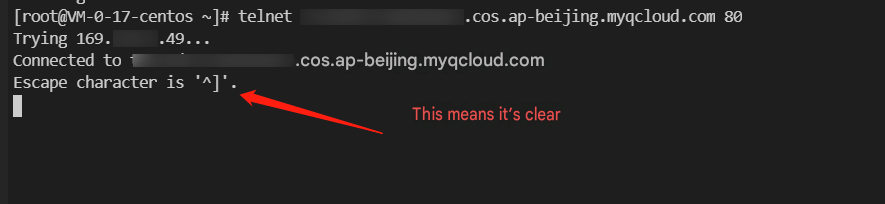
2. Execute the telnet command to test whether port 80 of the domain name is reachable.
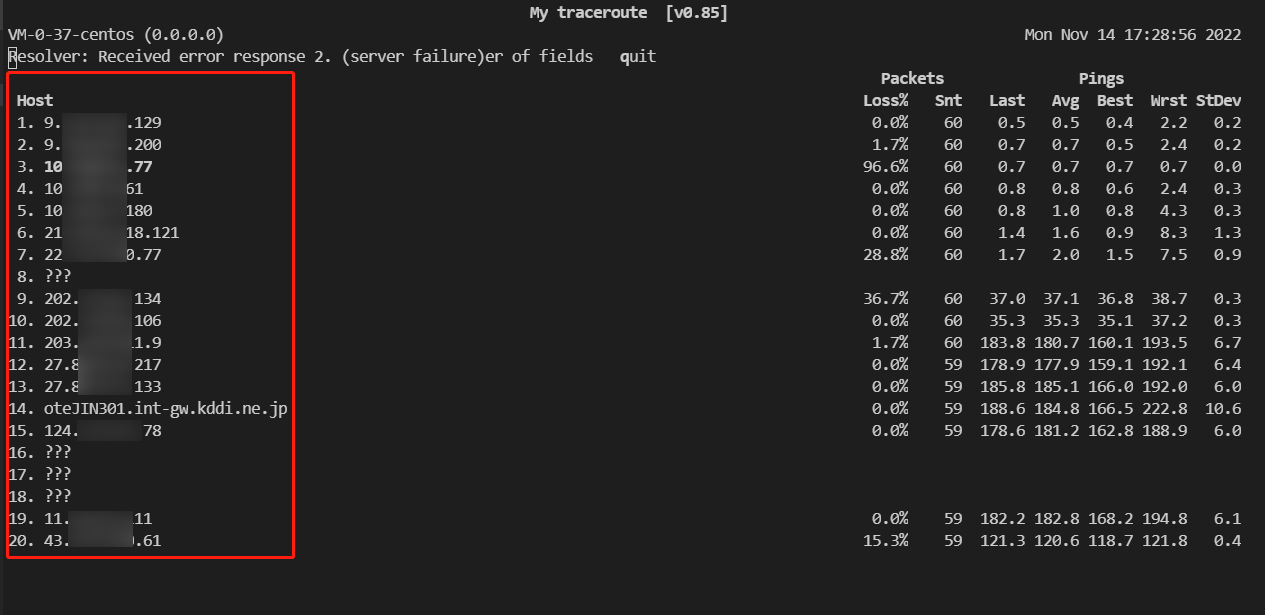
Then, you can view the Host column. These IP addresses represent the request network path. Check the source of these IP addresses.
For example, when accessing a bucket in Chongqing from Beijing, the IP addresses here should not go to other locations. If you find that an intermediate IP address goes to Hong Kong (China), this indicates a problem.
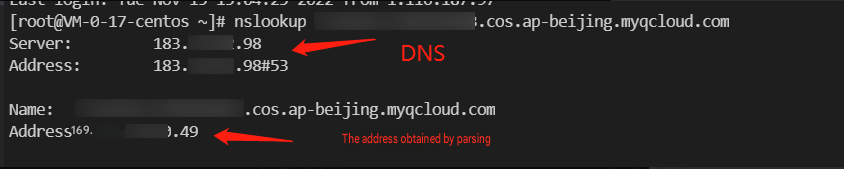
5. Execute the nslookup command to check whether the domain name resolution is normal.
Open another window to request the slow-access resource. After completion, interrupt the packet capture (Ctrl+C). The test.cap file is the captured packet file.
Then, submit a ticket for Tencent Cloud engineers to assist with troubleshooting. When submitting the ticket, please provide the network test information and screenshots you obtained above to facilitate rapid problem identification.
Scenario 2: Slow Browser Access to COS Resources on Mobile Devices
1. First, confirm the URL of the resource with slow access. Then, access this resource individually to check whether the speed is normal.
2. At the same time, also try accessing other websites to check whether they are normal (for example, Baidu).
3. Change to a different network environment, for example, by connecting to another Wi-Fi network.
After completing the above three steps, if you confirm that only COS resource access is slow while other websites are normal, then proceed to connect your computer to the same network environment as your mobile phone (for example, connect to the same Wi-Fi, or connect your computer to your phone's 4G network). Then, test accessing the COS resource again.
(1) If the issue is reproduced on the computer, you can refer to the Scenario 1 above for troubleshooting.
(2) If the computer accesses normally but only the mobile end has issues, you can perform network testing on the mobile end. For the operation method, refer to Step 1 in Scenario 1.
(3) Test the network route. Use your mobile phone to test IP address routing information. You can directly access http://www.webkaka.com/Tracert.aspx and enter the COS domain name for testing.
In the IP address column, these IPs represent the request network path. Check the source of these IP addresses. For example, when a bucket in Chongqing is accessed from Beijing, the IPs here should not include Hong Kong (China) IPs; otherwise, there is a problem.
(4) If no issues are found in the above steps, you can proceed with packet capture for troubleshooting. Refer to the Packet Capture Tutorial.
Then, submit a ticket for Tencent Cloud engineers to assist with troubleshooting. When submitting the ticket, please provide the network test information and screenshots you obtained above to facilitate rapid problem identification.
Scenario 3: Slow Access to COS Resources from a Linux Machine via the Command Line
1. Test whether port 80 of the domain name is reachable. The operation command is as follows:
If it is not reachable, test the Baidu website. Replace the aforementioned COS domain name with www.baidu.com. Check whether Baidu is reachable to confirm your local network environment.
2. Execute the nslookup command to check whether the domain name resolution is normal.
Here, you can directly check whether the local IP and the IP provided by COS belong to the same carrier (you can directly enter the IP into the Baidu search bar and press Enter to view it), for example, both are China Telecom or China Unicom.
In another window, request the resource that responds slowly. After completion, interrupt the packet capture (Ctrl+C). The test.cap file is the captured packet file.
Then, submit a ticket for Tencent Cloud engineers to assist with troubleshooting. When submitting the ticket, please provide the network test information and screenshots you obtained above to facilitate rapid problem identification.