TKE charges cluster management fees based on the specifications of the managed clusters, and charges cloud resources fees based on the actual usage. For billing modes and prices, see TKE Billing Overview. In this document, a managed cluster is created. You still need to pay for services such as cluster worker nodes, persistent storage, and CLB instances bound to the service. Before making a purchase, top up your account as instructed in Payment Methods.
Step 3. Authorizing TKE
Log in to the Tencent Cloud console, select Tencent Cloud services > Tencent Kubernetes Engine to enter the TKE console and authorize TKE according to the prompts. If you have already authorized TKE, skip this step.
On the Cluster Information page, enter a Cluster name, select the Region, choose the Cluster network and Container network, keep the other default options, and click Next. See the figure below:
Cluster name: Enter the cluster name. We use "test" as the cluster name in this document.
Region: select a region closest to you. For example, if you are in “Shenzhen”, please select “Guangzhou”.
Cluster network: Assign IP addresses within the node network address range to the servers in the cluster. Here we select VPC.
Container network: Assign IP addresses within the container network address range to the containers in the cluster. Here, we select an available container network.
Select a model
On the Select Instance Type page, confirm the Billing mode, select the Availability zone and corresponding subnet, confirm the node instance type, and click Next. As shown in the following figure:
Node source: You can select Add node or Existing nodes. Here, we select "Add node".
Cluster type: You can select Self-deployed cluster or Managed cluster. Here we select the latter.
Cluster specification: Various cluster specifications are available. In this case, we will select "L5".
Billing mode: Offers both Pay-as-you-go and Monthly Subscription billing options. In this case, we choose "Pay-as-you-go".
Worker node configurations: You only need to select an availability zone and the corresponding subnet and confirm the node model. Keep other default settings unchanged.
Availability zone: Here we select "Guangzhou Zone 6".
Node network: Here we select the subnet under the current VPC.
Model: Here we select SA2.MEDIUM2 (Standard SA2, 2-core 2 GB).
Configure CVM
On the CVM configuration page, select the login method, keep other default settings unchanged, and click Next.
Login method: You can select SSH key pair, Random password or Custom password. Here we select "Random password".
Add-on configurations
On the Add-on Configurations page, you can choose the add-ons you need, including storage, monitoring, and image. If you don't need them, click Next. Here, we choose not to install add-ons and keep other default settings unchanged.
Information confirmation
On the "Selected configuration" page, review the selected cluster configuration and costs. After reading and agreeing to the TKE Service Level Agreement, click Finish. As shown in the image below:
You can create your first TKE general cluster after making the payment. Then, you can view the created cluster in the TKE console.
Step 5: Viewing the Cluster
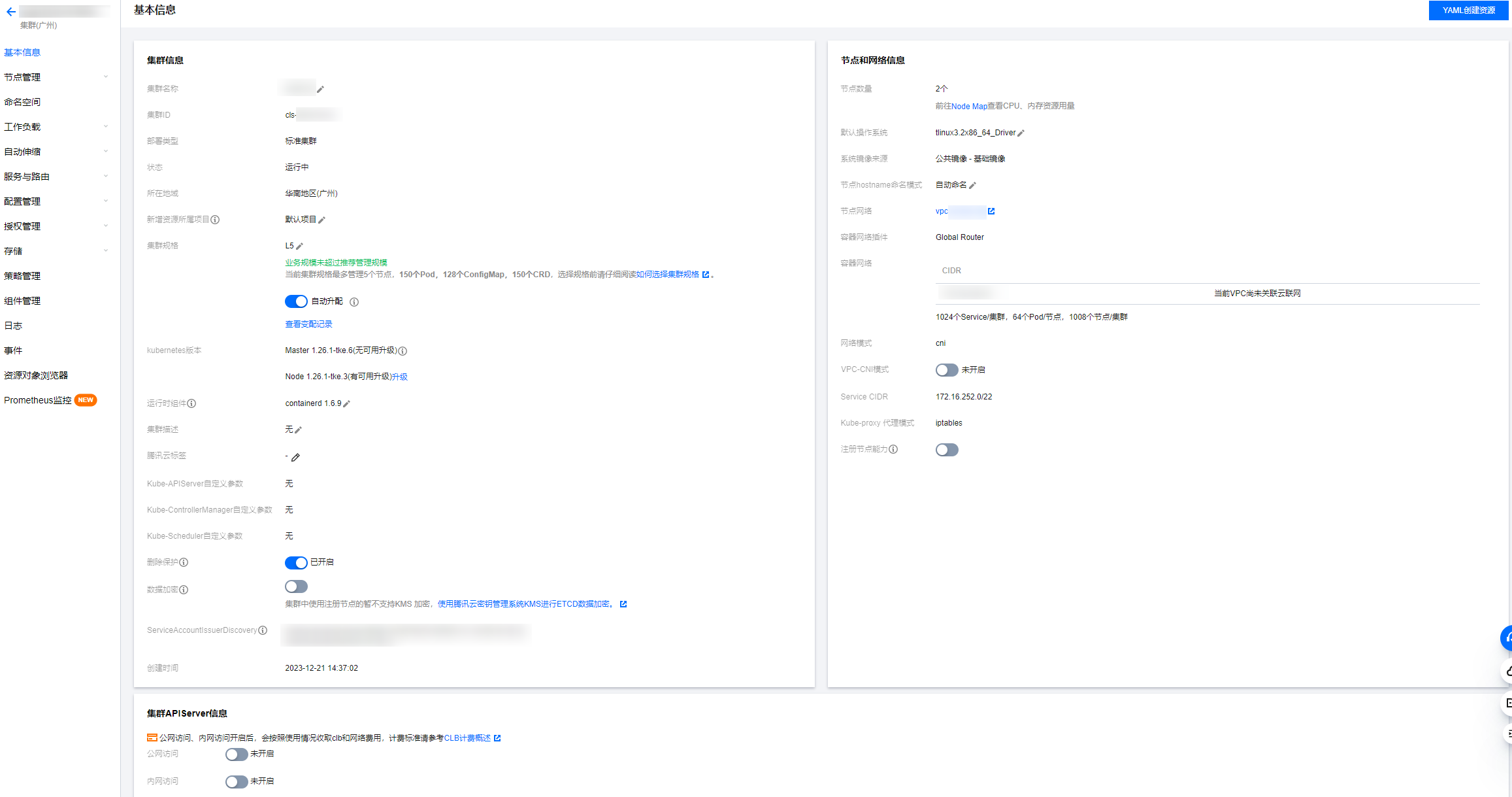
You can view clusters that have been created in the cluster list. You can click the cluster ID to enter the details page, and then view the cluster, node, network, and API Server information on the Basic information page.
Step 6: Deleting Clusters
Once started, clusters will start to consume resources. To avoid unnecessary costs, you can follow the steps below to clear all the resources.
1. Select Clusters in the left navigation pane, and on the "Cluster Management" page, choose More > Disable Deletion Protection in the row where the cluster to be deleted is located, as shown below:
2. Select More > Delete on the right side of the cluster row, as shown below:
3. Confirm related information in the Delete clusters pop-up window and click Confirm to delete clusters.
Subsequent Operation: Using a Cluster
Now you know how to create and delete clusters in TKE. You can set workloads and create services in the clusters. Common tasks include:
For detailed directions on how to create a general cluster in the TKE console, see Creating a Cluster. If you encounter any problems during the use, contact us for assistance.